What are the flower language and symbolic meanings of the ZZ plant?
The ZZ plant (Zamioculcas zamiifolia) is a rather popular large indoor potted plant, especially suited for placement in wider living rooms, studies and sitting rooms, where it lends an elegant, simple tone with a touch of southern charm. It is a world-famous new-generation indoor foliage plant with a graceful, neat plant shape. Let's take a look together below at what the flower language of the ZZ plant is!
The flower language of the ZZ plant
Bringing in wealth and treasure、Prosperity and honor. The ZZ plant suits many occasions and can be placed in spacious offices, new homes, living rooms, studies, balconies and other places. It not only boosts fortune and attracts wealth with an auspicious meaning, but also gives the home environment an elegant, simple tone with a touch of southern charm. Its leaves, like strings of strung-together copper coins, look from a distance like a large bird spreading its wings, very grand and beautiful. Seeing this plant full of vigorous life every day at work or in daily life makes people more motivated and energetic in their striving.
Does the ZZ plant bloom?
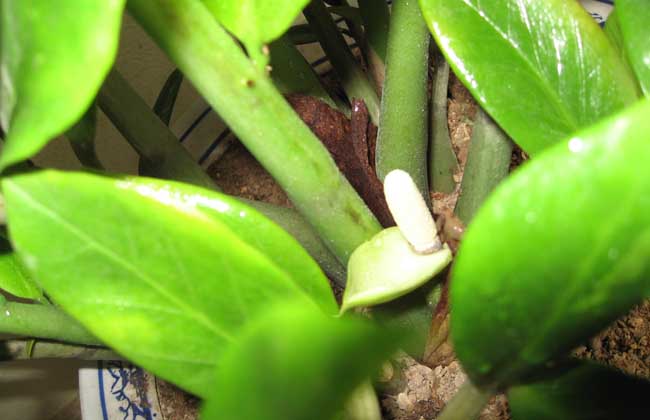
The ZZ plant does bloom. The flowers of the ZZ plant are spadix inflorescences, appearing as small flowers in pale yellow, brown or bronze, partly hidden among the leaf bases. The blooming time is from mid-summer to early autumn, and flowering usually occurs 3-4 years after planting a ZZ plant.
How to grow the ZZ plant
1. Temperature: The suitable growth temperature for the ZZ plant is 20-32°C. Whether potted or grown in the ground, it requires small annual temperature fluctuations; for commercial cultivation it is best carried out in a temperature-controlled greenhouse. Every summer, when the temperature reaches above 35°C, the plant grows poorly, so measures such as adding black shade netting and spraying water around the surrounding environment should be used to cool it down, creating a suitable environment with an appropriate ambient temperature that is also relatively dry. In winter it is best to maintain a greenhouse temperature above 10°C; if the room temperature falls below 5°C, the plant is prone to cold damage and its survival is seriously endangered. In late autumn and early winter, when the temperature drops below 8°C, it should be promptly moved to a well-lit indoor spot, and throughout the overwintering period the temperature should be kept between 8°C-10°C, which is relatively safe and reliable.
2. Light: The ZZ plant likes light and also has fairly strong shade tolerance. It should be given an environment with good sunlight but a certain degree of shade. Direct strong light is taboo, and in particular one should avoid the scorching sun after long rain and sudden clearing in late spring and early summer, as well as the 5-6 hours of unshielded strong light baking around midday in summer, otherwise the newly sprouted tender leaves are very easily sunburned. In commercial cultivation, from late spring to mid-autumn it should be placed under a shade shed with 50-70% shading, but it must not be too dark, otherwise the newly sprouted tender leaves will become slender, the leaf color will turn yellow and listless, and the leaflets will be sparsely spaced, thus affecting the plant's compactness and beauty. For potted plants moved into a greenhouse in winter, supplemental lighting should be given. Keeping the potting soil on the dry side allows the plant to remain disease-free year after year. In addition, the newly sprouted pinnate compound leaves do not show obvious phototropism, and the plant shape remains good.
3. Humidity: To care well for a potted ZZ plant, one should strive to create an environment that is both moist and on the dry side. In commercial cultivation, for plants placed in a greenhouse, when the room temperature reaches above 33°C, the plant should be sprayed with water once a day. Because this plant has strong drought tolerance, it is best to keep the potting soil slightly moist and on the dry side, though occasionally applying excessive water and fertilizer will not cause root rot. In winter, pay attention to spraying water on the leaf surfaces and the surrounding environment so that the relative air humidity reaches above 50%. After mid-autumn, reduce watering, or replace watering with misting, to help the newly sprouted tender leaves pass the winter safely. In addition, in winter special attention should be paid to keeping the potting soil from being too wet; drier is better, otherwise under low-temperature conditions, overly wet potting soil more easily leads to root rot and even the death of the whole plant.
4. Soil: The special climatic conditions of the ZZ plant's place of origin gave it strong drought resistance, so the basic requirement for the growing medium is good permeability. The basic requirement for the growing medium is good permeability. The growing medium is mostly a mix of peat, coarse sand or rinsed coal cinder with a small amount of garden soil, with its pH adjusted to between 6-6.5, in a slightly acidic state. Because of its large tubers, well-developed root system and relatively long pinnate compound leaves, during the growing season one should promptly observe its growth to decide whether to repot and change the soil. Always keep the growing medium well aerated, so as to create a root environment with good air and water drainage. During the plum rain season, check frequently, and when water accumulation in the pot is found, promptly repot and change the soil.
5. Fertilizer: The ZZ plant relatively likes fertilizer. In addition to adding an appropriate amount of decomposed cake fertilizer or multi-element slow-release compound fertilizer to the growing medium, during the growing season one may apply 2-3 times a month a mixed solution of 0.2% urea plus 0.1% potassium dihydrogen phosphate, or apply a balanced fertilizer 20-10-20 (20-20-20) at a concentration of 200-250 ppm in combination with calcium nitrate. After mid-autumn, to help it pass the winter safely, nitrogen fertilizer should be stopped, and 0.3% potassium dihydrogen phosphate solution should be applied 2-3 times in succession to promote the hardening and filling out of the young leaf rachises and newly sprouted leaves. After the temperature drops below 15°C, all forms of topdressing should be stopped to avoid fertilizer damage to the roots under low-temperature conditions.