What are the propagation methods for lotus? A full analysis of practical techniques
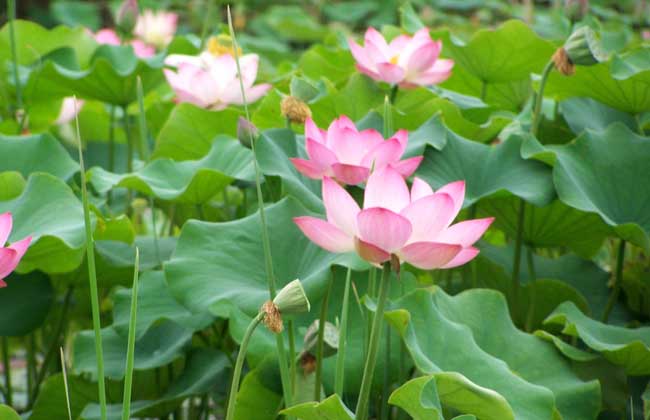
Lotus is a perennial aquatic herbaceous plant. Relatively stable, calm shallow water, lakes and marshes, swampy land, and ponds are its suitable habitats. It is divided into two major categories, ornamental and edible, and has a cultivation history of more than 3,000 years in China. Its propagation methods mainly include lotus rhizome division propagation, lotus shoot propagation, lotus whip propagation, and seed propagation. Let us take a look at these propagation methods for lotus!
Lotus rhizome division propagation
Lotus rhizome division propagation is usually carried out from mid-March to mid-April. Planting too early will be affected by cold waves, and the seed rhizomes are prone to frost damage. In northern regions, transparent agricultural film can be used for covering when cold waves occur. Before planting, the pot soil should be mixed into a paste. When planting, insert the top end of the seed rhizome obliquely into the mud along the edge of the pot at 20 degrees, at a depth of about 5 cm for bowl lotus. For large lotus, the depth is about 10 cm, with the head low and the tail high, and half of the tail end tilted up so that water does not enter the tail of the rhizome. After planting, place the pot in sunlight so that slight cracks appear on the surface of the soil, which helps the seed rhizome bond completely with the soil. Then add a small amount of water, and after the buds emerge, gradually deepen the water level, finally maintaining a water layer of 3-5 cm. For pond planting, the early water layer is the same as for pot lotus, and later it should be kept at a level that does not submerge the lotus leaves.
Lotus shoot propagation
Lotus shoots are the terminal buds at the front ends of the main rhizome, secondary rhizomes, and tertiary rhizomes. They are all vigorous meristematic tissues, wrapped externally by thick scales, with internal tissues nested layer upon layer, containing young leaves, terminal buds, axillary buds, and flower bud organs at successive levels. Cutting the terminal buds for cuttings and seedling cultivation is a technique that uses the continuous growth of terminal buds to reproduce a new generation. It is usually carried out only when the spring temperature rises to 15°C and the buds begin to sprout. Propagating lotus with terminal buds is most suitable for vegetable lotus production. It can not only save a large number of seed rhizomes and facilitate transportation, but also reduce diseases, making it a propagation technique worth promoting.
Lotus whip propagation
Lotus whip propagation is usually carried out during the growing season when the lotus whip elongates and many standing leaves grow from the whip nodes. For pond planting, one can enter the pond following the direction of the lotus rhizome, feel for the shoot bud, leave 2 leaves, break the lotus whip, take it out, and transport it to the pond to be planted or plant it immediately in the same pond. For lotus grown in vats and pots, from June to August, when flowers are abundant, leaves are lush, and new rhizomes have initially formed, one can turn over the pot to take lotus whips and new rhizomes, retain several lotus leaves, and transplant them into another pot to encourage reflowering. When using lotus whip propagation, materials must be obtained locally and planted on the spot, and the terminal buds and standing leaves must be protected from damage for success.
Seed propagation
1. Seed selection: Lotus seeds have a very long lifespan, and seeds several hundred or even a thousand years old can still germinate, with very strong sprouting ability. Sometimes, in order to speed up propagation, in mid-July, when the seed coat changes from green to yellow-brown, sowing immediately can also result in germination. However, if sowing is to be done after the following year, harvesting should wait until the lotus seeds are fully mature and the seed coat is black and hardened. The harvested seeds should be dried and stored indoors in a dry, ventilated place. Therefore, when selecting seeds, mature and plump seeds should be chosen for propagation.
2. Sowing: Sowing lotus seeds is more suitable when the daily temperature is around 20°C. For seed lotus, in order to reach the number needed for harvesting lotus seeds in the same year, the sowing period is generally early to mid-April. For flower lotus, sowing from early April to mid-July generally allows flowering in the same year. Sowing can also be done from late July to early September, but because the later temperature is lower, only plants can form and the goal of flowering cannot be achieved.
3. Germination promotion: The method for promoting germination is to use scissors to cut open the hard shell at the concave, flat end of the lotus seed tail so that the seed coat is exposed, while taking care not to injure the embryo bud. Place the cracked lotus seeds in a germination promotion basin and soak the seeds in clean water, generally keeping the water depth at about 10 cm, changing the water once a day. After 4-6 days, the embryo bud can appear. During high summer temperatures, sowing should be properly shaded, and water should be changed twice a day, in the morning and evening. At this time, because the temperature is high, lotus seeds need only 2 days for the embryo bud to appear.
4. Seedling cultivation: The main seedling cultivation methods for lotus are pot cultivation and seedbed cultivation. Pot cultivation means placing thin pond mud in a pot, with the pot soil accounting for 2/3 of the pot. For seedbed seedling cultivation, generally use a seedbed 100 cm long and wide and 25 cm high, then add 15-20 cm of thin pond mud and level it. Finally, arrange the germinated seeds at a spacing of 15 cm, sow them into the mud one by one, and maintain 3-5 cm of water.
5. Transplanting: When the seedlings grow to 3-4 floating leaves, they can be transplanted. Plant one seedling per pot, and transplant immediately after taking them out, carrying soil during transplanting to increase the survival rate. For field planting of seed lotus, generally 700 seedlings are planted per mu. After transplanting, in order to promote the normal growth of the seedlings, shallow water should be maintained in the early stage, and the water level should be gradually raised according to the growth of the seedlings.