What are the uses and benefits of Monstera deliciosa?
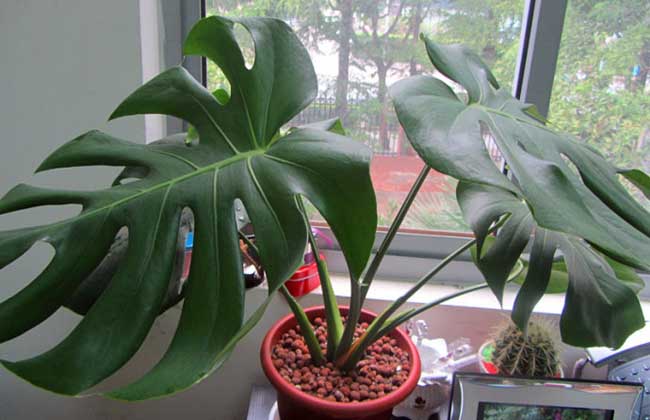
Monstera deliciosa (Swiss cheese plant) is a common indoor potted plant in our homes. Placed indoors, it offers ornamental value, air purification, and Feng Shui improvement, and if it flowers and fruits, the fruit is even edible. If you like this unusual plant, you can grow a few pots at home. Let's take a look below at what Monstera deliciosa can do!
The uses of Monstera deliciosa
1. Ornamental value: Monstera deliciosa has a very graceful plant shape, unusual leaves that stay emerald green all year round and look ready to drip with freshness, and long extending aerial roots that can coil around, giving it plenty of charm and a distinctive beauty. It stands out among foliage plants. Large specimens are suitable for display in entrance halls, living rooms, and conference rooms, while small and medium-sized plants are suitable for the home, giving the environment an elegant atmosphere. In some places it is planted beside trees or in slightly shaded spots such as house corners, left to grow and climb freely, where it grows extremely lushly.
2. Air purification: Monstera deliciosa has the ability to absorb carbon dioxide at night, which greatly helps improve indoor air quality and raise oxygen levels. It has the characteristic of preferentially absorbing harmful gases such as formaldehyde, benzene, and TVOC, achieving an indoor air purification effect, making it an ideal indoor plant.
3. Edible value: Besides its ornamental beauty, the flowers and fruit of Monstera deliciosa also have certain edible value. The spadix is tender and juicy, and in its native regions it is often eaten as a superior vegetable, cool and refreshing. The yellow spathe outside the inflorescence is quite thick and fleshy and can be eaten raw or battered and fried in oil. The berries of Monstera deliciosa have an even better flavor and can be eaten as a fruit, tasting similar to pineapple, and can also be made into a beverage with an excellent taste.
4. Feng Shui effect: Placing Monstera deliciosa in the home has a certain Feng Shui effect, but attention must be paid to where it is placed. In the north, the water position of Ren and Gui, Monstera deliciosa is used as the Black Tortoise; specifically, placing it at the study door can increase official luck and add fortune and prosperity. Placing Monstera deliciosa in an elderly person's bedroom can add fortune and longevity and benefit the elderly.
How to propagate Monstera deliciosa
1. Division propagation: Carried out in summer and autumn, cut off an entire side branch of a large Monstera deliciosa with some aerial roots attached and plant it directly in a wooden tub or pot. Not only is the survival rate high, but the plant takes shape quickly, making it one of the most widely used and simplest methods of propagating Monstera deliciosa today.
2. Stem cutting propagation: Monstera deliciosa can be propagated by stem node cuttings in both spring and autumn, with cuttings taken in April-May of spring and September-October of autumn giving the best results. This is because the temperature during these periods is suitable for the cut stem nodes to heal and root, and they root quickly. Select current-year side shoots with plump stem tissue and robust growth as cuttings; the cuttings should be 20-25 cm long, and the leaves at the base should be cut off. Keep the small leaves at the upper end, cut off the long aerial roots, and keep the short aerial roots to absorb water and aid rooting. Use a mixed substrate of coarse sand and peat or leaf mold for the cutting bed. After insertion, maintain 25-27°C and relatively high air humidity; rooting only begins about 1 month after insertion. After the cuttings root, the axillary buds on the stem nodes also begin to sprout and unfold leaves. To speed up seedling growth, keep the room temperature above 10°C and strengthen fertilizer and water management. In the second year after insertion, the seedlings take shape and can be sold as commercial products.
3. Seed propagation: Sowing seeds is also a fairly commonly used propagation method for Monstera deliciosa, though relatively less used than the previous two. Monstera deliciosa blooms in summer. To increase the seed setting rate, artificial pollination is needed, with pollination at 9-10 a.m. and 3-4 p.m. being best, giving a high success rate. From pollination to seed maturity takes 15 months. During the seed development stage, pay attention to ventilation and fertilizer and water management to encourage plump seeds. Before sowing, soak the seeds in 40°C warm water for 10 hours, and the sowing soil should be sterilized at high temperature. Monstera deliciosa seeds are relatively large, so spot sowing can be used. After sowing, keep the room temperature at 20-25°C, cover the box opening with plastic film, and maintain humidity above 80%. Generally, germination occurs 20-25 days after sowing. If the room temperature is too low during the sowing process, it will not only affect emergence but may even cause the seeds to become water-soaked and rot.
How to grow Monstera deliciosa
1. Light: Monstera deliciosa likes a warm and humid environment, dislikes drought, and fears direct sunlight, otherwise it easily develops withered leaves. In summer, place Monstera deliciosa indoors or under a shade shed; do not put it on a balcony with overly strong sunlight to bake, as this can very easily kill it. When the winter temperature drops to 6°C, move Monstera deliciosa indoors to keep it warm.
2. Watering: Monstera deliciosa needs sufficient moisture, and the potting soil must be kept moist at all times. During the summer growing period, water once in the morning and once in the evening, and also sprinkle the leaf surface frequently to keep the leaves bright and the air humid. In winter, water evaporates slowly, so water once every 3-4 days; for routine watering, once a day is sufficient.
3. Fertilizing: Monstera deliciosa is a plant that quite likes fertilizer, so be careful to fertilize it appropriately. During the growing period of Monstera deliciosa, apply diluted cake fertilizer water once every half month. With sufficient and appropriate fertilization, Monstera deliciosa will grow with pleasing leaf color.
4. Pests and diseases: Monstera deliciosa is highly susceptible to scale insect damage, and the stems and leaves are most easily attacked by scale insects. They can be cleaned with an old toothbrush and then sprayed with a 1000-fold dilution of 40% omethoate. Common diseases of Monstera deliciosa include leaf spot, gray spot, and stem blight, and timely prevention and control are needed.
5. Repotting: Potted Monstera deliciosa needs to be repotted once a year, and the best time for repotting is between March and April. When repotting, remove the old soil, cut off the dead roots of Monstera deliciosa, and then add decomposed organic fertilizer or phosphorus and potassium fertilizer to the pot as a base fertilizer.