Does the Monstera deliciosa bloom? Detailed explanation of flowering conditions and care methods
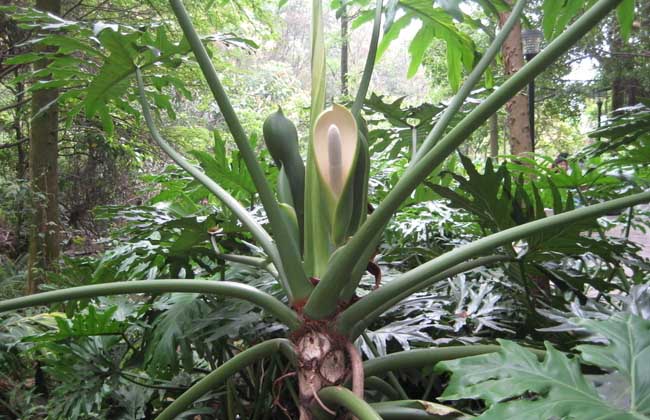
The Monstera deliciosa is a sun-loving plant native to Mexico, originally growing in the tropical rainforests of Mexico. It is evergreen year-round and is often kept as a large potted foliage plant. There is even a folk saying that "when the Monstera deliciosa blooms, it is harder to see than the cycad flowering," but is that really true? Let's take a look together below!
Will the Monstera deliciosa bloom?
The Monstera deliciosa does bloom. Its flowering period is from August to September. The flower stalk is 15-30 cm long, the spathe is thick and leathery, and the spadix is nearly cylindrical. The staminal filaments are linear, the pollen is yellowish-white, and the pistil is yellow and top-shaped. The fruit ripens after the flowering period in a different year, is pale yellow, has blue-purple spots around the stigma, and is 1 cm long and 7.5 mm thick.
Reasons the Monstera deliciosa does not bloom
1. Environment: The Monstera deliciosa generally finds it difficult to reach the basic conditions for flowering because of indoor environmental factors such as temperature and humidity at home, so it rarely blooms in northern regions. There is even a folk saying that "when the Monstera deliciosa blooms, it is harder to see than the cycad flowering."
2. Flower buds: In home cultivation, the Monstera deliciosa is mostly propagated by asexual methods, divided from the mother plant. Dividing can affect or damage the flower buds of the Monstera deliciosa, which is also one of the reasons it is difficult to see it bloom at home.
3. Flowering period: The Monstera deliciosa has a long flowering period, and blooming even once is not easy. Some take several years, or even more than ten years, to bloom. However, if you want it to bloom, try to maintain temperature and humidity conditions as suitable as those of its place of origin.
How to grow the Monstera deliciosa
1. Light: The Monstera deliciosa likes a warm and humid environment, is averse to drought, and fears direct sunlight, otherwise it very easily develops withered leaves. In summer, the Monstera deliciosa should be placed indoors or under a shade shed; it must not be placed on a balcony with overly strong sunlight for exposure, as this can very easily cause it to die. When the winter temperature drops to 6°C, the Monstera deliciosa should be moved indoors to keep warm.
2. Watering: The Monstera deliciosa needs sufficient moisture, and the potting soil must be kept moist frequently. During the summer growing period, water once in the morning and once in the evening, and also sprinkle water on the leaves from time to time to keep the leaves bright and the air humid. In winter, water evaporates slowly, so water once every 3-4 days; for routine watering, once a day is enough.
3. Fertilizing: The Monstera deliciosa is a plant that relatively likes fertilizer, so attention should be paid to fertilizing it appropriately. During the growth period of the Monstera deliciosa, apply a dilute cake fertilizer solution once every half month. With sufficient and appropriate fertilizing, the Monstera deliciosa will grow with pleasing leaf color.
4. Pests and diseases: The Monstera deliciosa is very susceptible to damage by scale insects, and the stems and leaves are most easily attacked by scale insects. They can be cleaned with an old toothbrush and then sprayed with a 1000-fold dilution of 40% omethoate. Common diseases of the Monstera deliciosa include leaf spot, gray leaf spot, and stem blight, and timely prevention and control should be carried out.
5. Repotting: Potted Monstera deliciosa needs to be repotted once a year, and the best time for repotting is between March and April. When repotting, remove the old soil, cut off the dead roots of the Monstera deliciosa, and then add decomposed organic fertilizer or phosphorus and potassium fertilizer to the pot as a base fertilizer.