How to grow English ivy? Master these few points for lush foliage and good growth
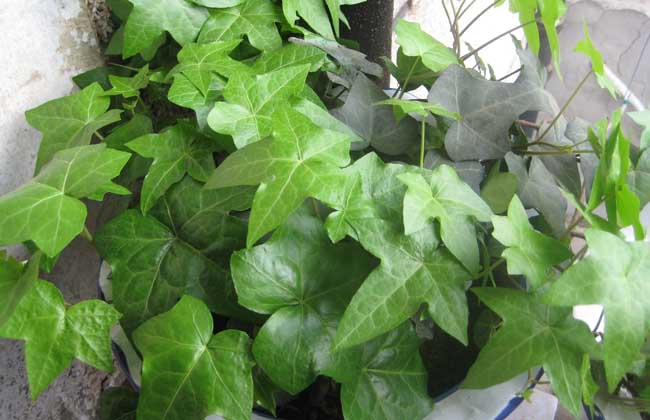
English ivy (Hedera helix) has beautiful leaf shapes and stays evergreen all year round. In various parts of southern China it is often used for vertical greening, mostly planted beside rockeries and at the foot of walls, letting it naturally attach and grow vertically or as ground cover, achieving an effect of decorating and beautifying the environment. For pot cultivation, small and medium pots are mainly used, and it can be trained into many shapes for indoor display. Let's take a look below at how to grow English ivy!
The uses of English ivy
1. Greening use: English ivy is an important material for indoor hanging cultivation, combination planting, green sculpture cultivation and outdoor greening applications. It is a woody evergreen vine that climbs by means of well-developed adhesive aerial roots. Its stems can reach 30 m in length, with dense foliage, evergreen in all seasons, tolerant of pruning, and suitable for shaping.
2. Medicinal use: English ivy has the effects of dispelling wind and promoting diuresis, activating blood and reducing swelling, calming the liver and removing toxins. It is mainly used for rheumatic joint pain, lumbago, traumatic injuries, hepatitis, dizziness, facial paralysis, epistaxis, eye opacity, acute conjunctivitis, nephritic edema, amenorrhea, carbuncles and swellings, urticaria, eczema and other conditions.
3. Ecological use: In a room of about 10 sq m, it can eliminate 70% of benzene, 50% of formaldehyde and 24% of trichloroethylene. Since harmful gases such as formaldehyde in newly renovated houses are continuously released, after renovation keep ventilation going and grow a few pots of green plants such as English ivy; generally, after a new house has been left empty for three to six months, it can basically meet the standard for moving in.
How to propagate English ivy
1. Seed propagation: Harvest when the fruit is ripe, pile it up for after-ripening, soak in water and rub, wash clean and dry in the shade, then sow. It can also be stored in damp sand and sown in spring the following year. After sowing, cover with 1 cm of soil and cover with grass to retain moisture. When the seedlings emerge, set up a shade frame. In the second spring, transplant or thin the seedlings and then grow them into larger plants.
2. Layering propagation: Carry out in spring and autumn, using the wavy layering method. After ring-barking the part to be buried in soil, it roots very easily. This is a relatively simple propagation method.
3. Cutting propagation: For English ivy, cutting propagation is generally best done in spring from April to May and in autumn from August to September. When taking cuttings, use loose, well-aerated, well-drained sandy soil as the medium. For hardwood cuttings in spring, cut vigorous woody branches from the English ivy into strong cuttings 15-20 cm long, keeping 2-3 leaves at the upper end. After cutting, keep the soil moist and place under side-shade conditions; roots will form quickly. For softwood cuttings in autumn, use semi-woody young shoots cut into 15-20 cm long cuttings with 3-4 nodes and aerial roots. After cutting, provide shade and keep the soil constantly moist; generally, roots and survival are achieved 20-30 days after cutting.
How to grow English ivy
1. Suitable temperature: English ivy likes warmth, with an optimum growing temperature of 20°C-25°C. It fears heat and is not cold-tolerant. Therefore, when keeping it indoors, pay attention to ventilation and cooling in summer. In winter, the room temperature is best kept above 10°C, and must not fall below 5°C.
2. Moderate light: English ivy likes light and is also fairly shade-tolerant. Grown under semi-light conditions, its internodes are shorter, the leaf shape is more uniform and the leaf color is brighter, so it is best placed in a bright spot indoors. If in spring and autumn you can each time place it for a period in a shaded spot outdoors so that it receives more morning and evening sunlight, it will grow vigorously with bright green leaves. However, be careful to prevent direct strong light, otherwise it is prone to sunscald.
3. Appropriate watering: During the growing season, water according to the principle of watering when dry and keeping it moist, and do not let the potting soil become excessively wet, otherwise it easily causes root rot and leaf drop. In winter, when room temperature is low, watering must especially be controlled, keeping the potting soil only slightly moist. In northern winters the climate is dry, so it is best to spray and wash the plant once a week with clean water close to room temperature to maintain air humidity; the plant will then look lively, with tender green and glossy leaves.
4. Reasonable fertilizing: For home cultivation of English ivy, the potting soil should preferably be a culture soil mixed from leaf mold or peat soil plus 1/4 river sand and a small amount of bone meal. During the growing season, apply a dilute cake fertilizer solution once every 2-3 weeks. Generally, do not fertilize in summer and winter. When fertilizing, never apply too much nitrogen fertilizer alone, otherwise the patterns and blotches on the leaves of variegated varieties will fade to green. The ratio of nitrogen, phosphorus and potassium is best 1:1:1. In the peak growing season, you can also spray the leaves 1-2 times with a 0.2% potassium dihydrogen phosphate solution, which will make the leaf color look even more beautiful. But note that when applying liquid fertilizer, avoid staining the leaves, so as not to cause leaf scorch.