Detailed Explanation of Lavender Planting Techniques and Management Methods
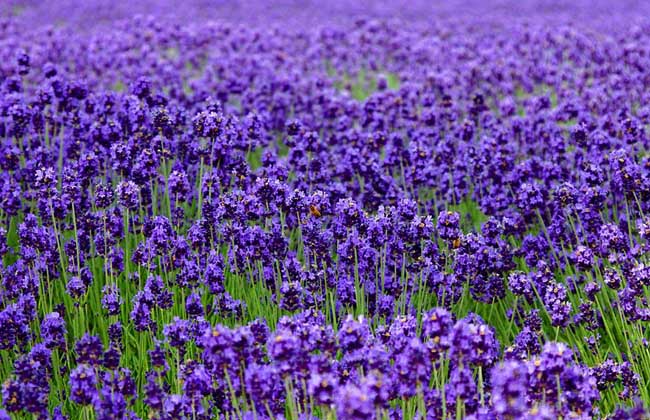
Lavender, also known as perfume plant, spirit vanilla, vanilla, yellow vanilla, etc., is a small shrub of the genus Lavandula in the Lamiaceae family. Its leaf shapes and flower colors are elegant and graceful, and its blue-purple inflorescences are long and beautiful. It is a new perennial cold-resistant flower in courtyards, suitable for clump planting or row planting along flower borders, and can also be grown in pots for ornamental purposes. It has high planting value. Let's take a look at lavender planting techniques together below!
Lavender's Growth Habits
1. Temperature: Lavender has strong adaptability. Mature plants tolerate both low and high temperatures, and during the harvest season can withstand high temperatures of around 40°C. In the Huanglong area of Shaanxi, lavender plants overwinter safely in the open field at -21°C. In the ** region, with soil mounding treatment and snow cover, they can withstand low temperatures of -37°C. Seedlings can tolerate low temperatures of -10°C. During the growth and development process of lavender in the following year, when the average temperature is around 8°C, it begins to sprout and requires 10-15 days; when the average temperature is 12-15°C, the plant branches begin to turn green and elongate, requiring 20 days; when the average temperature is 16-18°C, it begins to form buds, requiring 25-30 days; when the average temperature is 20-22°C, it begins to bloom; and when the average temperature is 26-32°C, it is the seed-setting period.
2. Water: Lavender is a plant that prefers dry conditions and does not require much water. An annual rainfall of 600-800 mm is relatively suitable. During the greening period and bud formation period, the plants grow faster and require more water; during the flowering period, water demand is low; during the seed-setting period, water amount should be moderate; and during the winter dormant period, winter irrigation or snow cover is needed. Therefore, the ideal rainfall distribution throughout the year is abundant in spring, moderate in summer, and sufficient snow in winter.
3. Sunlight: Lavender is a long-day plant and requires sufficient sunlight during its growth and development period. The annual sunshine hours required are more than 2000 hours. If the plant is in a shady and humid environment, it will develop poorly and age quickly.
4. Soil: Lavender has a well-developed root system and prefers deep, loose, well-aerated, fertile soil rich in silicon and calcium. Soil that is strongly acidic or alkaline, heavily clayey, poorly drained, or has a high groundwater level is not suitable for planting.
Lavender's Propagation Methods
1. Seed sowing and seedling raising: Seed sowing and seedling raising has the characteristics of fast propagation, well-developed root systems, and robust seedlings, but it has high variability and is a good material for seed selection. Seeds should be selected for uniform size, plump grains, and brown glossy appearance. Before sowing, the seeds should be sun-dried, soaked in 30°C warm water for 12-24 hours, soaked in concentrated sulfuric acid for 5 minutes, rinsed with water, air-dried, and then sown. In April, seeds can be used for sowing and propagation. The minimum temperature for seed germination is 8-12°C, and the optimum temperature is 20-25°C. Transplanting is done in May, but lavender seed propagation has relatively high variability and seeds are relatively expensive.
2. Cutting propagation: In production, lavender is mainly propagated by cuttings, which can maintain the excellent qualities of the mother plant and has strong adaptability. It can be done in both spring and autumn. Generally, healthy pest-free plants' terminal buds or relatively tender, non-lignified branches are selected for cuttings. When taking cuttings, remove the leaves from the bottom 2 nodes, then soak in a 100-fold dilution of "Root Sun" rooting agent, and after treatment, insert into soil for about 2-3 weeks to root. The cutting medium can be river sand and rice husk mixed evenly at a ratio of 2:1, placed into 5×10 plug trays for cutting. After cutting, place the seedlings in a ventilated and cool environment. Keep the soil moist for the first 3 days, then depending on the weather, ensure the branches do not wrinkle or dry out, to improve the survival rate. Cutting seedling management is relatively convenient, and no fertilization is needed throughout the entire seedling period, so it is widely used in production.
Lavender Planting Techniques
1. Pruning and training: Newly planted lavender grows relatively slowly in the early stage. As spring temperatures rise, lavender enters the greening period in mid-April. To promote increased branching and root development of lavender, manual pruning should be carried out from late April to early May, that is, pruning the top branches more than 15 cm above the ground level, heavily pruning the middle of the plant, and lightly pruning the surrounding areas.
2. Flowering period management: Lavender usually enters the bud formation period for the first flush of flowers in late May, and enters the full bloom period in late June. In the first year of planting, to promote branch growth of lavender seedlings and reduce nutrient consumption, the first flush of flower buds can be removed in early June. The second flush of flowers enters the bud formation period in mid-August, and the full bloom period is in mid-September. Under good climatic conditions in autumn, the third flush of flowers has its full bloom period in mid-October.
3. Irrigation and intertillage: For newly planted lavender, sufficient irrigation must be ensured in the first 3 years to promote plant growth. Every year in mid-to-late April during the greening period of lavender, timely irrigate the greening water. According to weather conditions and soil moisture, water 6-8 times throughout the year. Pay attention to watering the bud formation water and flowering water as key points, and water evenly and thoroughly to ensure watering quality. Combine each irrigation with timely intertillage to achieve the purposes of preserving soil moisture, increasing temperature, and weed control. Generally, intertillage and weeding are done 5-7 times throughout the year, and winter irrigation water is applied in early-to-mid November.
4. Timely topdressing: Although lavender has strong tolerance to poor soil and drought, after planting, to promote rapid plant growth and increase yield, relatively more water and fertilizer need to be supplied. For newly planted lavender, within 3 years after planting, fertilizer should be applied early and frequently. Combined with irrigation, the first fertilization should be at the bud formation period of the first flush of flowers, applying 15 kg of urea and 10 kg of diammonium phosphate per mu along with watering. The second topdressing should apply 10 kg of urea per mu, applied manually in holes beside the plants.
5. Overwintering management: Winters are long and temperatures are relatively low. Field experiments have proven that to ensure lavender overwinters safely in this region, artificial soil mounding must be carried out before overwintering. That is, after irrigating winter water in early November, first prune the branches more than 15-20 cm above the ground level, then surround with soil, with a soil mound thickness of about 15 cm, to ensure that the basal growth part is not damaged by freezing. Note that the soil mound should be neither too thick nor too thin. In the following spring, before watering the greening water, promptly remove the soil to release the seedlings, that is, remove the soil covering the plants to prevent branches and leaves from rotting in the soil.
6. Timely harvesting: The suitable harvest period for lavender is the full bloom period, that is, when 70% of the florets in the flower spikes are open. Harvesting too early or too late will affect yield. The first flush of flowers is generally from late June to mid-July, and the second flush is from late September to early October. Before harvesting, estimate the yield. When harvesting, do not include weeds and excessive stems and leaves, so as not to affect oil quality. After harvesting, choose sunny days after 10:00. If morning dew is heavy or it is cloudy, harvesting is not suitable. The stronger the light and the hotter the weather, the higher the oil yield. During transportation and flower drying, do not pile too thickly to prevent heating and self-steaming. Harvested flowers must be processed on the same day.
7. Pest and disease control
① Leaf spot disease: Spray Bordeaux mixture at 1:200 for 2-3 preventive applications, or zineb at 500-800 times dilution.
② Root rot and Fusarium wilt: Use 50% carbendazim at 500 times dilution, or 50% thiophanate-methyl at 400 times dilution for root irrigation or foliar spraying.
③ Red spider mite: Use 1.8% abamectin diluted 600-1000 times, or dicofol, etc., for foliar spraying.
④ Leafhoppers and flea beetles: Use 50% phoxim emulsifiable concentrate, 50% fenitrothion emulsifiable concentrate, 12% Miechongguan emulsifiable concentrate, and other pyrethroid insecticides for control.