Is Maidenhair Fern Toxic? You'll Understand After Reading This
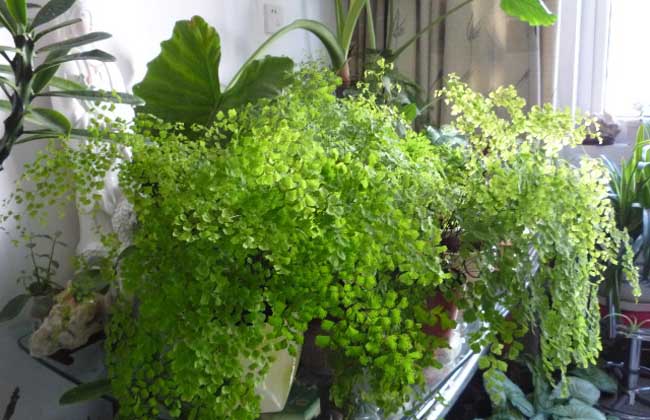
Maidenhair fern is a perennial herbaceous plant of the genus Adiantum in the family Pteridaceae, with high ornamental and medicinal value, strong adaptability, and easy cultivation. It is suitable for year-round potted cultivation indoors and is one of the most popular potted foliage plants in homes today. Let's take a look below at whether maidenhair fern is actually toxic!
Is Maidenhair Fern Toxic?
Maidenhair fern is not toxic. Maidenhair fern, also known as wire grass, maiden's hair, iron wire grass, water pig bristle soil, etc., has a bland and bitter taste, is cool in nature, and is non-toxic. It has the effects of clearing heat and detoxifying, draining dampness and reducing swelling, and promoting diuresis to treat strangury. It is commonly used for dysentery, scrofula, cough due to lung heat, hepatitis, strangury, venomous snake bites, bruises and injuries, and other conditions.
Types of Maidenhair Fern
1. Fan-leaved maidenhair fern: The fan-leaved maidenhair fern plant is 20-45 cm tall, with a short and upright rhizome densely covered with brown, glossy, awl-shaped lanceolate scales. The leaves are clustered, with veins branching dichotomously multiple times. The leaves are nearly leathery when dry, green or often brown, hairless on both sides. The sori are 2-5 per pinna, borne transversely on the upper and outer margins of the lobes, separated by notches. The indusia are semicircular or oblong, with a straight upper margin, leathery, brown-black, entire, persistent. The spores have indistinct granular ornamentation.
2. Whiptail maidenhair fern: Whiptail maidenhair fern, also known as bristle maidenhair fern, has linear-lanceolate leaves about 10-25 cm long, with the apex often extended into a whip-like form that roots upon touching the ground. The leaf blade is rectangular, once-pinnate or twice-torn, with the upper and outer margins often deeply cleft into narrow lobes, and the lower margin straight and entire. The sori are borne beneath indusia formed by the reflexed, modified apex of the lobes. The indusia are kidney-shaped to round-reniform, slightly hairy.
3. Lotus-leaf maidenhair fern: Lotus-leaf maidenhair fern, also known as lotus-leaf pennywort, iron wire grass, iron wire fern, etc., is 5-20 cm tall, with a short and upright rhizome. The leaves are elliptic-reniform, 2-6 cm wide, dark green above, smooth with 1-3 concentric rings, sparsely covered with brown long soft hairs beneath, with rounded teeth along the leaf margin. The leaf margins of fertile fronds roll back to form false indusia. The sori are oblong or short-linear, borne on the leaf margins.
How to Grow Maidenhair Fern
1. Soil: Maidenhair fern prefers loose, well-drained, fertile calcareous sandy loam. For potted cultivation, the growing medium can be made by mixing equal parts of loam, leaf mold, and river sand.
2. Temperature: Maidenhair fern prefers warmth, with an optimal growing temperature of 13-22°C. Planting in spring in the south is excellent, and it can also be grown in the north, but since maidenhair fern is not tolerant of high temperatures, the care methods differ.
3. Light: Maidenhair fern prefers semi-shaded environments. Never expose maidenhair fern to direct sunlight; it is suitable for growing in semi-shade.
4. Watering: Maidenhair fern prefers moisture and needs more watering during the growing season. In hot weather, spray or sprinkle water on the leaves to maintain relatively high air humidity and keep the leaf patterns distinct and the foliage emerald green.
5. Fertilizing: Apply dilute liquid fertilizer 2-3 times per month. When fertilizing, do not splash the leaf surface to avoid causing leaf rot. Due to the maidenhair fern's calcium-loving habit, add an appropriate amount of lime and crushed eggshells to the potting soil. Regular application of calcium fertilizer will produce better results. In winter, reduce watering and stop fertilizing.
6. Pests and diseases: Potted maidenhair fern often suffers from leaf blight. In the early stages, Bordeaux mixture can be used for control. In severe cases, 70% thiophanate-methyl at 1000-1500 times dilution can be used. If scale insects harm the plant, 40% omethoate at 1000 times dilution can be used for control.
7. Pruning: After autumn begins, as temperatures drop, maidenhair fern enters a slow-growth phase, and old leaves gradually turn yellow. At this time, they should be cut off.