How to prune Photinia × fraseri? A full analysis of pruning methods
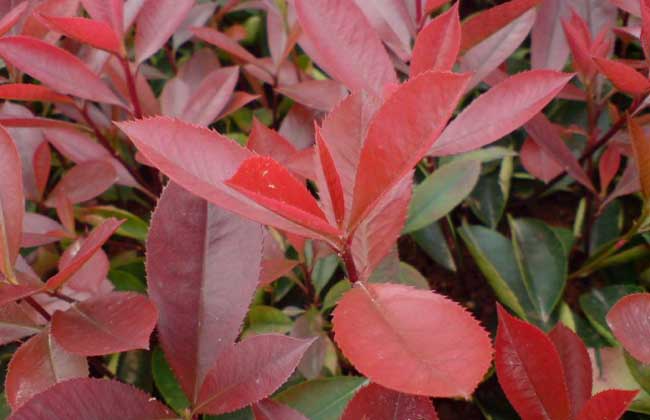
Photinia × fraseri is a landscaping plant, with common cultivars such as 'Red Robin' and 'Red Lips'. It is usually used as a street tree or hedge and needs pruning and shaping; after pruning, its forms can be endlessly varied, with a beautiful landscape effect. Pruning Photinia × fraseri requires skill, so let's take a look at the pruning methods for Photinia × fraseri below!
Growth habits of Photinia × fraseri
Photinia × fraseri prefers a warm, humid, sunny environment and has strong cold resistance, tolerating a minimum temperature of -18°C. It likes strong light but also has strong shade tolerance. It is suitable for various medium-fertility soils and tolerates poor soil. It has a certain tolerance to salinity and alkalinity and to drought. It does not tolerate waterlogging. It grows quickly, sprouts readily, tolerates pruning, and is easy to transplant and shape.
Pruning techniques for Photinia × fraseri
1. Pruning time: Photinia × fraseri has three main months of new growth each year, namely March, June, and September. Therefore, Photinia × fraseri should be pruned in the middle of these 3 months, keeping the places with gaps and pruning away excess branches, so that its crown becomes rounder and finer with each pruning.
2. Pruning position: When pruning the branches of Photinia × fraseri with scissors, do not get too close to the buds, so as to avoid affecting the growth of new buds.
3. Fine crown pruning: Generally, there are always a few drooping branches at the lower part of the crown, and these branches will affect the beauty of the crown. Therefore, as long as these branches do not affect the tree crown, it is necessary to prune them. In this way, the crown of Photinia × fraseri becomes both round and compact, and a Photinia × fraseri with a premium crown is thus presented!
Pruning methods for Photinia × fraseri
1. Specimen tree form: In the first year during the seedling stage, increase water and fertilizer management to promote seedling height growth. In the second year, properly prune some lower side branches of the plant and continue to increase water and fertilizer management. From the end of February to early March of the third year, according to the requirement of a trunk height of about 1.5 m, prune away all lower side branches, and pinch the top of the upper main shoot to promote side branches to form a crown. Generally, 3-4 side branches are required. If after the first pinching there are still not 3-4 side branches, then after the main shoot grows 30-40 cm, perform a second pinching to make it branch again into side branches. Through continuous cultivation, it can reach the standard for a specimen tree form for engineering use.
2. Low spherical shape: When the seedlings of Photinia × fraseri are about 40 cm tall, pinch the top to promote the formation of multiple side branches (at least 3-4). If after the first pinching there are still not 3-4 side branches, perform a second pinching as appropriate. After that, because the upper branches of the crown grow vigorously, prune heavily, prune side branches lightly, and promptly thin out vigorous water sprouts, so that the whole crown draws toward the center and gradually “clusters into a ball”. After light pruning and shaping, it becomes spherical.
3. Tall-trunk spherical shape: Generally, the tall-trunk spherical shape of Photinia × fraseri can be achieved in two ways
① Method one: In the first year during the seedling stage, strengthen water and fertilizer management to promote seedling height growth. In the second year, properly prune some lower side branches of the plant and continue to increase water and fertilizer management. From the end of February to early March of the third year, according to the requirement of a trunk height of about 1.2 m, thin out all lower side branches, keep all branches above 1.2 m, and pinch the top of the main shoot to promote side branches. After that, prune according to the low spherical shaping method to complete it.
② Method two: Select large Photinia seedlings as rootstock. While leaving sufficient trunk height, after shaping and pruning the crown, according to the distribution positions of the crown branches and the requirement for crown roundness, graft 5-6 buds onto the rootstock by bud grafting. After grafting, pay attention to promptly removing sprouts to promote the sprouting of the grafted buds. After that, use the low spherical shaping method for pruning, and a tall-trunk Photinia × fraseri ball can be cultivated. Because bud grafting survives very easily, using this method to cultivate tall-trunk spherical Photinia × fraseri nursery stock is not only labor-saving but also easy to operate, and is worth vigorously promoting.
4. Cylindrical shape: Select plants according to the height to be shaped (that is, the required height of the cylinder). When the selected plant reaches the required column height, pinch the top of the trunk (that is, pinch the top). Then, according to the intended pruning line, prune the branches and leaves from the upper part to the lower part of the plant into a cylindrical shape. After small branches grow out, gradually adjust them and directly cultivate a cylindrical tree form. When the selected plant height does not reach the required column height, strengthen water and fertilizer management, keep the central upright branch of the plant, and shorten and round the surrounding branches, giving the plant a “soaring” feel, and cultivate it. When the plant height reaches the requirement, pinch the top of the trunk and continue to shorten and round the surrounding branches. Through gradual pruning and management, a cylindrical tree form can be cultivated.
5. Hedge shape: Photinia × fraseri hedges can be divided into hedge walls and spaced hedges.
① Hedge shape: According to the required hedge height, heavily flat-prune the top of the plant. Its cross-section can be a flat rectangle or a trapezoid. Side branches can be vertically flat-pruned according to the thickness requirement of the hedge wall. The pruning surface is required to be “flat and neat”, and after that, gradual fine pruning will complete the shaping.
② Spaced hedge: The hedge wall length is required to be somewhat divided, generally about 1-1.5 m as one section, with a certain interval between each section. The shaping method is basically the same as that for the hedge wall.
6. Cube shape: The cube tree form means that the top cross-section and the surrounding cross-sections of the plant are all neat squares. According to the size requirement of the cube, select strong-growing, lush Photinia × fraseri plants. First heavily prune and level the top of the plant, then heavily prune the surrounding side branches leaving an appropriate length to promote new branches. After the new branches sprout and are cultivated, gradually prune them into “four-sided” flat surfaces.