A detailed explanation of the growth habits of carnations, understood in one article
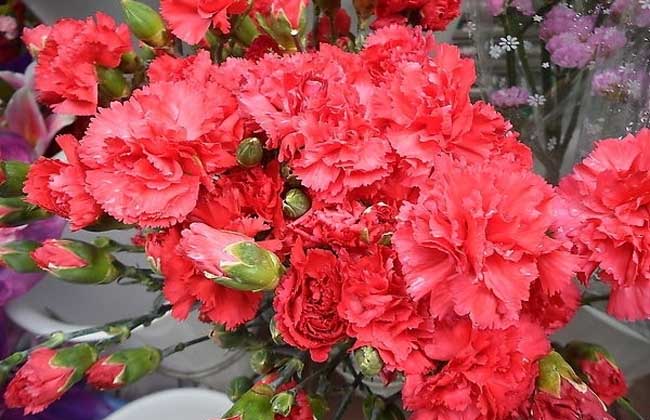
The carnation, originally named Xiangshizhu, also known as lion-head pink, musk pink, large-flowered pink, and others, is a perennial herbaceous plant of the genus Dianthus in the family Caryophyllaceae. It is mainly distributed in the temperate zones of Europe and in Fujian, Hubei, and other places in mainland China. It originated in the Mediterranean region and is one of the most widely used flowers in the world. Now let us take a look at the growth habits of carnations!
Light conditions
The carnation is a intermediate-day plant and likes sufficient sunlight. Apart from the seedling stage and the full flowering stage, there is no need to worry about damage from strong light, and with supplementary light, the flower crown diameter and the vividness of the flower color can be increased. Light intensity has an obvious positive correlation with the cut flower yield per unit area.
Temperature conditions
The carnation likes cool conditions and cannot tolerate heat, but it can endure a certain degree of low temperature. If the summer temperature is higher than 35°C, or the winter temperature is lower than 9°C, growth will be very slow or even stop. During periods of high summer heat, corresponding cooling measures should be taken, while in winter plastic film should be used for covering or the plants should be moved into a greenhouse to maintain an appropriate temperature.
Moisture conditions
The root system of the carnation is a fibrous root system. Long-term water accumulation in the soil or medium, excessively high humidity, or long-term high temperatures on the leaf surface are all unfavorable to its normal growth and development. Therefore, drip irrigation is advocated, and attention should also be paid to the problems of water quality and the salt content of the water.
Soil conditions
The carnation likes soil that retains fertilizer well and has good aeration and drainage performance, among which heavy loam is best. The suitable soil pH for its growth is 5.6-6.4. Some soil analysis experiments show that within the pH range of 5.95-7.9, the soil organic matter content has no obvious effect on flowering, and this is mainly determined by soil texture.