What are the cultivation methods and precautions for carnations?
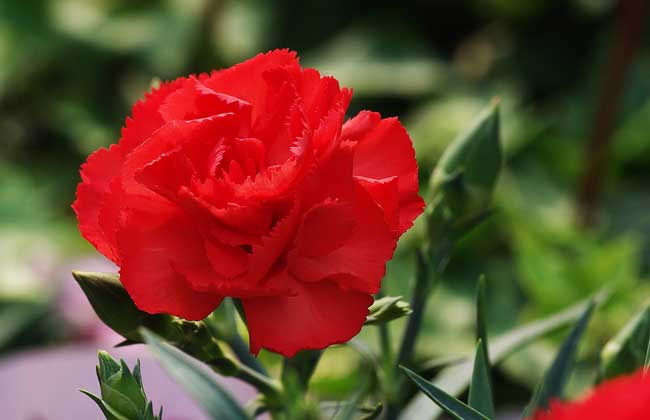
Carnations have upright stems, fresh green leaves, beautiful flower shapes, elegant bearing, rich colors, and a pleasant fragrance. When conditions are suitable, they bloom in all four seasons and are outstanding among cut flower materials. Arranged in a vase with supporting foliage such as asparagus fern, they create a pleasing contrast and are an excellent choice for decorating interiors. Let us now take a look at the cultivation methods and precautions for carnations!
Propagation methods for carnations
Carnations can be propagated by cuttings, sowing, tissue culture, and other methods. In general, routine propagation is mainly by cuttings. Cutting propagation is mostly carried out in spring, and can also be done at other times except the hot summer. The cutting bed medium can be perlite mixed with peat or scorched chaff. For cuttings, it is best to choose thick, strong side shoots from the middle of the plant, with short internodes. When taking cuttings, hold the shoot with your hand and pull it downward so that the base of the cutting carries a strip of the main stem's cortex, which makes it easier to survive. After collection, cuttings should be inserted immediately and must not be allowed to wilt, otherwise the survival rate will be greatly reduced.
Cultivation methods for carnations
1. Soil selection: Soil or medium is the place where plant roots are active. Creating a rhizosphere environment that is loose and breathable while also having a certain capacity to retain fertilizer and water is crucial for carnation cultivation. Carnations are fibrous-rooted herbaceous flowers, and their roots prefer to grow in loose, fertile, well-aerated soil or medium. The best soil for planting carnations is sandy loam. A soil air-filled pore space of about 30% is most ideal. Heavy clay and waterlogged soils are unfavorable for carnation growth and need to be improved. The core is to coordinate the relationship among the solid, liquid, and gas phases in the soil.
2. Temperature requirements: Temperature has both qualitative and quantitative effects on the growth and development of carnations, shown in its influence on growth speed, the morphology and size of flowers, leaves, and stems, cut flower yield, and cut flower longevity, among other aspects. Carnations are cool-loving plants. The optimum temperature for growth and development is 19-2l°C, and the day-night temperature difference should remain within 10°C. If the daytime temperature is too high, carnations show phenomena such as narrow leaves, small flowers, and poor branching. If the nighttime temperature is too high, abnormal reactions appear such as weak stems, small flowers, and good flower color. When the summer temperature is above 350C and the winter temperature is below 9°C, growth is slow or abnormal and may even stop.
3. Light requirements: Light is the energy source for plant growth, and the light requirement of carnations is one of the highest known among plants. Except during seedling raising or full bloom, there is no need to worry that strong light will have any harmful effect on carnations. Carnations are also a cumulative long-day plant. The longer the accumulated daylight hours, the more flower bud differentiation is promoted, thereby advancing flowering and improving the uniformity of flowering and cut flower yield. The use of supplemental lighting can not only promote internode elongation and inhibit side branch growth, but also increase flower crown diameter and the vividness of flower color.
4. Watering method: Carnations are shallow-rooted flowers, and the planting depth should not exceed 2 cm. After planting, water once thoroughly, and thereafter water thoroughly again when the potting soil becomes dry. Carnations are not tolerant of moisture. Apart from increasing watering during the vigorous growth period, flowering period, and midsummer, watering should generally not be excessive; keeping the soil at a certain humidity is sufficient. During the flowering period, avoid soil that is too dry or too wet.
5. Fertilization method: Carnations are shallow-rooted plants, with roots mainly distributed within the 20 cm soil layer. During cultivation, a sufficient amount of base fertilizer should be applied. Organic fertilizers such as barnyard manure, compost, and bone meal are used as base fertilizer to improve the physical properties of the cultivation soil and enhance its fertility, making it a loose and fertile loam rich in humus. Base fertilizer must be composted and decomposed before use. Because carnations have a long growth period, soil nutrients need to be continuously replenished. The principle for topdressing is light fertilizer applied frequently. For open-field planting, topdressing can be applied once every 25-30 days. If the soil fertility was originally not high, the interval between topdressings should be shortened. For potted plants, topdressing can be applied once every 7-10 days. During the two growth peaks of the plant, the number of topdressings can be increased. Fertilizers can include cake fertilizer water, chicken manure water, or alternatively compound chemical fertilizers.
Precautions for carnations
1. During the vigorous growth periods in spring and autumn, the soil should be kept moist to meet the needs of growth and development. During the high-temperature period in summer, growth is inhibited. At this time, watering should be moderated and ventilation strengthened, so that the potting soil remains slightly dry.
2. Generally, move plants into the greenhouse around “Frost's Descent”, and the most suitable temperature regulation is 10-20°C. To force or delay the flowering period, the temperature can be appropriately raised or lowered. Measures should be taken to reduce humidity in the greenhouse to decrease the occurrence of diseases.
3. The principle for topdressing is light fertilizer applied frequently. For potted plants, apply dilute decomposed liquid fertilizer once every 7-10 days.
4. In winter, move indoors and cultivate in a place with ample sunlight and good ventilation. If the temperature is suitable, the flowering period can be extended to March of the following year.
5. During the seedling stage, pinch the tips 1-2 times to promote branching, so that each plant has about 10 side branches. After pinching, the plant shape is attractive and flowering is abundant. As the branches grow, supports should also be set up to prevent lodging. During the growth period, promptly remove the side buds and small flower buds produced on each branch, keeping only one flower bud at the top of each branch, so that nutrients are concentrated in supplying the terminal bud.