Identification Methods and Maintenance Tips for Boxwood Carvings
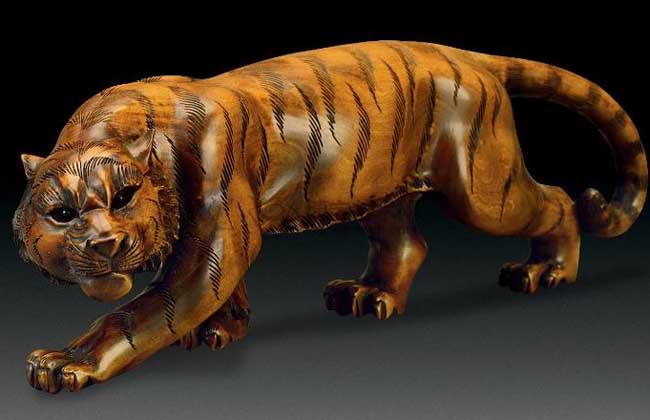
Boxwood carving is one of the folk carving arts of the Han ethnic group. It uses boxwood as the carving material, drawing on its natural forms with smooth wood, fine grain, and dignified color. The craft process is complex, and the fineness and technical requirements of each step are unmatched by other carvings and cannot be replaced by modern technology. Below, let us take a look at the identification methods and maintenance methods for boxwood carvings!
Identification of Boxwood Carvings
1. Material: Boxwood is a precious evergreen shrub with a long growth period to maturity, and its resources are increasingly scarce. A root material 20 cm in diameter needs 500 years to grow. If you see large boxwood carvings on the market, you must be careful; many unscrupulous merchants use water boxwood as a substitute.
2. Carving workmanship: When identifying, check whether the carving workmanship is refined. Arts and crafts value unique ingenuity. Boxwood carving should make clever cuts according to the material's own unique natural shape or grain direction, with seven parts natural and three parts carved. In addition, if it is the work of a famous master, this kind of boxwood carving work that blends ingeniously with nature has greater collectible value than others.
3. Color: Boxwood carvings naturally change color during storage, and the color gradually deepens year by year. Experienced collectors can roughly determine the age of a work based on the depth of color and the patina.
Maintenance of Boxwood Carvings
1. Boxwood carvings should not be exposed to high temperatures or prolonged direct sunlight. Like all wooden carving crafts, boxwood carvings should not be placed in high-temperature environments. Exposure to the sun will damage the boxwood wood, making it brittle and hard, and it will easily crack later. In particular, it must not be placed on a balcony. If placed by a window, it is best to put it in a shaded place beside curtains. Indoors, it should be kept in a humid environment to prevent drying and cracking. At the same time, boxwood carvings should not be placed near open flames, fire walls, heated kang, stoves, and similar sources.
2. Wood products fear water most. When storing boxwood carvings ordinarily, pay attention to controlling appropriate humidity, and never let boxwood carvings remain in a humid environment for a long time. If kept in a humid environment for a long time, boxwood carvings are extremely prone to growing “mold”; a large amount of mildew will appear on their surface, and over time, boxwood carvings will rot very easily. If mildew appears on a boxwood carving, you can polish it with abrasive paper and then apply clear lacquer for protection.
3. Boxwood carvings will inevitably gather dust after being placed for a long time. For boxwood carvings that have not been lacquered, simply use a soft brush to sweep away surface dust. For boxwood carvings with a lacquered surface, you can wipe them with a slightly damp pure cotton towel. If you feel the surface luster of the boxwood carving is insufficient, you can dip a towel in some walnut oil and wipe it, which can add some gloss.
4. In an overly dry environment, boxwood carvings may crack. Modern living standards have improved, and every household has an air conditioner, especially in the north, where it is used for most of the year. Therefore, be careful not to let boxwood carvings be directly blown by the air conditioner outlet, so as to avoid drying and cracking, and do not place them near heating pipes.
5. Do not wipe boxwood carvings with a towel containing water. Instead, use a pure cotton towel containing wax or oil. If you often wipe with a wet cloth, not only will it fail to achieve the expected effect, but over time moisture will penetrate into the boxwood carving and damage the quality of the wood carving. Therefore, when cleaning, you can use a dry cotton cloth or feather duster to dust the wooden carving craft.
6. Sometimes, unintentionally or under some external force, some cracks appear in a boxwood carving. In this situation, do not worry too much. We can use a toothpick dipped in a little super glue and apply it into the cracks, then press firmly with our hands, and after a while those cracks can basically be repaired. However, in order to avoid such situations, we should usually pay more attention and try not to let it lose its original charm.
Auctions of Boxwood Carvings
1. In December 2007, a boxwood arhat from the Republic of China period was sold at auction for 1.45 million yuan.
2. In June 2011, a Qing Dynasty redwood shrine inlaid with boxwood sold at auction for 1.8 million yuan.
3. In December 2012, a Qing Dynasty boxwood rose chair with dragon-head patterns sold for 1.38 million yuan.
4. In December 2012, a Qianlong-period Qing Dynasty red sandalwood piece inlaid with silver wire and boxwood sold at auction for 1.55 million yuan.
5. In October 2013, a large boxwood root burl brush from the late Ming and early Qing period sold at auction for 1.8 million yuan.
6. In December 2013, a Qing Dynasty Wu Zhifan boxwood brush pot was sold at auction for 1.6 million yuan.
7. In March 2014, an inscribed boxwood work by Wu Zhifan from the early Qing period sold at auction for 1.5 million yuan.
8. In June 2014, a late Qing boxwood figure brush pot sold at auction for 1.4 million yuan.
9. In June 2014, a late Qing boxwood Fu Lu Shou was sold at auction for 1.45 million yuan.
Master Boxwood Carvers
1. Zhu Zichang: Zhu Zichang (1876-1934), a famous folk carving master in Wenzhou, inherited traditional sculpture techniques, combined them with the characteristics of boxwood, and used unique methods to create many excellent works, greatly promoting the development of boxwood carving. His works “Hide and Seek”, “Five Sons Delighting Maitreya”, and “Cloth-Bag Monk” are all famous works with vivid images, rich expressions, and exquisite antique beauty. In 1909, his work “Mad Monk Ji” participated in the Nanyang Industrial Exposition and won an award of excellence. Later generations praised his works as having round and smooth knifework, light and transparent clothing lines, lifelike modeling, and fresh and elegant figures.
2. Wang Fengzuo: Wang Fengzuo (1905-1993), a famous boxwood carving master from Yueqing, was among the first batch of folk artists of Zhejiang Province. In the 1950s, he was very prestigious among his peers. At the age of thirteen, he became an apprentice, and four years later he first made a name for himself by creating the table screen “Drinking in Yellow Crane Tower”. Later he became an assistant to the Buddha statue sculptor Huang Chongshou and benefited greatly. His “Arhat Picking His Ear” was as tall as a real person, with a crooked mouth, one eye open and one eye closed, and a vivid expression. He also “stole” skills from Zhu Zichang, and his works could be mistaken for Zhu's. After liberation, his works “Su Wu Herding Sheep” and “The Cowherd and the Weaver Girl” were exhibited at the folk art exhibition of five provinces and cities in East China, winning Chen Yi's appreciation and praise from the art world, and won first prize. Later they were sent for exhibition in the then Soviet Union. “Pravda” and “Literature and Art Newspaper” both introduced “Su Wu Herding Sheep”, and it was collected by the Leningrad Museum.
3. Ye Runzhou: Ye Runzhou (1918-1996) was the fourth-generation inheritor of Ye Chengrong of Yueqing. His father, Ye Furu, won an award of excellence at the 1929 West Lake Exposition for the boxwood carving work “Boy Riding a Cow”. Ye Runzhou studied the craft with his father from childhood. In more than 50 years, he created more than 200 boxwood carvings, among which “Transformed Universal Joy” won first prize in China's arts and crafts “Hundred Flowers Award”. Others such as “Qu Yuan”, “Immortals Dancing Together to Celebrate the Human World”, and “Zhong Kui Suppressing Evil” were all treasured by relevant state institutions for their exquisite technique and vivid images. His works have also been purchased and collected by collectors at home and abroad.
4. Wang Duchun: Born in 1932, representative inheritor of the national intangible cultural heritage project “Yueqing Boxwood Carving”, Chinese Arts and Crafts Master, among the first batch of folk artists of Zhejiang Province, and among the first batch of outstanding folk literature and art talents of Zhejiang Province.
5. Zheng Shengning: Zheng Shengning was born in 1943 in Xiangyang Town, Yueqing City, Wenzhou, Zhejiang. He is a Chinese root art master, Chinese wood carving art master, Zhejiang arts and crafts master, outstanding folk literature and art talent of Zhejiang Province, senior arts and crafts artist, guest professor at Zhejiang Tourism Vocational and Technical College, and honorary chairman of the Zhejiang Root Art Fine Arts Society. He is skilled in boxwood carving, root carving, and urban sculpture. His works have won national gold awards many times. Representative works include “Laozi”, “Exuberant Grassland”, “Master Hongyi”, “Mending Shoes Across the World”, “Lu Xun”, and “Fish-Basket Guanyin”.
6. Wang Dufang: Member of the China Arts and Crafts Society Wang Dufang was born in 1947 and studied under Professor Zheng Ke. He is skilled in figure carving. He is a Chinese Arts and Crafts Master, Chinese root art master, and folk artist of Zhejiang Province. After graduating from the Special Arts Department of the Central Academy of Fine Arts, he ran the Fenglin Wood Carving Factory himself. He successively created works such as “Li Bai” and “Thousand-Hand Guanyin” for the Li Bai Memorial Hall in Jiangyou County, Sichuan, and the Guanyin Cave in Yandang Mountain, gaining fame in China.
7. Yu Jinshun: In Yueqing there is also a pair of Yu brothers who are Chinese Arts and Crafts Masters and outstanding folk literature and art talents of Zhejiang Province. The elder, Jinshun, was born in 1949. He is skilled in figure modeling with traditional carving materials, especially in carving the smiling Cloth-Bag Monk full of harmony and cheer. His works “Laughing Buddha” and “Ten Great Joys” are lively and full of humor. The younger, Dingliang, was born in 1950 and served as director of the Boxwood Carving Factory. His signature skill is carving animals, and he is especially known for “cattle works”. His works “Bullfight” and “Earth” capture the posture of bulls fighting and the beauty of bovine strength. His knifework draws on landscape painting, carving the folds of the ox's body to highlight the ox's power, praising the pioneers of the era with the spirit of the pioneering ox.
8. Mou Xiangbo: Born in 1969, a major inheritor of Yueqing boxwood carving, Chinese wood carving art master, Zhejiang arts and crafts master, outstanding folk literature and art talent of Zhejiang Province, and senior arts and crafts artist.
9. Zheng Fangyang: Born in 1972, a major inheritor of Yueqing boxwood carving, national rural youth folk craft master, folk artist of Zhejiang Province, outstanding folk literature and art talent of Zhejiang Province, and a wood carving art master favored by Chinese collectors in 2006.