What is the legendary story of the silk tree flower?
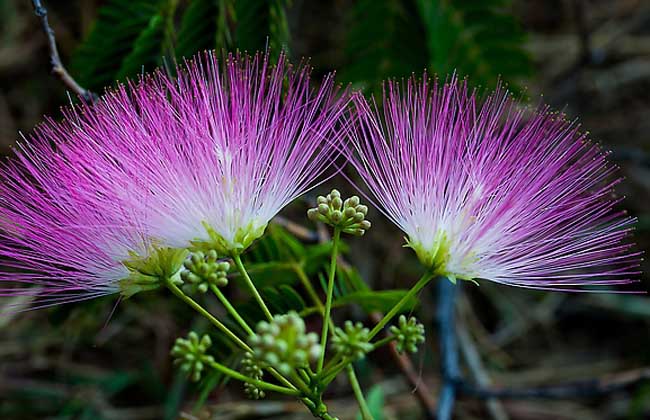
The silk tree flower comes from the silk tree (Albizia julibrissin), a deciduous tree in the legume family Fabaceae. Its leaf shape is elegant, its crown is broad and open, and in early summer it offers cool, quiet shade. Its bipinnate compound leaves open by day and close by night, which is quite remarkable. It carries the meaning of "making peace and enjoying family harmony," symbolizes eternal love and pairing together, and is a symbol of marital harmony. There are many legends about the silk tree flower, so let us take a look together below!
Legend One of the Silk Tree Flower
It is said that Yu Shun died while on an inspection tour to Cangwu in the south. His consorts Ehuang and Nüying searched everywhere along the Xiang River but never found him. The two consorts wept bitterly all day long, and when their tears were exhausted they wept blood, and when the blood was exhausted they died, and thus became spirits. Later, people discovered that their spirits and Yu Shun's spirit "became one," turning into the silk tree. The silk tree's leaves open by day and close by night, loving each other. From then on, people often used the silk tree to express steadfast and unchanging love.
Legend Two of the Silk Tree Flower
In ancient times, the silk tree flower was called the bitter-love flower, and it did not bloom either. The transformation of the bitter-love flower into the silk tree begins with a scholar. The scholar had studied diligently for ten years and was preparing to go to the capital to take the examination for official rank.
When he was about to leave, his wife Fenshan pointed to the bitter-love tree in front of the window and said to him: "My husband, on this journey you are sure to pass with high honors, but the capital is full of distracting flowers that dazzle the eyes. Whatever you do, do not forget the road home!" The scholar agreed and left, but from then on there was no news of him at all.
Fenshan waited and waited at home, hoped and hoped again, until her black hair turned white, and still she did not wait for her husband's figure to return. When the end of her life was near, Fenshan, dragging her sick and weak body, struggled to the bitter-love tree that had witnessed her vow with her husband, and with her life made a solemn oath: "If my husband changes his heart, then from now on let this bitter-love tree bloom. Let him be the leaf and I be the flower. May the flower never grow old and the leaf never fall, one heart for a lifetime, harmony in every life!" Having said this, she breathed her last and died.
The next year, all the bitter-love trees indeed bloomed, soft and pink, hanging all over the branches like little fans, and carrying a faint fragrance, except that the flowering period was very short, only one day. Moreover, from that time on, all the leaves actually opened in the morning and closed at dusk along with the blooming and fading of the flowers.
In order to commemorate Fenshan's devoted love, people renamed the bitter-love tree the silk tree.
Legend Three of the Silk Tree Flower
It is said that long ago there was a village at the foot of Mount Tai, and in the village there was a Squire He. In his later years, Squire He had a daughter, named Huanxi. The girl was born clever and beautiful, and Squire He and his wife cherished her like a pearl in the palm of their hand.
In the year the girl turned 18, she went to the southern mountain to burn incense on Qingming Festival, and after returning she contracted a stubborn illness: she was dazed and absent-minded, had no appetite for food or drink, and grew thinner day by day. Many famous doctors were summoned and many medicines were taken, but none were effective. Seeing that she was failing, Squire He posted a notice: whoever could cure Miss He's illness would be richly rewarded with a thousand pieces of gold.
The notice was taken down by a poor scholar from West Village. This scholar had delicate features, was handsome and refined, and besides studying the classics diligently, he was also thoroughly versed in medical books. It was just that his family was poor, and with the capital examination approaching, he did not have a single coin for travel expenses, so he thought of curing the young lady and obtaining some silver and money for his trip to the capital.
It turned out that the young lady's illness was lovesickness. The scholar from West Village was exactly the fair-faced scholar she had seen on the southern mountain at Qingming Festival. Seeing him today, she was more than half better even without treatment. The scholar did not know the girl's feelings, and simply took her pulse and examined her complexion and tongue coating, saying: "This young lady's illness is caused by unfulfilled thoughts, worry turning into illness, and emotional stagnation."
He also said that on the southern mountain there was a tree people called the "sentient tree," with bipinnate compound leaves, each leaflet paired opposite another, and it opened by day and closed by night. Its flowers were like threads, with a refreshing fragrance that could clear the heart and relieve stagnation, calm the mind and soothe the spirit, and when decocted in water and drunk, it could cure the young lady's illness.
Squire He quickly sent someone to fetch it and gave it to the young lady to take, and the young lady's illness indeed improved. Through their repeated dealings, the scholar also developed feelings for the young lady.
Before long, the scholar went to the capital for the examination, passed with high honors, and upon returning married the young lady. Later, people called this kind of tree the silk tree, and its flower the silk tree flower.