What does "a tree of pear blossoms pressing down on crabapple" mean?
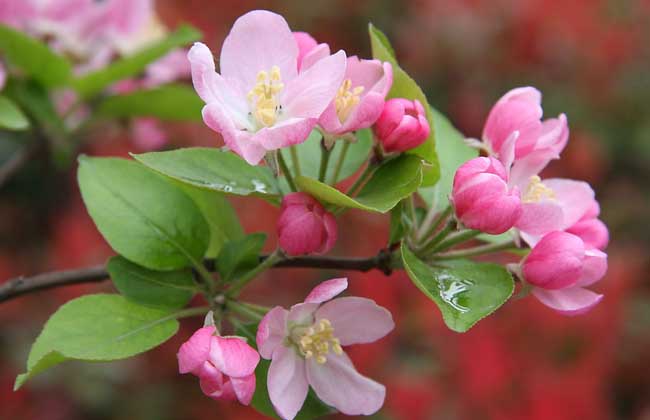
"A tree of pear blossoms pressing down on crabapple" comes from a teasing piece by Su Dongpo mocking his good friend, the ci poet Zhang Xian. The original text reads, "In the mandarin duck quilt, a night of pairing; a tree of pear blossoms pressing down on crabapple." Many people have surely heard this line of poetry, but few know what it means. Below, let us take a look together at what "a tree of pear blossoms pressing down on crabapple" actually means!
The meaning of "a tree of pear blossoms pressing down on crabapple"
"A tree of pear blossoms pressing down on crabapple" is a poetic way of saying "an old ox eats tender grass." In this line, the pear blossoms are white, referring to a white-haired husband, while the crabapple is red, referring to a young beauty; a single word "press" says all the countless things left unsaid.
The origin of "a tree of pear blossoms pressing down on crabapple"
"A tree of pear blossoms pressing down on crabapple" comes from a teasing piece by Su Dongpo of the Song Dynasty mocking his good friend, the ci poet Zhang Xian. It is said that at the age of 80, Zhang Xian married an 18-year-old concubine, and in his excitement he wrote a poem:
I am eighty, you are eighteen, you are a beauty, I am white-haired.
Turned around, we are actually the same age, separated only by one sexagenary cycle in between.
When Su Dongpo learned of this, he teased:
An eighteen-year-old bride and an eighty-year-old groom, hoary white hair facing red makeup.
In the mandarin duck quilt, a night of pairing; a tree of pear blossoms pressing down on crabapple.
References to "a tree of pear blossoms pressing down on crabapple"
In the film "Flirting Scholar," Tang Bohu is caught by the four great lechers of the east, west, south, and north. To save his life, he falsely claims to be one of them and describes himself with two lines of poetry. The plot goes as follows:
Bandit A: "Just arrived and already seeing something this disgusting, what rotten luck."
Bandit B: "I heard the four fragrances of spring, summer, autumn, and winter are each as beautiful as flowers, and that Qiuxiang especially is to die for."
Bandit C: "Of course Qiuxiang should be left for the boss."
Bandit A: "Boss, what should we do with this one, kill him?"
Bandit Boss: "Eh, this pair of adulterous lovers can count as one of our kind, just knock him out."
Tang Bohu: "Wait, if I am not mistaken, you four must be the Four Great Lecherous Knights famous in Jiangnan."
The four bandits: "Exactly, we are the Four Great Lecherous Knights: Lust of the East, Meanness of the West, Theft of the South, and Lechery of the North."
Tang Bohu: "Aiya, I am the one who stands elegant as jade and surpasses Pan An, the little lecher Zhou Botong, a tree of pear blossoms pressing down on crabapple."
Bandit A: "Never heard of him."
Bandit Boss: "Eh, this one even dares to go for such goods; the title of little lecher is well deserved."
Tang Bohu: "Small case, I have played with even worse."
Bandit Boss: "Oh, then I should respectfully call you big brother."
Tang Bohu: "I would not dare, I would not dare. I heard you four big brothers want to go in and have some fun with Qiuxiang, so let me lead the way."
Bandit Boss: "What, you want a second round."
Tang Bohu: "Hehe..."
Bandit Boss: "You go first."
Bandit Boss: "Wipe the soles of your shoes clean, do not leave footprints."