Is the Crassulaceae Sempervivum tectorum poisonous? Is it safe to keep at home
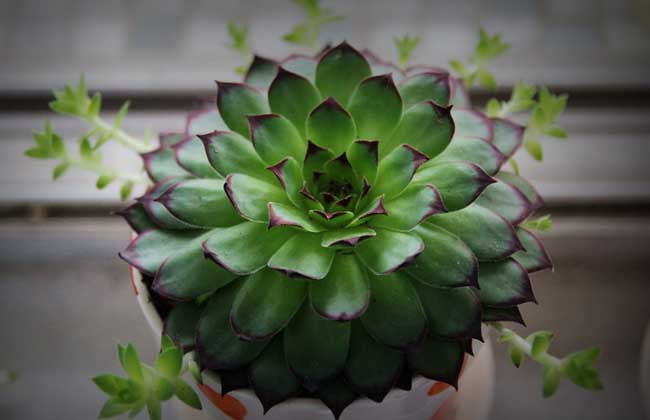
The Crassulaceae Sempervivum tectorum, also known as houseleek, Guanyin zuolian, or Fozuolian, is native to the mountainous regions of Spain, France, Italy and other European countries. It is a perennial succulent plant of the genus Sempervivum in the Crassulaceae family, grown mainly for its foliage. Many people are concerned about whether the Crassulaceae Sempervivum tectorum is poisonous. Let us take a look together below!
Is the Crassulaceae Sempervivum tectorum poisonous?
The Crassulaceae Sempervivum tectorum is slightly poisonous. The Crassulaceae Sempervivum tectorum belongs to the Crassulaceae family, and most plants in this family are slightly poisonous. However, the toxicity exists only in the sap, is not volatile, and as long as it is not ingested, it can be kept without worry. For ordinary household growing, try to avoid growing and caring for it in homes with children.
How to grow the Crassulaceae Sempervivum tectorum
The Crassulaceae Sempervivum tectorum is easy to grow successfully. During the growing season, except for shading needed from June to September, it is best to give it half a day of sunlight at other times. If placed indoors for viewing, it is best to put it near a south-facing window. After being placed indoors for 1 month, it should be moved to a humid place under a shed for a period of care. Water it frequently to keep the soil moist, but also prevent excessive moisture, over-wetness, or water accumulation in the pot, otherwise the tuberous roots will rot. Therefore, when potting, a layer of coarse sand or similar should usually be placed at the bottom of the pot as a drainage layer to strengthen drainage. During high temperatures and dry conditions, spray water to increase humidity, so that it can obtain external conditions for vigorous growth. Fertilize 2-3 times per month during the growing season. After moving indoors in winter, reduce watering, and the temperature should not be lower than 5°C.
Common varieties of the Crassulaceae Sempervivum tectorum
In the Crassulaceae genera Aeonium, Graptopetalum, Dudleya, Orostachys, and Echeveria, there are also many varieties whose succulent leaves are arranged in a rosette shape, very similar in form to plants of the genus Sempervivum, but the flower shapes differ greatly.
1. Mingjing: Mingjing, also known as panyelianzhang, belongs to the genus Aeonium in the Crassulaceae family. Its succulent leaves are closely arranged and grow horizontally. The leaves are spoon-shaped, grass-green, with cilia on the leaf margins. The entire leaf rosette is as level as a mirror, without a single gap, like a geometric pattern, very peculiar.
2. Zichi Nianhua: Zichi Nianhua, also called Zichi Lianhua, belongs to the genus Orostachys in the Crassulaceae family and is native to Hokkaido. Its succulent leaves are gray-blue or gray-green, round or long spoon-shaped, smooth on the surface, entire, and covered with white powder. The stem is slender, with a rosette-shaped leaf cluster at the top.
3. Meililian: Hongjuanjuan, also known as Bielusi, belongs to the genus Graptopetalum in the Crassulaceae family. Its compact rosette-shaped leaf disk is gray-green-brown, covered with white powder, and the flowers are magenta.
4. Hongjuanjuan: Hongjuanjuan, also known as Dachijuanjuan, belongs to the genus Sempervivum in the Crassulaceae family. Its oval succulent leaves are densely arranged and grow radially, with the tips curving slightly outward. The leaf tips are densely covered with short white hairs, especially dense in the center of the plant, resembling a spider web. The leaves are green and turn purplish-red under cool and sunny conditions.
5. Shilianhua: Shilianhua, also known as Baoshihua, Shilianzhang, Lianhuazhang, etc., belongs to the genus Echeveria in the Crassulaceae family. The leaf cluster is compact and upright in a rosette shape. The leaves are wedge-shaped obovate, with short, sharply pointed tips, hairless, and powdery blue. The flower stem is soft, with bracts, covered with white frost. 8-24 flowers form a cyme, the corolla is red, the petals are lanceolate and do not open, and the flowering period is July-October.