How to propagate kalanchoe by cuttings? A detailed explanation of the cutting propagation method
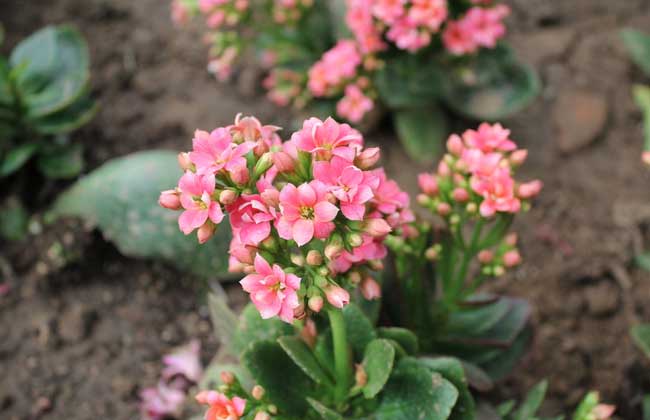
Kalanchoe is mostly propagated by cuttings. There are two cutting methods: leaf cuttings and terminal bud cuttings. Generally, leaf cuttings and tissue culture are mostly used for the production of mother plants, while terminal bud cuttings are mostly used for potted flower production. Let's take a look at the cutting propagation methods for kalanchoe!
Kalanchoe cutting methods
1. Leaf cuttings: Remove the whole leaf (the larger the leaf, the better), place it in a shady spot to let the wound dry. After several hours, insert the petiole completely into a moist substrate. If the petiole is too short, you can also insert part of the leaf into the substrate instead of the short petiole. At this stage, it must not be too wet, to avoid the leaf becoming diseased and rotting. After cutting, place it in a spot with slightly weak sunlight, keeping the temperature between 20-25°C. After 3-4 weeks, the root system begins to establish; at this point, it can be placed under full sun and given a low-concentration fertilizer. After another 7-10 weeks, seedlings differentiated from callus tissue can be seen. When the seedlings grow to 15-20cm, they can be separated from the leaf and grown on their own, while the leaf can continue to produce seedlings. The separated seedlings can be used as mother plants for producing unrooted cuttings.
2. Terminal bud cuttings: Insert the prepared unrooted cuttings directly into a flower pot filled with substrate, keeping the substrate moist. The substrate is generally a mix of peat and perlite at a ratio of 7:3, with the substrate pH adjusted to between 5.5-6.0. Producers can adjust the ratio according to their own water quality, production variety and production season, or add vermiculite, sand and other soilless substrates, to achieve a substrate with good drainage and moderate nutrient content. In addition, the light intensity should not be too strong; keep the temperature between 20-25°C. Roots will form in about 2-3 weeks, after which production-stage management can begin. Terminal bud cuttings are generally mostly used for potted flower production (Note: kalanchoe is a typical long-day flowering plant. During cutting propagation, the day length must be longer than 12.5 hours. When propagating by cuttings in winter, supplemental lighting must be used).
Kalanchoe cutting methods
1. Cutting time: Leaf cuttings of kalanchoe can be done all year round, but summer and autumn are best. Before cutting, prepare the cutting bed first; the cutting substrate is fine river sand or well-drained sandy loam.
2. Cutting method: On the second day after cutting kalanchoe, spray the cuttings once with a mixed solution of 0.1% sucrose and urea. Since kalanchoe is a succulent plant with a high water content in its body, it should not be watered too frequently at ordinary times; if the substrate is too wet, it easily causes root rot. Usually water once every 2-3 days. On rainy days, be careful to prevent rain exposure. Roots will form in about half a month. After 3-4 weeks, the callus tissue at the base of the petiole can grow small tiller buds. After the tiller buds emerge from the soil, spray once with a mixed solution of 0.2% monopotassium phosphate and sucrose.
3. Management after cutting: Spray 0.5% foliar nutrient solution for flowers once every 10 days. After one and a half months, they can be potted and transplanted. The potting soil is best as well-drained, loose and fertile sandy loam. After potting, water once every 2-3 days. In winter, if the temperature is lower than 5°C, move them indoors to overwinter.
Precautions for kalanchoe
1. Suitable temperature: Kalanchoe likes a warm environment; too cold or too hot is not good for its growth. During the day, its temperature should not exceed 30 degrees, while at night it should not be lower than 18 degrees. If the temperature is too high or too low, it will enter a dormant state, that is, stop growing. Therefore, when growing kalanchoe, in summer it should be avoided from direct sun exposure, and in winter it should be placed indoors to prevent freezing.
2. Sufficient water: Kalanchoe is a drought-tolerant plant, and its water requirement is relatively low; watering only twice a week is enough. Note that if you water it at noon, you must make sure the leaves of the kalanchoe remain dry before nightfall.
3. Sufficient sunlight: Kalanchoe prefers to grow in an environment with sufficient sunlight. If it is placed in a shady environment for a long time, it cannot carry out normal photosynthesis and therefore cannot grow normally, and at the same time it will cause leaf drop or failure to bloom. Therefore, in general seasons we can place it in a sunny spot, but in summer it should be avoided from direct sun exposure.
4. Moderate fertilization: The growth of any plant cannot be separated from an appropriate amount of fertilizer, and kalanchoe is no exception. Only when it has sufficient nutrients can it grow normally. During the growth period of kalanchoe, we should fertilize it once every two weeks, which helps promote its growth needs.