What to Do When Kalanchoe Leaves Turn Yellow? Causes and Solutions
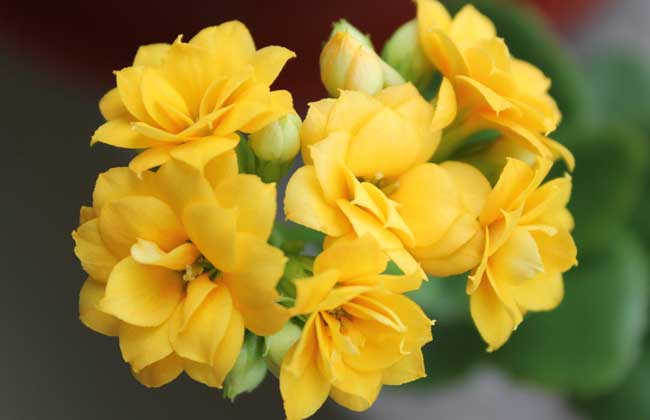
Because kalanchoe has a long flowering period, many flower colors, is easy to grow, and is easy to propagate, it is also quite widely popular. However, during the process of growing kalanchoe, yellowing leaves, softening leaves, and leaf drop often occur. Let us take a look at what to do when these situations arise!
What to Do When Kalanchoe Leaves Become Soft
This is usually caused by long-term lack of light or insufficient light, insufficient watering, or long-term waterlogging. Light should be increased; apart from appropriate shading in summer, good to sufficient light must be provided at other times. Watering should alternate between dry and wet; never allow long-term waterlogging or drought.
What to Do When Kalanchoe Drops Its Leaves
1. Insufficient light: If kalanchoe receives insufficient light during routine care, not only will the branches be weak and slender, the leaves thin, and the plant shape unattractive, but the number of flowers will also decrease, the flower colors will be less vivid, and a large number of leaves will drop, causing it to lose its ornamental value.
2. Dark environment: A too-dark care environment can also easily cause leaf drop. Even a plant that has already bloomed, if placed in a shady spot, will have its flower colors become dull and then the flowers drop and wither.
What to Do When Kalanchoe Leaves Turn Yellow
1. Overwatering: If kalanchoe is watered too much, the leaves will turn yellow. This shows as old leaves having no obvious change while young leaves turn yellow. In this case, water should be controlled immediately.
2. Excessive drought: This is caused by lack of water and drought. Its characteristic is that old leaves turn yellow first from the bottom upward. If the lack of water lasts a little longer, the whole plant's leaves will turn yellow, and it may even die, so it should be watered promptly.
3. Excessive fertilizing: This is caused by fertilizing too frequently or with too high a concentration. Its characteristic is that young leaves are thick, glossy, and uneven. Fertilizing should be controlled, and the soil should be cultivated and watered.
4. Insufficient fertilizing: This is caused by insufficient fertilizer, too low a fertilizing concentration, and too long an interval between fertilizing. Its characteristic is that yellowing starts first at the young leaves and tender stems. If this phenomenon is seen and fertilizer is not applied in time, it can also cause the whole plant's leaves to turn yellow and even death. Note: For flowers lacking fertilizer, never apply a large amount of concentrated fertilizer at one time, so as to avoid burning the roots.
5. Iron deficiency: For woody flowering plants in greenhouses, because soil fertility conditions vary greatly, yellowing leaves often occur. Its characteristic is that young leaves are obviously affected while old leaves are less so, the mesophyll is yellow, the veins are green, and a typical network forms. This can be solved by applying ferrous sulfate aqueous solution. The method is to mix 7 parts cake fertilizer, 5 parts ferrous sulfate, and 200 parts water into a diluted solution and water with it.