The Meaning Behind the Camellia's Flower Language and Its Legendary Stories
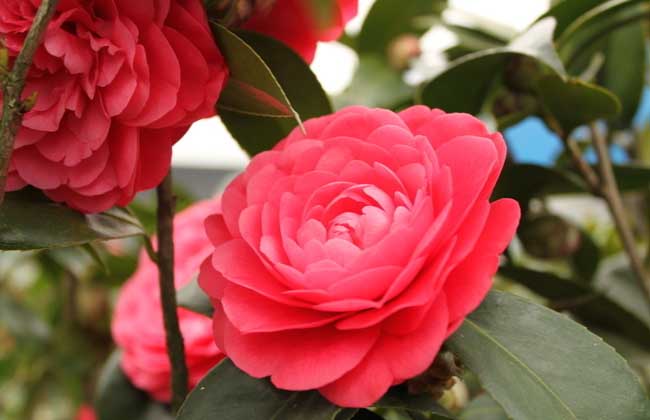
Camellia, also known as the camellia plant, belongs to the Theaceae family, genus Camellia. Its flowering period is quite long, blooming from October to May of the following year, with the peak blooming season usually from January to March. It is a traditional ornamental flower of China, ranking eighth among the "Ten Famous Flowers," and is also one of the world's precious flowering trees and shrubs. Let us now take a look at the camellia's flower language and legendary stories!
When Does the Camellia Bloom
Depending on the variety, camellias bloom successively from late September to early May, presenting a scene of vigorous vitality in late autumn, deep winter, and early spring. The camellia produces new shoots twice a year: the first is the spring shoot, beginning in March to April, and the summer shoot, which emerges from July to September. The camellia's flowering period is long, with most varieties blooming for 1 to 2 months. A single flower typically lasts 7 to 15 days, and the flowering period is from February to March.
What Is the Camellia's Flower Language
1. Camellia: Lovable, modest, prudent, virtue, ideal love, extraordinary charm.
2. White Camellia: Pure and innocent, lovable, perfect charm, true affection, ideal love, elegant and refined.
3. Red Camellia: Naturally beautiful, the virtue of modesty, yielding, noble rationality.
4. Pink-White Camellia: Extravagance, fashionable.
5. Pink Camellia: Overcoming difficulties.
The Legend of the Camellia
In the final years of the Ming Dynasty, Emperor Chongzhen sent Wu Sangui to guard Shanhaiguan. Later, the peasant rebel army led by Li Zicheng captured Beijing, and Emperor Chongzhen hanged himself. Seeing the situation turn unfavorable, Wu Sangui surrendered to the Qing army and served as a vanguard, leading the Qing forces into the towns to suppress the peasant rebel army. After the Qing army entered the pass, Wu Sangui was ranked first for his merits and was enfeoffed as the Prince of Pingxi, stationed in Yunnan. From then on, Wu Sangui ran rampant in Yunnan, oppressing the common people everywhere. He built a palace on Wuhua Mountain and constructed Axiang Garden, and ordered the people throughout Yunnan to present rare flowers and exotic plants.
At that time, it happened that within Puji Temple in Luliang County there was a camellia with flowers bearing nine stamens and eighteen petals, richly fragrant, a treasure of the world. When the magistrate of Luliang County saw the imperial decree, he sent men to Puji Temple and forced the residents around the temple to dig up the camellia. The villagers refused to comply, and not a single person would lift a hand to dig up the tree. One night, a highly respected elder in the village saw a beautiful young woman walking toward him, holding a blooming camellia in her hand. The young woman said to the elder: "The villagers love me and nurture me, so my flowers bloom only for the fellow villagers. Wu Sangui need not think he will ever lay eyes on me. But you cannot keep me here. If you insist on defying the order, it will only bring suffering to the common people. It would be better to let that magistrate send me away. I have my own way to deal with them, and I will return in triumph." The elder reached out to grasp the young woman's hand, but suddenly woke with a start and realized it had all been a dream.
The next day, the elder told the villagers what he had seen in his dream. After hearing it, everyone agreed that it was the Camellia Fairy sending a message through the dream, so they decided to follow the fairy's wishes and dig up the camellia. The magistrate was overjoyed when he saw it and personally delivered the camellia to Wu Sangui's Axiang Garden. But no sooner had he set the camellia down than there came a "whoosh," and all the leaves fell off the tree. Wu Sangui flew into a rage at the sight and blamed the magistrate for not protecting it properly along the way. At this moment, one of Wu Sangui's advisors said to him: "Your Highness, calm your anger. Flowers and plants exposed to the sun along the journey often end up like this. As long as it is replanted, it can still survive." Only then did Wu Sangui's anger subside.
But when spring came, the camellia grew a full set of leaves yet refused to bloom. Enraged, Wu Sangui grabbed a whip and lashed the camellia, leaving a scar on the trunk. When the second spring arrived, Wu Sangui brought everyone to Axiang Garden again to admire the flowers, only to see the camellia bloom a few thin, small flowers. Wu Sangui said angrily: "What kind of world-famous flower is this!" And with that, he raised his whip and lashed again, leaving a second scar on the trunk. The third spring came, and Wu Sangui came to Axiang Garden once more, only to find that no flowers bloomed in the garden at all, and that a crow was perched on the camellia, cawing straight at him. Wu Sangui was burning with fury and swung his whip at the camellia tree again. This time, blood seeped from the second scar. Wu Sangui ordered the gardener seized at once and punished. To save the gardener, the Camellia Fairy endured her wounds and came into Wu Sangui's dream, singing:
Sangui, Sangui, do not stay drunk with pride,
Blame not the Flower King, blame your own muddled mind.
I am but a common girl, not seeking wealth or fame,
I only wish to go home, and live out my poor years.
Wu Sangui raised his precious sword and slashed at the Camellia Fairy. With a "crack," the sword struck the Nine-Dragon Chair and cut off a blood-dripping dragon head. The Camellia Fairy sneered and sang again:
Your soul is base and low, your name stinks to the sky.
A traitor who sold his lord for glory, a fox among dogs!
In vain you build palaces and gardens, your throne stained with blood.
Heaven is wrathful, the people resentful; disaster will surely fall.
Hearing this, Wu Sangui broke out in a cold sweat. After waking, he summoned an advisor who interpreted dreams and asked whether this dream boded good or ill. The advisor said: "The ancients said that fortune leans upon misfortune, and misfortune lurks within fortune. The camellia is a lowly species; bringing it into the palace brings disaster, sending it out brings blessing. Better to banish it back to its original home, to escape disaster and gain blessing." Wu Sangui found this reasonable and sent the camellia back to Luliang County.
When the camellia returned to its hometown, the villagers were overjoyed and all came out to welcome it. Everyone stroked the whip scars on the trunk with aching hearts, overcome with mixed sorrow and joy, shedding tears of excitement. That night, all the villagers had the same dream. The Camellia Fairy said to them: "In fighting enemies, one must have patience and resilience. Though I am covered in scars, I have finally returned. I am the victor." From then on, the people of Yunnan all called the camellia the Flower of Victory, and the blooming of the camellia represents the joy of the people's triumph in battle.