What are the legend and origin of the red spider lily?
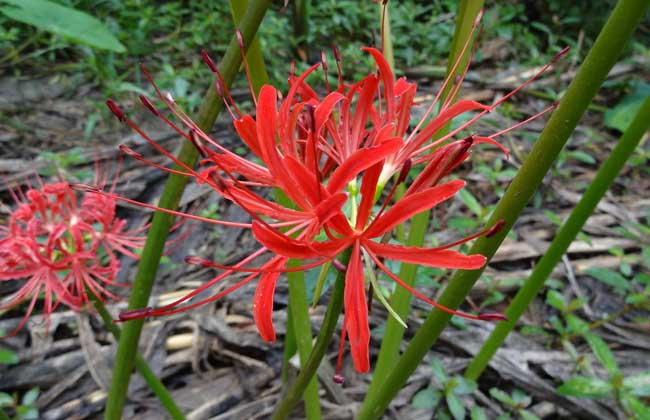
The red spider lily is native to China and Japan. "It blooms for a thousand years and falls for a thousand years; flower and leaf never meet. Love is not ruled by cause and effect; fate decrees life and death." This is the best expression of the red spider lily's flower meaning. There is also a poignant legendary story behind the flower meaning of the red spider lily. Let's take a look together below!
The flower meaning of the red spider lily
The flower meaning of the red spider lily carries a sorrow that is hard to face directly. In China, the flower meaning of the red spider lily is graceful and pure, but it also represents separation, heartbreak, ill omen, and the beauty of death. In Japan, the flower meaning of the red spider lily is sad memories. In Korea, the flower meaning of the red spider lily is mutual longing.
The legend of the red spider lily
According to legend, long ago there were two people named Bi and An, and Heaven decreed that they could never meet. They cherished each other in their hearts and admired each other. Finally one day, disregarding Heaven's decree, they secretly met. As the saying goes, hearts connected understand each other with a single touch. After they met, Bi discovered that An was a woman as beautiful as a flower, and An likewise discovered that Bi was a handsome and elegant young man. They felt like old friends at first sight, love arose in their hearts, and they pledged a lifelong union, deciding to stay together forever, life after life.
The outcome was destined, because they violated the heavenly laws, and this love was ultimately mercilessly strangled. The heavenly court sent down punishment and laid upon them an extremely vicious curse: since they had defied the heavenly laws to meet in secret, they would be turned into the flower and the leaf of a single plant. But this flower was very strange: when there is a flower, no leaf is seen; when a leaf grows, no flower is seen. Life after life, flower and leaf always miss each other.
Legend says that after countless cycles of reincarnation, one day the Buddha came here and saw a flower on the ground with extraordinary bearing, bewitchingly red like fire. The Buddha came before it and observed it carefully, and with a single glance he saw the mystery within. The Buddha was neither sad nor angry. He suddenly threw back his head and laughed three times toward the sky, reached out, and pulled the flower from the ground. Holding the flower in his hand, the Buddha said with emotion: "In your previous life you longed for each other but could not meet; after countless cycles of reincarnation, you loved each other but could not stay together. So-called partings and reunions are nothing but the arising and ceasing of karmic conditions. You bear the heavenly court's curse, which lets your fate end yet keeps you from scattering, lets your fate cease yet keeps you from separating. I cannot undo this vicious curse for you, so I will take you to the other shore and let you bloom all over that place."
On the way to the other shore, the Buddha passed the Sankha River in the underworld and accidentally got his clothes wet with its water, and that was exactly where the red flower the Buddha was carrying was placed. When the Buddha reached the other shore and opened the clothes wrapping the flower to look again, he found that the fiery red blossom had turned pure white. The Buddha pondered for a moment, then laughed greatly and said: "Great joy is not equal to great sorrow; remembering is not equal to forgetting. Right and wrong, how can they be divided? Good flower, good flower." The Buddha planted this flower on the other shore and called it Mandarava, and because it was on the other shore, he also called it the other-shore flower.
But the Buddha did not know that on the Sankha River, the flower whose color had been stripped away by the river water had dripped all its red into the river, wailing ceaselessly all day long, making all who heard it grieve. Ksitigarbha Bodhisattva had extraordinary supernatural powers. Learning that Mandarava had already been born, he came to the riverbank, took out a seed, and threw it into the river. Before long, a flower even more brilliantly red than before grew from the water. Ksitigarbha took it in his hand and sighed: "You escaped and attained great freedom. Why leave this boundless hatred in a hell already boundless as a sea of suffering? I will make you a guide who receives and leads them toward reincarnation. Just remember this one color of yours. The other shore already has Mandarava, so I will call you Manjusaka."
From then on, there were two completely different kinds of red spider lily in the world: one growing on the other shore, and one growing by the Sankha River. It is said that many years later, there were two people in the world who loved each other very much. But one year, when the man went out to handle affairs, he unfortunately met with disaster. He came to the bank of the Sankha River, saw blood-red filling his eyes, and felt grief beyond measure. He cried bitterly: "I do not want reincarnation. I want to go back and find my wife. She is still at home waiting for me." He stumbled to Meng Po. Before drinking the soup of forgetting, he asked Meng Po why, among all things in the world, this soup alone made people forget love. Meng Po smiled and said nothing, only urging him to drink quickly. He stared blankly at the soup and said: "Everyone must forget love, but I refuse to forget. After reincarnation, I will go find my wife."
After the man's wife learned of his death, she was overwhelmed with grief and tried several times to kill herself, but each time the man's family saved her. In the end, the woman promised not to seek death again, but said she would remain widowed for life. The man's family, firstly seeing her fierce character and fearing that bringing up old matters would only wound her again, and secondly respecting her devotion, temporarily agreed with her, planning to persuade her to remarry once her emotions had stabilized. Thus the woman continued to live in the man's home, supporting herself by sewing and mending.
It is also said that after this man was reincarnated, he truly was born again in the small town where he and the woman had lived together. Time flew by, and before anyone realized it, twenty years had passed. One day he went out and passed by the gate of the woman who had remained widowed. He felt strange in his heart, so he stopped and took a look. That one look mattered little, for the woman happened to see him face to face. After reincarnation, the man's appearance and temperament had completely changed, but as soon as the woman saw him, tears streamed down. She walked up to him and said one sentence: "You came to find me." Then she fainted to the ground. When the man saw an unknown old woman collapse before him, he was so frightened that he hurriedly fled that place.
Later this woman became gravely ill and could not rise from her bed. Before she died, she said something over and over, but her voice was too small and no one ever heard it clearly, so no one paid attention. In the end the woman shed two lines of bloody tears and died. When the woman came to the underworld and saw Meng Po, she suddenly asked her very softly: "Old woman, was there once a man here who told you he would not forget me and would definitely come back to find me?" Meng Po nodded. The woman's heart ached terribly, and choking with sobs she said: "Then why, when he came back, was he unwilling to acknowledge me? Even if he had said one word to me, even if he had come to see me before I died, that would have been good." Meng Po patted her shoulder and said: "You loved each other deeply, and I admire your courage. How about this: twenty years from now, at the moment the answer arrives, I promise to let you see it. But before that you cannot reincarnate and must suffer here for twenty years. Are you willing?" The woman said: "I am willing. If I do not see that answer, I cannot let go of my love for him. Even if I am reborn, my heart will ache for a lifetime." So this woman was arranged by Meng Po to weed the red spider lilies. In truth there were no weeds to pull, but in the woman's eyes the whole bank was weeds, and no matter how she pulled them they grew again, never finished. And so day after day, year after year.
Twenty years later, Meng Po brought her to the gate of reincarnation and said: "Stand here and watch, but do not speak. The person you waited twenty years for is coming." The woman was so agitated she could hardly stand. After much effort she calmed her emotions and stood there nervously waiting for the one she loved to appear. At last he walked over. It turned out he had fallen ill, had not been cured, and had died again in his early forties. He walked up to her and Meng Po. Meng Po handed him the water of forgetting. He took it and was about to drink. The woman grew anxious and said: "Have you forgotten what you said?" The man glanced at her, drained the water in the bowl in one gulp, and then walked into the gate of reincarnation.
Meng Po looked at the devastated woman and said: What is love? Nothing but a bowl of water. You drink it too. Whether you can forget is not for you to decide. There is this life, but no next life. Even if you remember, if he has forgotten, how is that different from truly forgetting?