What are the growth habits of the red spider lily? A detailed explanation
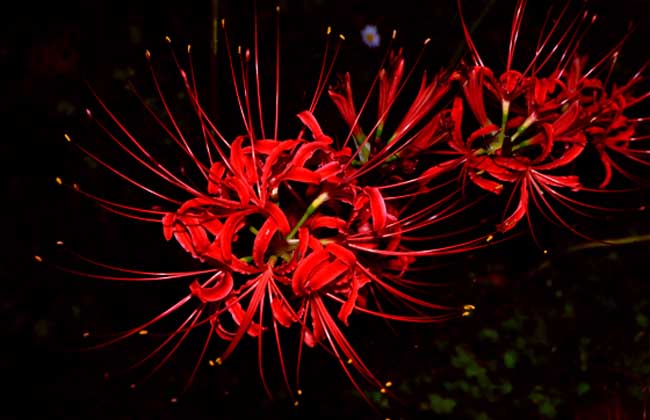
The red spider lily is a perennial herbaceous plant in the Amaryllidaceae family, genus Lycoris, native to the Yangtze River basin in China. It is currently widely distributed across various parts of East Asia, growing wild on shaded, damp hillsides and along stream banks, and is also cultivated in gardens. It has high horticultural value. Let's take a look together at the growth habits of the red spider lily!
The growth habits of the red spider lily
Wild varieties grow in dark, damp places, and their growing sites are red soil. Therefore, they have strong cold resistance and prefer shade. The maximum high temperature they can tolerate is a daily average temperature of 24°C. They like moisture but are also drought-tolerant, and are accustomed to slightly acidic soil, with loose, fertile humus soil being the best. They have a summer dormancy habit and are extremely easy to propagate. Usually, a single Lycoris radiata can easily spread into a patch.
The flowering time of the red spider lily
The three days around the spring equinox are called the spring equinox Higan, and the three days around the autumn equinox are called the autumn equinox Higan. The red spider lily blooms during the autumn equinox Higan period, very punctually, which is why it is called Higanbana.
The origin and distribution of the red spider lily
The red spider lily is distributed in Shandong, Henan, Anhui, Jiangsu, Zhejiang, Jiangxi, Fujian, Hubei, Hunan, Guangdong, Guangxi, Shaanxi, Sichuan, Guizhou and Yunnan in China, and is also distributed in Japan.