How to prevent and control pests and diseases of white champaca (Michelia alba)? A detailed guide to practical control techniques
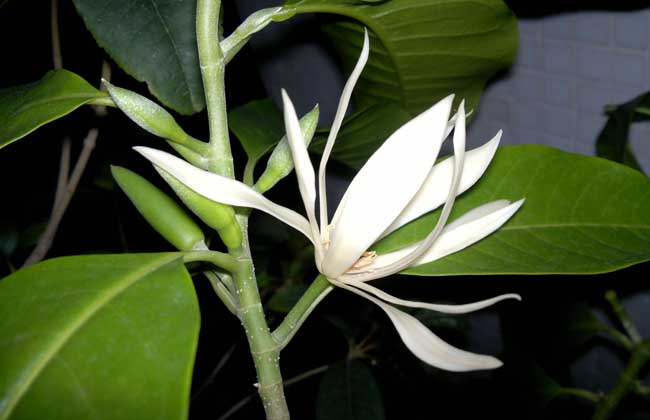
The white champaca plant grows upright with branches, elegant and poised. It originated in Java, Indonesia, and is now widely planted in Southeast Asia. It is cultivated extensively in China's Fujian, Guangdong, Guangxi, Yunnan and other provinces and regions, while in the provinces and regions of the Yangtze River basin it is mostly grown in pots. It can also serve as a spice and for medicinal use. Let's take a look below at the pest and disease control techniques for white champaca during the growing process!
Red wax scale
[Damage characteristics] The nymphs and adults of red wax scale pierce and suck the sap of ornamental plants. Their excrement often induces sooty mold, causing a layer of black mold or a thicker black film to form on the leaves, turning the whole plant into a black tree. The plant becomes weak and rarely blooms or cannot bloom at all.
[Control methods] (1) In winter and early spring, remove some heavily infested branches while pruning. (2) If the affected ornamental plants are few or short, they can be removed by hand in winter and spring. (3) During the peak hatching period of nymphs, spray 25% phosmet emulsifiable concentrate at 1000 times dilution, or 40% omethoate emulsifiable concentrate at 1500 times dilution, once every 4-6 days, for 3 consecutive sprays. (4) When introducing ornamental seedlings, carry out strict quarantine to prevent bringing in the pests.
Red spider mite
[Damage characteristics] Red spider mites pierce their mouthparts into the leaves to suck sap, destroying chlorophyll. The leaves show grayish-yellow spots or patches, turn orange-yellow, fall off, and may even drop completely.
[Control methods] (1) Soak citrus peel in 10 times its volume of water for a whole day and night, filter, and spray the plants. (2) Mix 15 g of washing powder, 15 mL of 20% caustic soda, and 7.5 kg of water, then spray the plants. (3) Add 50 g of plant ash to 2.5 kg of water, stir thoroughly, soak for two days and nights, filter, then add 3 g of washing powder and mix well before spraying, once a day for 3 consecutive sprays, then after 1 week spray 3 more times, which can eliminate the second generation of pests; putting it into the soil can control maggots. (4) Light 1 mosquito coil and place it in the pot of the affected plant, then tie the whole pot tightly in a plastic bag; after 1 hour of fumigation, the eggs and adults can be killed.
Cicada
[Damage characteristics] The nymphs of cicadas suck sap from the roots of ornamental plants in the soil, while the adults pierce and suck sap from the main leaves. The female inserts her ovipositor into branches to lay eggs, causing the branches to wither and die.
[Control methods] (1) Kill the mature nymphs that have just emerged from the soil in time. (2) If the infestation is severe, light a fire near the trunk on hot summer nights, shake the branches to make the cicadas fly into the fire and be killed, and kill the cicadas that fall outside the fire pile. (3) Apply sticky tung oil or a sticky ball kneaded from spider webs to the end of a bamboo pole to catch the adults. (4) From April to August, inspect promptly and prune out egg-laying branches.
Cottony cushion scale
[Damage characteristics] Cottony cushion scale often gathers on leaf buds, tender buds, and new shoots to cause damage. When the infestation is severe, the leaves turn yellow, causing defoliation and shoot withering, and even entire branches or the whole plant die. Even if some branches remain, their excrement causes sooty mold, leaving them gray-black and seriously affecting ornamental value.
[Control methods] (1) Manual control: use hands or tweezers to remove female insects and egg sacs, or prune off heavily infested branches and leaves. (2) Biological control: introduce natural enemies such as the vedalia beetle and the Australian ladybird to prey on cottony cushion scale. (3) Chemical control: during the dispersal period of newly hatched nymphs, spray 40% omethoate at 1000 times dilution, or 50% fenitrothion at 1000 times dilution, or ordinary washing powder at 400-600 times dilution, once every 2 weeks, for 3-4 consecutive sprays.
Anthracnose
[Symptoms] Dark brown circular or nearly circular lesions appear on the leaves, with slightly darker edges. After expansion, the center gradually becomes grayish-white, with a size of 2-8 mm. Later, small black granules, which are the pathogen's acervuli, appear on the lesions. When humidity is high, orange-yellow sticky substance, the pathogen's conidial mass, oozes from the lesions. The disease is severe in rainy and humid weather.
[Control methods] In the early stage of the disease, spray Bordeaux mixture at 1:1:100, or 25% carbendazim at 500 times dilution, or 70% thiophanate-methyl at 600 times dilution.
Chlorosis
[Symptoms] It first appears as loss of green color in young leaves on tender shoots, then spreads from top to bottom and from leaf margins to the leaf base. After the leaf margins lose green color, it gradually spreads to the mesophyll tissue, causing the interveinal tissue to fade. As it continues to develop, the veins also lose green color, turning the leaves milky yellow to milky white. In severe cases, the leaf margins scorch, and even the whole leaf dries up and falls off. If 1-year-old seedlings are affected, their height is shorter than normal plants; if 3-4-year-old young trees are affected, they turn completely yellow and are about 30 cm shorter than generally healthy ones. Chlorosis causes slow plant growth, shortened internodes, and symptoms such as dieback of shoots.
[Control methods] (1) Bury ferrous sulfate the size of a mung bean under the cortex at the base of the seedling, then wrap it with plastic film to help the wound heal. (2) Dig a trench and apply ferrous sulfate, add decomposed cake fertilizer, and cover with soil. (3) On sunny mornings before sunrise or after 4 p.m., spray the leaves with 0.5% ferrous sulfate aqueous solution or 500 times dilution of a yellow-leaf quick-green plant antiviral compound nutrient solution, at intervals of about 7-10 days.