How to Grow Tulips? Detailed Guide to Planting Methods and Care Tips
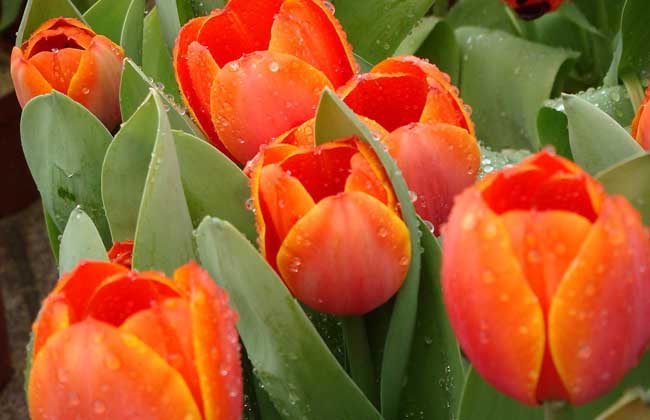
Tulips are perennial bulbous flowers of the genus Tulipa in the lily family. Everyone is familiar with them; they are generally planted to form overall blocks of color for viewing. Medium and dwarf varieties of tulips can be grown in pots. Because of their elegant appearance and pure flower colors, they are deeply loved by people and are an important early-spring ornamental garden flower. However, many people do not know how to grow tulips. Let's take a look together below!
How to Select Tulip Bulbs
1. Choose pure varieties, large bulbs free of pest and disease damage and free of injury, because bulbs are required to have a circumference of more than 8 cm; 6 cm bulbs will not bloom, and 6-8 cm bulbs give no guarantee of blooming. Bulbs can be divided into four grades by circumference: grade one is 12 cm or more (diameter 3.8 cm or more), grade two is 11-12 cm (3.5-3.8 cm), grade three is 10-11 cm (3.2-3.5 cm), and below 10 cm (below 3.2 cm) is substandard.
2. Dark-colored bulb skins indicate red varieties, while light-colored ones indicate pale yellow or white varieties. You should also ask clearly whether they are imported bulbs or domestically produced bulbs, and whether they are room-temperature bulbs or low-temperature bulbs. Room-temperature bulbs are bulbs that have not undergone low-temperature treatment; after planting, they go through a natural low-temperature period, and the flowering period is from mid-to-late March to early April.
Tulip Bulb Planting Methods
1. Low-temperature treatment: Place the bulbs in a refrigerator at 4°C-9°C for cold storage, then take them out to plant after two months, or plant them directly in a pot and place the pot in the refrigerator. Prepare a flower box about 70 cm long or a 5-inch flower pot.
2. Soil selection: It is best to use all peat soil.
3. Planting density: A long flower box can hold two rows of five bulbs each, planted with a spacing of 8 cm between each bulb, while a 5-inch pot can hold three bulbs.
4. Planting method: When planting, place the pointed, protruding part of the bulb facing up, and place the flatter side facing the same direction, so that the leaves will grow in a neat direction and the leaves will also be more attractive. After planting the bulbs, cover with soil and level the surface, use slow-release fertilizers such as Osmocote and Magamp as base fertilizer, and water thoroughly.
Tulip Care and Management Methods
1. Soil: Tulips require planting soil that both retains water and breathes well, with salinity that is not too high and soil that is not too acidic. The pH value should be no less than 6. Using peat, decomposed soil and sand mixed at 1:1:1 as the cultivation substrate gives better results.
2. Sunlight: Sufficient sunlight exposure is essential for the growth of tulips. Insufficient light will cause poor plant growth, bud drop, weakened plants, lighter leaf color and a shortened flowering period. However, within more than half a month after tulips are potted, they should be properly shaded to help the bulbs develop new roots. In addition, during germination, the elongation of flower buds is inhibited by light; after shading, the elongation of flower buds can be promoted, preventing excessive vegetative growth and spindly growth in the early stage. After seedlings emerge, light should be increased to promote stem elongation, the formation of flower buds and coloring. In the later stage, after the flower buds are fully colored, direct sunlight should be prevented to extend the flowering time.
3. Temperature: Tulips prefer a climate with warm winters and cool summers, with an optimum growth temperature of 9-13°C. They are highly cold-tolerant and can withstand low temperatures of -35°C in winter.
4. Watering: After planting, water thoroughly so that the soil and bulbs can fully bind closely together, which helps rooting. After sprouting, watering should be properly controlled. When the leaves gradually elongate, water can be sprayed on the leaf surface to increase air humidity. During the flower stem elongation stage and bud stage, a sufficient water supply must be ensured to promote full flower development. After flowering, watering should be properly controlled.
5. Fertilizing: Tulips do not have high fertilizer requirements. If growth vigor is weak, some nitrogen fertilizer can be applied. After the root system develops well, apply 2 kg of calcium nitrate per 100 sq m, broadcast in three applications with an interval of more than one week between each.
6. Pests: The pathogens of tulip pests and diseases can be carried by bulbs and can also infect bulbs through the soil, mostly occurring in high-temperature and high-humidity environments. The main diseases include stem rot, soft rot, color breaking, damping-off and blind buds, while the main pest is aphids. Carry out thorough soil disinfection before planting, choose virus-free bulbs for cultivation as much as possible, promptly dig out and destroy diseased plants when found, and apply fungicide 1-2 times during greenhouse growth for better results; maintain good ventilation to prevent high temperature and high humidity; when aphids occur, spray with 3% natural pyrethrum at 800 times dilution.