Detailed Explanation of the Key Technical Points for Marigold Pest and Disease Control
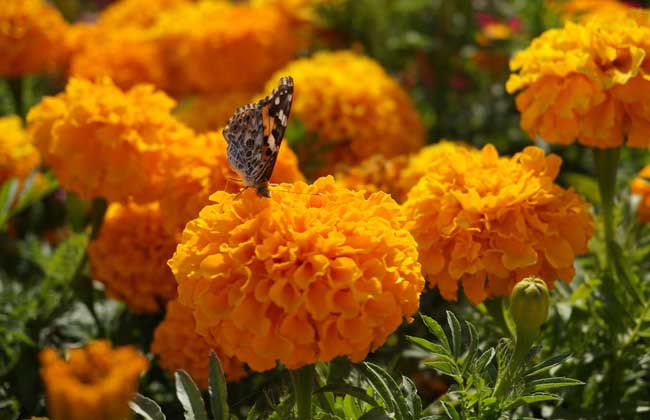
Marigolds have relatively few pests and diseases, mainly damping-off, black spot, powdery mildew, slug moths, scale insects and other pests and diseases. In the control process, one must adhere to the principle of giving priority to prevention, with prevention being more important than cure, and carry out timely control. Now let us take a look at the pest and disease control techniques for marigolds!
Black Spot
[Disease characteristics] Black spot mainly attacks leaves, petioles and young shoots. When the leaves first become diseased, small purplish-brown to brown spots appear on the upper surface, which after expanding are mostly round or irregular dark brown lesions.
[Control method] Spraying with carbendazim, thiophanate-methyl, daconil and other agents is effective.
Powdery Mildew
[Disease characteristics] Powdery mildew attacks young leaves, with white powdery material appearing on both sides. Early symptoms are not obvious. After the powdery layer appears for 3--5 days, the leaves become water-soaked, gradually lose green color and turn yellow, and in severe cases cause leaf drop.
[Control method] Spraying carbendazim or triadimefon during the disease period is sufficient, but Guoguang Yingna has the best effect.
Leaf Blight
[Disease characteristics] It mostly invades from leaf tips or leaf margins, initially as small yellow spots, then rapidly expanding inward into irregular large lesions. In severely affected leaves, the withered area reaches 2/3 of the whole leaf. The diseased parts fade green and turn yellow, then turn brown, dry up and fall off.
[Control method] Integrated control should be adopted when the disease occurs, and fungicides such as carbendazim and thiophanate-methyl should be sprayed.
Slug Moths
[Damage characteristics] Mainly the larvae of the yellow slug moth, brown-edged green slug moth, beautiful brown slug moth, mulberry brown slug moth and flat slug moth, which feed heavily on leaves during high-temperature seasons.
[Control method] Once discovered, immediately spray with 90% trichlorfon crystal at 800 times dilution, or with 2.5% fenvalerate EC at 1500 times dilution.
Scale Insects
[Damage characteristics] Mainly white wax scale, Japanese wax scale, red wax scale, brown soft scale, cottony cushion scale, chaff scale, snake-eye scale, etc. Their damage is characterized by piercing and sucking the sap of young stems and young leaves of marigolds, resulting in poor plant growth. It is mainly induced by high temperature and high humidity, poor ventilation and insufficient light.
[Control method] During the peak hatching period of the nymphs, spray with 25% buprofezin wettable powder at 2000 times dilution.
Aphids
[Damage characteristics] Mainly the marigold tube aphid, green peach aphid, etc. They pierce and suck the sap of young and tender organs of the plant, damaging young stems, young leaves, flower buds, etc., seriously affecting plant growth and flowering.
[Control method] Promptly spray with 10% imidacloprid wettable powder at 2000 times dilution.
Rose Three-Segmented Sawfly
[Damage characteristics] Mostly in the larval stage, dozens or more than a hundred gather in groups to cause damage, and in a short time can eat all the young leaves of the plant, leaving only a few main veins, seriously harming the normal growth of the plant.
[Control method] For a small number of potted plants, when they first appear, pick off the leaves on which large numbers of larvae have gathered and crush them underfoot. If they appear in large numbers, spray with 75% phoxim EC at 4000 times dilution.
Carmine Spider Mite
[Damage characteristics] It can occur 10 to 15 generations a year. Adult mites, young mites and nymphs gather on the underside of leaves to pierce and suck, causing damage. Eggs are mostly laid on both sides of the veins on the underside of leaves or under gathered fine silk webs. Each female mite can lay 50 to 150 eggs, up to 500 at most. The time to complete one generation is only 10 to 13 days at temperatures of 23°C to 25°C, and about 7 to 8 days at 28°C. It breaks out severely in hot and dry seasons, often causing large numbers of dense small white spots on the upper surface of leaves, with the underside turning yellow and occasionally bearing blighted spots.
[Control method] Once discovered, promptly spray with 25% fenbutatin oxide wettable powder at 2000 times dilution.
Scarab Beetles
[Damage characteristics] Mainly the copper-green scarab, black velvet scarab, white-spotted flower scarab, small green flower scarab, etc. Adults often chew on new leaves, young shoots and flower buds, seriously affecting plant growth and flowering.
[Control method] Taking advantage of the adults' death-feigning behavior, shake them off in the evening and kill them. Taking advantage of the adults' phototaxis, use black light lamps to trap and kill them. When adults are feeding and causing damage, spray with 50% malathion EC at 1000 times dilution.