What regions is the marigold's place of origin distributed in?
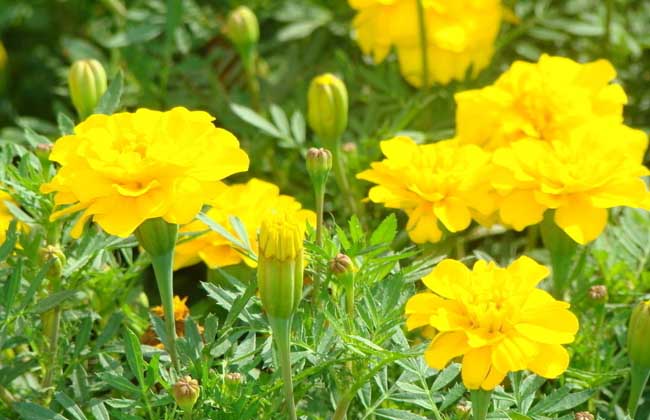
Marigold is an annual or biennial herbaceous plant of the genus Tagetes in the Asteraceae family, native to Mexico. It is a warm-season plant that prefers a warm climate with ample sunlight and tolerates transplanting. It is cultivated throughout China. Let's take a look at the distribution of the marigold's place of origin below!
The distribution of the marigold's place of origin
Marigold is native to Mexico and Central America and is cultivated throughout China. In Guangdong and southern and southeastern Yunnan it has become naturalized (naturalized: refers to a plant that, after arriving in a new environment, can survive well and continue to reproduce without undergoing natural selection), as well as in southwestern Henan (Neixiang County).
The environment of the marigold's place of origin
Marigold prefers warmth and sun, but can tolerate light early frost and partial shade. It has strong resistance, is not demanding about soil, tolerates transplanting, grows quickly, is easy to cultivate, and has few pests and diseases. It can grow in areas at altitudes of 1,150 m to 1,480 m, mostly on roadside meadows.
Marigold variety characteristics
1. "Discovery" series: The Discovery series marigolds have a full plant form and are dwarf, with potted plants 15-20 cm tall and field-grown plants 22.5-25 cm tall. Under long-day conditions they bloom earlier, have a long flowering period, and bear compact, spherical, fully double flowers 7.5 cm in diameter, with dark green, narrow, elongated leaves and rich flower colors. This series is known for its flower colors and plant form, is suitable for pots and flower beds, and has good heat tolerance and lodging resistance. Colors include orange and yellow.
2. "Antigua" series: The Antigua series marigolds can bloom in 60 days no matter when they are sown, and can be sold after 8 weeks in bags. Potted for 10 weeks, the plants are neat and uniform and can cover the entire pot. They also perform well when grown in open garden beds. Potted plants are 25-30 cm tall, and field-grown plants are 32.5-40 cm tall, with abundant flowers that are all double, in four colors: gold, orange, yellow, and pale yellow.
3. "Inca" series: The Inca series marigolds have large flowers reaching 10-12.5 cm in diameter, with a flowering period that lasts the entire summer. They are double, early-flowering, and continue to open after other marigolds have faded, with a plant height of 35 cm and beautiful, dark green leaves that give a clear and tidy effect. The plant form and flowering period are uniform, and they can tolerate high temperatures of 32-38 °C, making an excellent display in flower beds. 12-15 cm, plant 3 plants per pot; 10 cm, plant 1 plant per pot. Colors include orange, yellow, and gold.
4. "Fulness" series: The Fulness series marigolds are 30-35 cm tall and bloom about 10 days later than Discovery and Antigua. They have a long flowering period and many flowers that are fully double, with compact flower heads 9 cm in diameter. They grow better in hot, humid summers and are especially suitable for field-grown flower beds and can also be used for garlands. Colors include orange, gold, and yellow.
5. "Sweet Cream" series: The Sweet Cream series marigolds are an improved variety of the old "Drifting Snow" series, opening pleasing creamy-white flowers. They have good growth habits and a neat plant form, with a plant height of about 41 cm and full flowers 6-9 cm in diameter, requiring only 11 weeks from sowing to sale. They are very suitable as flower bed and edging plants, and also suitable for mixed planting with other plants.
6. "Gold Coin" series: The Discovery Gold Coin series marigolds can be harvested in 6-8 weeks under short-day conditions, with 70-100 flowers per plant and a plant height of 90-100 cm. The flower diameter depends on day length, water, temperature, nutrients, spacing, fertilizer, and growth regulators, and can reach 13 cm under suitable conditions. Using growth regulators can make the plants strong with good branching, promote more flowers, and regulate leaf color to turn green. This series is mainly used for cut flowers and garlands, and is cultivated on a large scale in Vietnam, Thailand, and southern China. There are four colors, each with a rather distinctive name.