When do peonies bloom? An introduction to the peony blooming period
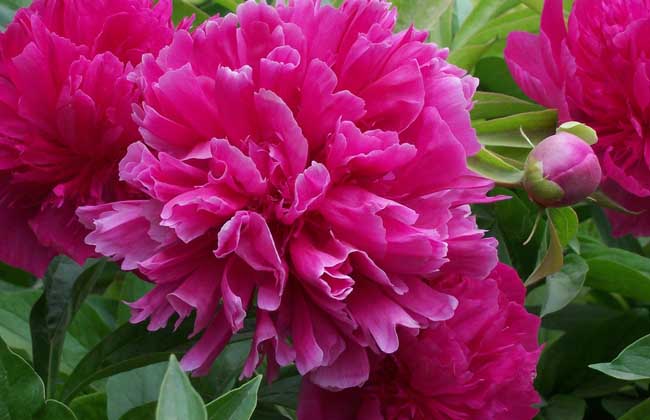
In the late Qing Dynasty, the peony was once regarded as China's national flower. The peony is also praised as the second of China's ten famous flowers. It is a precious woody flower unique to China, with thousands of years of natural growth and more than 1,500 years of artificial cultivation history. Many people do not know when peonies bloom, so let's take a look together below!
When do peonies bloom?
Like other flowers, peonies bloom in spring and summer. They generally bloom in April to May, with the flowering period in May and the fruiting period in June. If you want to admire peony flowers, be sure not to miss the timing.
How can the peony blooming time be extended?
1. Prevent wind damage: When peonies bloom, it is the windy season in the north. Because their flower diameter is generally 15 cm to 25 cm, they are prone to being top-heavy. Therefore, after blooming, if strong winds occur, the branches are very easily broken, and strong winds also easily damage the delicate petals, causing a "dry edge" phenomenon. Therefore, during the peony blooming period, they must be placed in a sheltered place, and the flowering branches should also be supported with thin wooden sticks.
2. Sufficient light: Peonies need sufficient light during the blooming period. If light is insufficient, besides the branches being prone to leggy growth and the leaves being small and yellowing, the leaves also cannot carry out photosynthesis normally, so the flowers cannot obtain enough nutrients. Not only will the flowers produced be small, but the flower color will not be vivid and there will be no fragrance.
3. Appropriate amount of water: Peonies need more water during the blooming period than usual. Although spring temperatures are not high, it is windy and water evaporates relatively quickly, so giving the plant sufficient water is very necessary. According to the author's experience, during this period the potting soil should be kept moist (but not waterlogged). When the potting soil is half dry, it should be watered. Usually, in sunny weather with high temperatures and sufficient light, water should also be sprayed on the plant leaves, but it must not be sprayed on the flowers, otherwise the flowers will easily fade earlier.
Peony blooming period management methods
1. Cold protection: In the middle reaches of the Yellow River, peonies sprout in early February. Because the early spring climate is changeable, they are easily harmed by cold waves and late frost, so special attention must be paid to cold protection work. Potted peonies should be moved to a sheltered, sunny place. Ground-planted peonies are best protected with a straw shed, or before frost, damp firewood and grass can be lit to produce smoke to prevent frost.
2. Bud thinning: Peony blooming is similar to fruit trees bearing fruit, and there is also a "biennial bearing" phenomenon. After buds become visible, appropriate bud thinning should be carried out according to the tree's vigor and the previous year's blooming situation. If there are many buds that year, it can be regarded as an "on year", and a portion of the smaller, lower buds should be removed (about one third). Bud thinning work should be done earlier rather than later.
3. Pre-bloom foliar topdressing: After peonies unfold their leaves, because photosynthesis intensifies, the leaves have a certain ability to absorb fertilizer. At this time, 0.1%-0.2% monopotassium phosphate can be used for foliar fertilizer spraying. If it can be sprayed 2-3 times before blooming, the buds can become fuller and larger, and the flowers will bloom more vividly.
4. Watering: In the north, spring is dry with little rain. In addition to watering once in early March, before blooming (early April) a thorough watering should also be given again. Near the blooming period, watering should be stopped. Do not spray water on the leaves or flowers, otherwise the blooming time will be shortened and the flowers will quickly wither.
5. Shading: When peonies bloom, they should avoid strong wind and harsh sun. To extend the blooming time, when the buds first begin to open, thin white cloth should be used to shade them (do not use colored cloth or printed cloth). This can extend the blooming period by 4-7 days.
6. Cut off spent flowers: After peonies finish blooming, spent flowers should be cut off in time. This not only avoids a "declining" scene, but also reduces nutrient consumption. Some single-petal varieties easily set seed. If it is not for hybrid seed collection, their flowers should also be cut off in time.
7. Fertilizing after blooming: Because peony blooming consumes a large amount of nutrients, pre-bloom foliar topdressing alone is far from enough to replenish them. After blooming, a relatively large amount of fertilizer must be applied to make up for it. For fertilizing, it is best to use fully decomposed mixed fertilizer of the three cakes (sesame cake, soybean cake, cottonseed cake or rapeseed cake). The fertilizing amount should be determined according to the size of the plant. When fertilizing, keep a certain distance from the root crown and open a ring-shaped shallow trench about 15 cm deep for application. Immediately after application, water thoroughly.
8. Leaf disease prevention: After peonies bloom, their resistance to disease weakens, and brown spot disease easily takes advantage of the opportunity. To protect the leaves from disease, after blooming, Bordeaux mixture or 200-fold carbendazim suspension can be sprayed once every 7-10 days, for 2-3 consecutive sprays. In this way, the leaves can suffer less damage throughout the year, allowing photosynthesis to proceed normally and accumulating more nutrients for the next year's blooming.