What is the flower language of agave? Let us take you through its legend
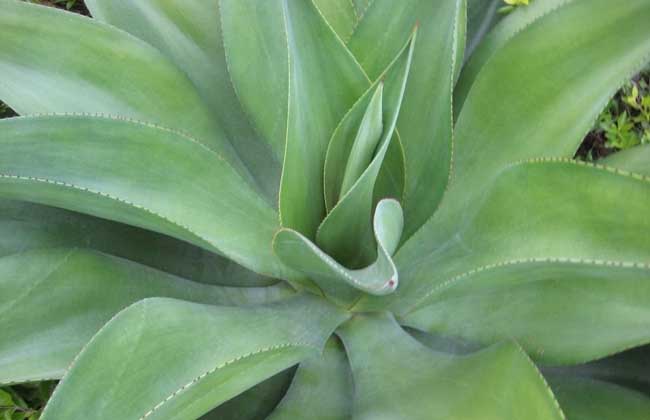
Agave, also known as dragon-tongue palm and sisal hemp, is a perennial evergreen large herbaceous plant of the genus Agave in the family Agavaceae, native to tropical America. Do you know what the flower language of agave is? There is a legend about the flower language of agave. Let us take a look together below!
What is the flower language of agave
The pain of parting and separation, giving everything for love.
Agave dies after blooming
The agave blooms only once in its life, usually between 10 and 25 years, although some species may take as long as 100 years to bloom, which is still very rare. The huge inflorescence can reach 7 to 8 m tall, the longest inflorescence in the world, with as many as several hundred white or pale yellow bell-shaped flowers. After blooming, the plant withers and dies.
The reason the agave dies right after flowering is that the process of flowering and fruiting consumes too much energy, so much that it cannot sustain its own life. The agave dies as soon as it blooms, and is therefore called the “century plant” and the world's “rarest flower”. Most agaves bloom only once in their lifetime, and only a few species can survive after flowering.
The legend of agave
Before the Spaniards discovered the American continent, a tribe already lived in the plateau region around Mexico City. They were gentle by nature and peace-loving, but if another tribe invaded them, they would never show weakness and would fight back with all their strength.
But the last gentle chief also passed away. After his son Metemoc ascended the throne, the situation changed: the new chief wanted to conquer other tribes by force! There was a neighboring tribe, and the chief of this tribe had a beautiful daughter. One day, Metemoc sent a messenger to see the chief of the neighboring tribe, asking to take his daughter as his wife. But the news the messenger brought back greatly disappointed Metemoc.
Metemoc felt greatly insulted by this, so he launched war against this tribe. He led all the men, carrying bows, arrows and spears, and captured the tribe in one night.
From then on, they became savage and warlike, spreading the flames of war in all directions. Everywhere they went, everything was razed to the ground. Metemoc was highly skilled in martial arts and, moreover, brave and adept at fighting, and before long all the tribes were under his rule.
One day, Metemoc said to his subordinates: “I heard there is a prosperous tribe on the high mountains in the north. The tribe's chief has a beautiful daughter, and I want to marry her as my wife. If he does not agree to this request, we will go to war against him.”
Metemoc led his soldiers northward. At night, they came to an open clearing in the forest and set up camp there. While inspecting the camp, Metemoc looked up and saw a bright moon hanging high in the sky, with all around in silence. In the dead of night, he began to look back on his past military career. A feeling of unease tormented him, and he felt deeply guilty about his past atrocities. At that moment, a breeze passed through the treetops, and a white light shone toward him. He felt dazzled, his hands and feet bound, and before he knew what had happened, a voice sounded: “Metemoc, where are you leading your tribe?”
The young chief looked up into the distance and saw the Moon Goddess appearing before him, riding on blue light. The Moon Goddess said: “You have done much evil, destroyed so many beautiful fields, and killed so many kind people. Now you want to force a beautiful girl to be your wife. Do you not know who could love such a cruel person as you?”
Metemoc was very uneasy when he heard this. He suddenly fell to the ground and cried out: “Ah, no one will forgive me!” Then the Moon Goddess disappeared into the pitch-black night sky. When the soldiers saw that their chief looked dazed, they all gathered around. After a while, Metemoc came to his senses and said to the soldiers: “I am fine. All of you go and rest!”
The next day, Metemoc said solemnly to the soldiers: “I have made up my mind. I will never wage war again. After negotiating with the chief of this mountain tribe, we will return home at once. Even if he is unwilling to marry his daughter to me, I will not attack them.”
The soldiers were all very surprised to hear this. In fact, the vast majority of people in the tribe did not like this kind of expedition and hoped to return home as soon as possible.
The chief of the mountain tribe refused to marry his daughter to Metemoc. Metemoc remembered the words of the Moon Goddess and restrained himself. He also vowed that from then on he would thoroughly reform and become a new person, to make up for his past wrongdoings.
When the chief of the mountain tribe heard his words, he could hardly believe that this savage and cruel man could suddenly become so gentle and modest. He wanted to see Metemoc's actions.
To prove that what he said was true, Metemoc agreed to come again to propose when the seventh month - the Deer Moon - arrived.
After Metemoc led his troops back home, everyone in the tribe found that their chief was completely different from before. Peace returned to the plateau region, the barren fields once again showed a scene full of vitality, and the chiefs of other tribes also shed their fear of him.
When the seventh month - the Deer Moon - came, Metemoc invited priests and sorcerers and chose an auspicious day, preparing to go propose to the chief of the mountain tribe. Metemoc followed the priests joyfully. This was the first time in his life he had taken part in such a ceremony. When the procession reached the altar, torrential rain began to fall from the sky. In an instant, thunder roared, and Metemoc heard a voice say to him: “Metemoc, I am the Water God, sent by the Sun God to speak with you. It is a good wish that you want to make up for your faults, but relying on your own strength alone is not enough.”
Metemoc said: “Please arrange it, O God. What should I do?”
“If you want to become a good person, these years of being alive alone are not enough. Only by following the gods can you do good forever.” Having said this, the Water God vanished. Metemoc suddenly felt his legs sinking into the soil, and his whole body and soul felt an indescribable joy. Under the astonished gaze of the people, Metemoc gradually turned into a beautiful agave.
From then on, agave appeared on the plateau of ancient Mexico. The local Indians used its juice to brew alcohol, used its fibers to weave cloth, and used its branches and leaves to roof their houses.
All people long for peace and detest war, and especially abhor those who start wars to seize the homes of others.
Such people will inevitably be punished, just like the cruel Metemoc. Although he later worked hard to reform, he was still turned into an agave, to be used by people forever, and only then could he redeem his sins.