What is the flower language of azaleas? Interpreting the legend of the azalea
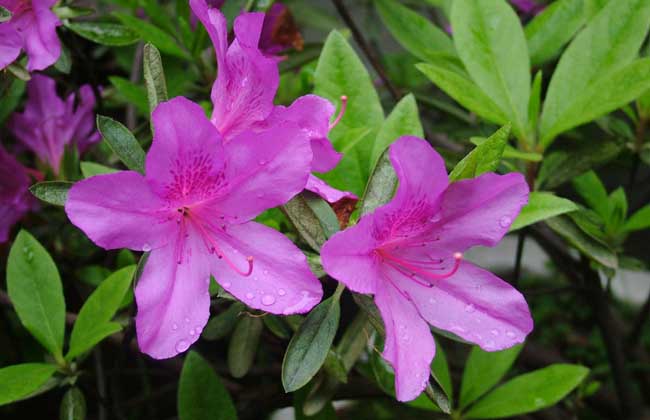
The azalea is praised as the "Xi Shi among flowers," and the great poet Bai Juyi once praised it thus: "Looking back, peach and plum blossoms are all colorless; reflected beside it, even the lotus is no flower." Whenever spring arrives, azaleas bloom in wild profusion across the mountains and fields, and seen from afar it is as if the mountain forests have been dyed and painted with rouge, which is why the azalea is commonly known as "ying Shan Hong" (Mountain-Reflecting Red). Now let us look at the flower language and legends of the azalea!
The flower language of azaleas
The flower language of the azalea is "forever yours," representing the joy of love. It is said that people who love azaleas are pure and innocent, and when they see azaleas blooming all over the mountains, that is the moment the god of love descends.
The azalea's flower language also includes "restraint of desire," and the biggest reason is that it only blooms in its own flowering season, even though azaleas always give people a lively and bustling feeling. When it is not in bloom, its dark green leaves are also very suitable for planting in gardens as a low hedge or screen.
The legend of the azalea
Legend has it that long ago, in a small village in Huanghe Mountain in the southern outskirts of present-day Zhenjiang City, Jiangsu, there was a beautiful river in front of the village that ran all the way to the Yangtze River. The people in the village made their living by farming and hunting.
Two families lived by the river. To the east lived a young man surnamed Liu named Liu Hu. He was sturdy and tall, and whether hunting in the mountains or catching fish in the river, no bird or beast could escape his hands. Moreover, Liu Hu always carried something special with him: a panpipe. Whenever he played it, many beautiful birds of every color would gather and circle above his head. Liu Hu also became good friends with these birds. When he had time, he would catch some small insects to feed them, and the birds would carry some rare flowers and plants to Liu Hu. These rare flowers and plants were all precious medicinal herbs, and Liu Hu often gave these herbs to the poor in the village to treat their illnesses.
Now, on the west side of the river lived a family surnamed Wang, with only a mother and a daughter, the two depending on each other for survival. The mother was blind, and life was inconvenient; they relied entirely on the daughter, Juanzi, who spun yarn, wove cloth, and sold cloth to earn money to support the family. Juanzi was clever, quick-witted, and beautiful, and most importantly, she was skillful with her hands. The cloth she wove was both beautiful and durable, and Juanzi was kind-hearted, often helping families even poorer than her own. Juanzi could also sing, with a mellow voice and moving songs, as melodious as a lark. There was something even more extraordinary: as soon as Juanzi sang, the patches of azaleas at the foot of Huanghe Mountain would open their buds and bloom, every blossom full and every blossom gorgeous.
Liu Hu and Juanzi drank from the same river and lived on the same riverbank. They had been playmates since childhood, innocent and carefree, childhood sweethearts whose hearts were in perfect harmony. They often had one playing the panpipe and the other singing, drawing hundreds of birds to dance and causing the azaleas to bloom.
Juanzi could sing and weave, and she was beautiful besides. People in the surrounding villages all knew of her and praised her. And so it spread from one to ten, from ten to a hundred, until at last it even reached the imperial palace. The emperor was a foolish ruler, immersed in wine and women all day long. He never concerned himself with state affairs and cared only about the annual selection of concubines. As soon as the emperor heard that Juanzi was a great beauty, he could not wait and issued an imperial edict naming Juanzi for selection into the palace.
This threw the county magistrate into a flurry of activity. After the emperor issued the edict, he began scheming: how to use this opportunity to curry favor with the emperor and pave the way for his own career advancement. So the county magistrate led a large group of yamen runners straight to Huanghe Mountain. As soon as they arrived at Huanghe Mountain, birds sang and flowers bloomed everywhere, for it turned out Liu Hu and Juanzi were singing and playing in harmony. The county magistrate rolled his eyes and thought: How strange, this great beauty really does have such skill. If I present her... heh heh, the county magistrate was secretly delighted. So the county magistrate stepped forward and said: "Congratulations! Congratulations! Miss Juanzi, the emperor has chosen you as an imperial concubine. From now on you must..." Before the county magistrate could finish, Juanzi turned and went into the house. Seeing that the soft approach would not work, the county magistrate was ready to use force. The county magistrate ordered several yamen runners to break down the door. Liu Hu, frantic, jumped down from where he was playing the panpipe to protect Juanzi. Then several more yamen runners rushed up, some grabbing his hands, some grabbing his feet, holding Liu Hu tightly, and Liu Hu could only fret helplessly. The door was broken open, and poor Juanzi, frail and with little strength, could not possibly fight off those wolf-like and tiger-like yamen runners; within moments she was seized and dragged out. As she was taken away she cried all along the way: "Liu Hu, save me! Save me!..." Liu Hu, burning with anxiety, could only watch helplessly as Juanzi was taken away.
After Juanzi was taken away, Liu Hu worried every day and every night, and Juanzi's mother cried every day and every night, and her eyes became even blinder. Liu Hu thought to himself: Even if I have to go through fire and water, I will bring Juanzi back. So he filled a whole vat of water for Juanzi's mother, chopped a bundle of firewood, bought a vat of rice, settled Juanzi's mother, and prepared to set off. Early the next morning, Liu Hu packed a small bundle on his back and set out with his beloved panpipe. He crossed ninety-nine and eighty-one mountains, forded ninety-nine and eighty-one rivers, and went around ninety-nine and eighty-one bends, and finally arrived at the imperial city.
Now, after Juanzi was taken to the imperial palace, the emperor was overjoyed the moment he saw her, and said to Juanzi: "I hear you can sing very beautiful songs. Sing one for me!" Juanzi did not open her mouth. He asked again: "I hear you can weave very beautiful cloth. Weave a bolt for me to see!" Juanzi still did not speak. No matter what the emperor said, Juanzi ignored him completely. The emperor then became shameless and pestering, and began to paw at her. Juanzi hated this old emperor to death. It was he who sent people to break into her home, he who tore her and Liu Hu apart. Thinking of this, she seized a stool and smashed it at the emperor's head. The emperor got no advantage at all; instead he was struck until his head was broken and blood flowed, and he fled in terror holding his head. From then on Juanzi neither ate nor drank, and gradually grew so thin she hardly looked human, her face withered and haggard. By then the emperor would not even look at her, let alone care whether she lived or died. And so Juanzi lay in bed waiting for death.
Liu Hu arrived in front of the imperial palace, but he did not know where Juanzi was, much less that she was so ill she was close to death. He was anxious to go in, but after circling the palace once, he saw guards everywhere and high walls everywhere, with no chance at all for him to enter and find Juanzi. In the midst of his worry, his right hand accidentally touched the panpipe, and then he had an idea. He quickly made a kite, tied the panpipe to the back of the kite, and then flew the kite into the sky. As the kite flew up in the sky, the panpipe was blown by the airflow and sounded. So he let out more and more string, and the kite flew above the imperial palace, and the sound of the panpipe reached all the way to Juanzi. Juanzi was lying dazed in bed, and as soon as she heard the familiar sound of the panpipe, she slowly opened her eyes and looked up at the sky through the window. She finally saw the panpipe and knew that Liu Hu had come to find her, so she struggled to sit up and sang a song from her hometown, a song familiar to Liu Hu. The song circled around the garden, circled around the great trees, circled around the palace walls, and as it circled and circled it reached Liu Hu. When Liu Hu heard this mournful and moving song, he was both happy and sad: happy that Juanzi knew he had come to find her, sad that he and Juanzi were separated by layer upon layer of palace walls. The more Liu Hu thought, the sadder he became; the more he thought, the more grieved he became. He could not save Juanzi from her sea of suffering. Though he had traveled through countless mountains and rivers and finally found Juanzi, he could only watch helplessly as she suffered. Liu Hu's heart ached as if cut by a knife.
So Liu Hu leaned against the palace wall and wept. He neither ate nor drank, only stared blankly at the sky, and gradually could not hold on any longer, and afterward he turned into a colorful little bird. The little bird flapped its wings and flew up, leaped over the high palace walls, and flew all the way to Juanzi's side, chirping "zhizhi zhazha" at Juanzi. Juanzi reached out her hand to stroke the little bird and said: "Bird, bird, if only you could carry me away from here!" After saying this she vomited blood, and the blood she spat out turned into one beautiful azalea after another, and Juanzi's body also slowly turned into an azalea. The little bird took this azalea in its beak and flew out of the palace, all the way to the foot of Huanghe Mountain, and planted this azalea at Juanzi's doorstep. From that time on, a beautiful patch of azaleas bloomed there, but the most beautiful plant of all was still the one Juanzi had become. This plant had five petals, and in the center of the flower was a jade-green pearl, called "Five Treasures Green Pearl," and it is a precious variety among azaleas.
Many years later, a temple was built here, called Helin Temple. In the temple there was a very beautiful flower terrace called the Azalea Terrace, and many azaleas of every kind were planted on the Azalea Terrace. That "Five Treasures Green Pearl" was also transplanted onto this Azalea Terrace, and among those flowers it bloomed even more delicately and charmingly. Whenever it was early morning or dusk, a flock of colorful little birds would always dance above the flower terrace, and among them one always liked to circle around that "Five Treasures Green Pearl," and this bird's cry was especially mournful, just like the sound of a panpipe being played. It is said that this was the one Liu Hu had become.