How to grow potted lilies? Growing methods and precautions
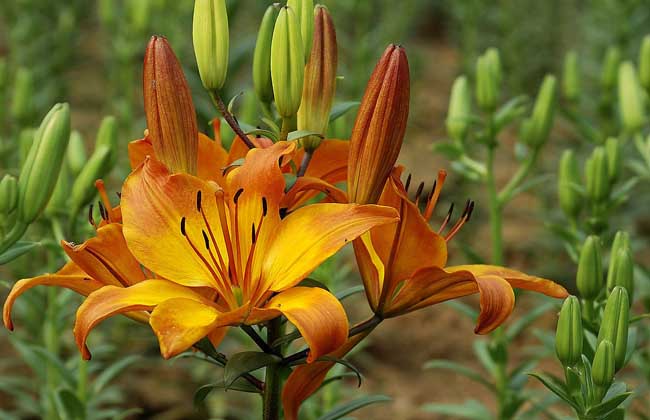
Lilies have long been known as the "fairy in cloud garments." Their appearance is elegant and pure, their flowers graceful, their leaves fresh and delicate, and their stems slender and upright, making them deeply loved by many. So do you know how to grow potted lilies? Let's take a look together below!
Lilies' growth habits
1. Lilies like moisture and light, and require fertile sandy soil rich in humus, with deep soil layers and extremely good drainage. Most varieties grow best in slightly acidic to neutral soil. Specifically, there are the following points:
2. Lilies like cool and humid environments. Places with sufficient sunlight and slightly shaded environments are more suitable for lilies. They avoid drought and extreme heat, and their cold tolerance is somewhat poor.
3. The growth and flowering temperature for lilies is 16-24°C. Below 5°C or above 30°C, growth almost stops. Only above 10°C do the plants grow normally. Above 25°C, growth stalls again. If the winter nighttime temperature is below 5°C for 5-7 consecutive days, flower bud differentiation and flower bud development will be seriously affected, delaying flowering or even causing blind flowers and split flowers.
4. Lilies like fertile, deep soil rich in humus, and most dislike hard clay; slightly acidic soil with good drainage is best, with a soil pH of 5.5-6.5.
Lily propagation methods
1. Scale propagation: In autumn, choose healthy, disease-free, plump scales and soak them in a 1:500 aqueous solution of benomyl or captan for 30 minutes. Take them out and dry them in the shade. With the base facing downward, insert 1/3~2/3 of the scale into a seedbed containing fertile sandy loam, at a density of 3~4 x 15 cm, and cover with grass to shade and keep moist. After about 20 days, 1~2 small bulbs will form at the cut end of the lower part of the scale. After 2~3 years of cultivation, the bulbs can weigh up to 50 grams. About 100 kg of seed scales are needed per mu, enough to plant about 15 mu of field.
2. Bulblet propagation: Multiple new small bulblets can grow on the stem axis of old lily bulbs. Collect the bulblets from disease-free plants, disinfect them, and sow them at a row spacing of 25 cm x 6 cm. After one year of cultivation, some can reach seed bulb standard (50 grams); smaller ones continue to be cultivated for another year before being used as seed.
3. Bulbil propagation: Bulbils are harvested after maturing in summer. After harvest, mix them with moist fine sand and store them in a cool, ventilated place. In September-October of that year, sow the bulbils in a seedbed at a row spacing of 12-15 cm and a depth of 3-4 cm, cover with 3 cm of fine soil, and cover with grass.
4. Seed propagation: Collect mature seeds in autumn. Sow them in a seedbed, and small bulbs can be produced in the autumn of the second year. This method takes a long time and the seed traits are prone to change, so it is rarely used in production.
Potted lily growing methods
1. Cultivation time: Potted lilies are best planted in September-October.
2. Soil: The growing soil should be mixed with leaf mold, sandy soil, and garden soil in a 1:1:1 ratio. Apply sufficient fully decomposed compost and a small amount of bone meal at the bottom of the pot as a base fertilizer. The planting depth is generally about 2-3 times the diameter of the bulb. The pot soil should not be too wet, otherwise the bulbs are prone to rot. Potted lilies should be repotted once a year, replacing with new growing soil and base fertilizer.
3. Fertilization: Lilies do not have very high fertilizer requirements. Usually, applying fertilizer when spring growth begins and at the early flowering stage is enough. Some growers abroad believe that lilies need relatively more nitrogen and potassium fertilizer, and should be fertilized every 10-15 days during the growing period, while phosphorus fertilizer should be limited because too much phosphorus fertilizer can cause leaves to turn yellow. During the flowering period, phosphorus fertilizer can be added for 1-2 days. To make the bulbs plump, remove faded flowers promptly after flowering to reduce nutrient consumption. Watering only needs to keep the pot soil moist, but during the peak growing season and in dry weather, water appropriately and more frequently, and often sprinkle water around the flower pot to increase air humidity.
4. Temperature: The suitable growing temperature for lilies is 12-18°C. In winter, even if the temperature drops to 3-5°C, they will not die from cold.
5. Light: Lilies have the characteristics of cold resistance, liking light, tolerating fertilizer, and fearing moisture. Lack of sunlight and long-term shading will affect normal flowering. However, they have wide regional adaptability and can be planted in the ground or in pots in both the north and south.
6. During the growing period of lilies, the flower pot should also be turned once a week. Otherwise, the plant tends to grow lopsided, affecting its appearance.