Why is Houttuynia cordata called the chewing gum that manufactures bad breath?
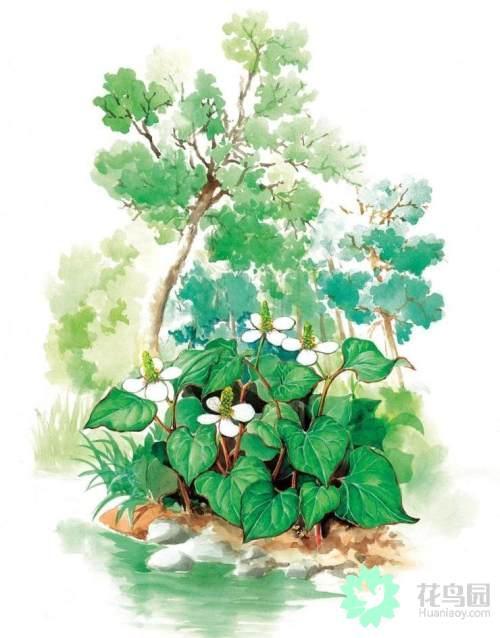
Houttuynia cordata is also called jicai or cencao, and is commonly known among the people as "zhe'ergen". It is distributed south of the Qinling Mountains and the Huai River in China, and mostly grows in mountain areas and valleys. Houttuynia cordata has a special fishy, foul odor; its leaves and rhizomes can be eaten as a wild vegetable, and can also be used as medicine, with effects of clearing heat, dispelling summerheat and detoxifying.
Wetlands beside streams, shady spots under trees, and shaded slopes are all places suitable for the growth of Houttuynia cordata. The ancients classified Houttuynia cordata as a "xi grass", meaning a grass that grows in damp, shady places, and because the yin energy is too strong, some people believed that eating too much Houttuynia cordata would damage yang qi and consume essence.
A nation-wide bad breath plan
During the Spring and Autumn period, King Fuchai of Wu heavily defeated the army of the State of Yue, and King Goujian of Yue had no choice but to become a subject and hostage of Wu. In order to win the trust of the King of Wu and return home early to rebuild his forces, Goujian endured humiliation and, through the "manure-tasting incident", won the favor of the King of Wu - when the King of Wu fell ill, Goujian claimed that he could taste human feces to diagnose illness, and did not fear the nausea, in order to show his loyalty. Goujian finally returned to Yue, slept on brushwood and tasted gall, and worked hard to govern, defeating the King of Wu and becoming a hegemon of his generation, but tasting feces left him with a hard-to-cure problem: bad breath. The strategist Fan Li presented a plan: among the mountains and fields there was a kind of wild grass with a fishy, foul smell, so it would be better to call on all the people of Yue, rich or poor, noble or humble, to gather this wild grass and eat it.
Because there was no chewing gum to cover up the special foul odor in the king's mouth, Fan Li proposed this seemingly not very brilliant suggestion. If everyone had bad breath, the king would not have to feel embarrassed, and incidentally they could gather wild grass as food, achieving two things at once. This matter is recorded in Wu Yue Chun Qiu, which says: "After King Yue suffered the nausea of tasting feces, he then fell ill with bad breath, so Fan Li ordered those around him all to eat cencao, in order to confuse its odor." Cencao is also called jicai, and because it contains a fishy, foul odor, the common people call it "Houttuynia cordata". It is said that the hill where Fan Li called on the people of Yue to collectively gather and eat Houttuynia cordata was named "Jishan" because of jicai, and is located in present-day Shaoxing, Zhejiang.
Houttuynia cordata can grow in large patches in relatively moist environments, and some people also cultivate them under tree shade or beside water as a lawn.
The rude wild vegetable
When the great Tang poet Du Mu was traveling in Xuancheng, Anhui, he saw Houttuynia cordata in a mountain stream and wrote the poetic line "Jing cen grass floats with light, the curved islet water unlocks its veins", lamenting that Houttuynia cordata, once eaten by the whole population, was now ignored by all, using the past to criticize the present, and incidentally lamenting his own circumstances. The fashion of eating Houttuynia cordata at that time spread from Yue to Wu, from Wu to Chu, and from Chu continued to areas farther south and southwest, but it never spread into the Central Plains. People of the Central Plains believed that Houttuynia cordata would cause bad breath and was a kind of food that made people lose propriety, and that only the ignorant Eastern Yi and Southern Man would eat it.
Today Houttuynia cordata also grows in Henan, but no one eats it at all; in the Jiangsu and Zhejiang area, after gradually becoming "enlightened", Houttuynia cordata was no longer favored by people; as for northerners who have never seen Houttuynia cordata at all, when they first eat it, they often vomit for three days. Eating Houttuynia cordata is a matter of dietary habit; southerners who have eaten it for a long time not only do not find it fishy and foul, but instead regard it as a delicacy. Besides being used as a wild vegetable, the leaves of Houttuynia cordata can also be used to wrap raw fish to slow the speed at which the fish spoils. In addition, some people use Houttuynia cordata to decoct a pungent-smelling soup to relieve summerheat, and from smell to medicinal effect, it is quite similar in spirit to today's Huoxiang Zhengqi Shui.