Poisonous plants have their oddities too; let us take you to understand toxic plants
Most people's impressions of poisonous plants come from two main sources - one is herbal medicine. The ancients said: "Shennong tasted a hundred herbs and met seventy poisons in a single day." When a hundred herbs are used as medicine, many of their properties are toxic, so Chinese materia medica divided them into upper, middle and lower grades, and mostly regarded the non-toxic ones as upper grade and the highly toxic ones as lower grade, which led to the folk saying that "every medicine is three parts poison." The other impression concerning poisonous plants comes from martial arts novels or TV dramas. The heartbreak grass, passion flower, seven-heart begonia and the like mentioned by Jin Yong were all extremely popular and known to every household. But the pharmacological mechanisms, anecdotes and legends concerning poisonous plants themselves are in fact a profound field of learning, involving biology, environment, history, literature and many other branches of knowledge. Now, serving merely as a miscellaneous writer, I will select a few well-known poisonous plants for commentary.
Gelsemium elegans - Heartbreak Grass
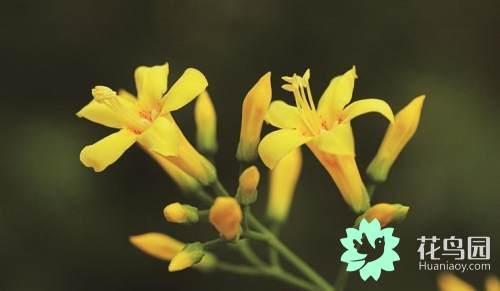
Gelsemium elegans
Gelsemium elegans is a vine with opposite leaves. Because its flowers, branches, leaves and vines somewhat resemble honeysuckle (that is, the heat-clearing herb Japanese honeysuckle), there have been incidents of people gathering Gelsemium elegans as honeysuckle to steep in water. One takes life and soul, the other cools and quells fire; the water steeped with heartbreak grass is naturally far removed from honeysuckle.
There was once a legend that Shennong died from the poison of heartbreak grass.
The Huainanzi says that Shennong tasted a hundred herbs and "in one day encountered seventy poisons." Luo Bi of the Song dynasty said in Lushi that Shennong died in what is today Yanling, Hubei. Even if Shennong really lived to be over a hundred years old and encountered seventy kinds of poisons in a single day without being poisoned to death, he suddenly died during a southern inspection tour, which shows that he encountered a highly toxic plant of the south that he had not yet come to know and could not neutralize. This makes later generations think of the heartbreak grass recorded in the Shennong Bencao Jing, an evergreen vine distributed throughout various places in southern China, whose main toxic substance is gelsemine; just a few grams can kill a person. Thus in 1979, someone in Folk Literature added such a scene: one day Shennong discovered a plant bearing small yellow flowers, so he picked it and tasted it himself, only to find after tasting it that his intestines were broken into pieces, and he died before he could take an antidote. So in recent years some people have dug up dusty old stories and, with seeming seriousness, deduced the exact cause of death of a legendary figure from high antiquity.
The legend of Shennong has no verifiable evidence, but Song Ci, the great Song dynasty forensic official, truly existed. In his Washing Away of Wrongs, Song Ci wrote a section on "Taking Poison," which specifically records the method for rescuing those who had taken the poison of heartbreak grass - pouring feces juice down their throats to induce vomiting and wash the stomach. The heartbreak grass spoken of here is generally regarded as "Gelsemium elegans," belonging to the Loganiaceae family. The name Gelsemium elegans comes from the fact that this substance "hooks a person's throat and lips upon entering the mouth," truly ferocious beyond measure.
In ancient times there was also a saying: Gelsemium elegans resembles the leaves of Polygonatum sibiricum. "Huangzhi and Gelsemium elegans, alike in appearance but opposite in nature. A word to the traveler on the path: when gathering, keep your eyes sharp." The huangzhi here is the Liliaceae plant Polygonatum sibiricum, a divine medicine consumed by ancient Daoists. It is often mentioned alongside Gelsemium elegans as a positive and negative pair of models, as in Western Jin dynasty Zhang Hua's Bowuzhi, volume five: "The Yellow Emperor asked Tianlao: Among what heaven and earth produce, is there anything that, eaten, makes one not die? Tianlao said: The herb of the sun is called Polygonatum sibiricum; eat it as food and you may attain long life. The herb of the moon is called Gelsemium elegans; it must not be eaten, for upon entering the mouth one dies immediately."
As for the connection between this life-taking poisonous plant and literary figures, the first person to trace is the poet immortal Li Taibai - Li Bai wrote in his poem "A Concubine's Ill Fate": "Once she was a hibiscus flower, now she is heartbreak grass." When Qing dynasty editors compiled The Collected Works of Li Taibai, they believed the term "heartbreak grass" had been transmitted erroneously and changed it to "broken-root grass," after which the earlier version ceased to circulate. The ancients placed the hibiscus flower and heartbreak grass on the same footing and even believed there was a rather deep connection between them; this has a long history.
As for the extreme popularity of heartbreak grass in literary works, one must count the romantic story in Jin Yong's novel The Return of the Condor Heroes. In the Valley of Despair, Yang Guo saw the passion flower and said: "It tastes extremely sweet at first, but afterward it turns bitter. This flower is called the passion flower? The name is quite distinctive." As he spoke he reached out to pick another flower, and although warned "Careful! There are thorns on the tree!" Yang Guo still had his finger pricked by the small hidden thorns behind the blossom, and in the end was poisoned by the passion flower. The novel describes the passion flower thus: "Looking closely at the flower tree, he saw that the branches and leaves were covered with small thorns, yet the color of the petals was incomparably delicate and beautiful, like a hibiscus but more fragrant, like a camellia but more brilliant." This highly toxic passion flower, resembling a hibiscus, immediately calls to mind the hibiscus and heartbreak grass, the same thing under different names, in Li Bai's poetry. Mr. Jin Yong was indeed a master novelist of intricate and unpredictable plots; in the novel he wrote these plants, suspected to be the same thing under different names, as companion plants that use poison to counter poison - Yang Guo, in agony from the passion flower poison, was saved by the heartbreak grass at the edge of the passion flower garden.
In Mr. Jin Yong's writing, heartbreak grass can cure passion flower poison. This passion flower, like a hibiscus, like heartbreak grass, may perhaps, as Li Bai said, at one moment be a hibiscus flower and at another become a poisonous plant. Thus The Return of the Condor Heroes openly speaks of using poison to counter poison and covertly suggests that love can heal love, so that countless readers were stirred to the depths of their souls and moved to tears, because the deadly poison of love is hard to be rid of even when one wants to be - and in the novel Yang Guo finally set fire to the passion flower, so that from then on this poisonous thing no longer existed in the world, leaving only the heartbreak grass widowed and alone, unable to find an object for its antidote.
Rhododendron molle - Mafeisan
Rhododendron molle
Rhododendron molle is a genuine rhododendron. Although its flower color is not of the traditional pink range, it is quite worth viewing. Unfortunately, bright flowers are often toxic, and Rhododendron molle is no exception. In fact most rhododendrons carry toxicity; if people or livestock eat too much, they are often poisoned. Even plants beneath the rhododendron groves are affected by their toxicity, and only some special species can survive.
It is said that Bitahai in Shangri-La, Yunnan, once had a marvel - azaleas intoxicating fish. Every May, when the rhododendrons bloom, azalea petals fall one after another into the water of Bitahai, attracting fish; after the fish swallowed the petals, they actually became drunk and floated on the surface. Drunken fish and azaleas thus formed a peculiar spectacle on the lake. Such a spectacle is no longer seen today, leaving people to yearn for it in vain, and making one wonder whether Bitahai really is the poisonous lake of the Tibetan legend The Epic of King Gesar.
Although the poisonous lake has no basis, the toxicity of rhododendrons is real. Among the many kinds of rhododendrons, "Rhododendron molle" is especially toxic: the Eastern Han Shennong Bencao Jing listed 21 toxic plants, including Gelsemium elegans, Veratrum nigrum, Aconitum, Rhododendron molle and others, and specifically classified Rhododendron molle as a highly toxic lower-grade drug; the Ming dynasty Bencao Gangmu says that its "flowers, roots and leaves are highly toxic; if a sheep eats its leaves, it staggers and dies." It is worth noting that although the most toxic parts of the whole Rhododendron molle plant are the flowers and fruit, poisoning incidents among goats and sheep mostly occur in early spring when tender leaves sprout and animals eat indiscriminately from hunger. So Rhododendron molle kills people and livestock not by means of its strange and bewitching yellow flowers.
The most important characteristic of Rhododendron molle toxin is that it anesthetizes people and livestock, making them stagger and lose consciousness, as if drunk, and this toxin seems to become even more potent when combined with alcohol. The book Chinese Toxic Plants states: "One of the ingredients of the knockout drops handed down through the ages is this flower; it is said that taken with alcohol it can anesthetize and render a person unconscious." This accords with the record in Mei Yuanshi's Yaoxing Huiyuan from the late Ming: "Rhododendron molle flowers must not be taken; a mistake will make a person tremble and faint for a whole day. If used, they may be mixed with sorghum liquor and steamed three times, and then there is no harm. Combined with datura flower, Sichuan aconite and wild aconite in powder, it becomes knockout drops." The book Yaoxing Huiyuan had long been extinct within China and in recent years returned from Japan as a rare edition. This book mentions knockout drops when discussing Rhododendron molle flowers, and its use was also to treat poisons and cure sores, which is extremely different from the anesthetic "knockout drops" in other Ming-Qing prescriptions and novels in both main ingredients and purpose of use. Other "knockout drops" seem not to mention Rhododendron molle flowers; it is now thought that Mei Yuanshi's knockout drops were inspired by the miraculous physician Hua Tuo's "Mafeisan."
So where did Hua Tuo's "Mafeisan" formula come from? Western scholars once pointed out that Hua Tuo's "Mafeisan" closely resembled early anesthetics of West Asia. Mr. Chen Yinke, writing at Tsinghua University in his article "The Records of Cao Chong and Hua Tuo in the Romance of the Three Kingdoms and Buddhist Stories," pointed out that "Hua Tuo" has considerable affinity with the Sanskrit word for "god of medicine," that Hua Tuo's original given name was "Fu" rather than "Tuo," and that people at the time compared Hua Tuo to the god of medicine in Indian mythology, hence calling him "Hua Tuo," actually regarding him as such. Chen Yinke's meaning is clear: the name Hua Tuo came from Indian mythology, was spread among the people by busybodies of the time, and was ultimately taken up by Chen Shou into Chinese history and compiled into the Records of the Three Kingdoms. Therefore some believe that both Hua Tuo and "Mafeisan" came from ancient India, but what can be certain is that even if the Central Plains during the Wei-Jin period did indeed prepare Mafeisan according to the formula, it could only have been based mainly on Rhododendron molle, not on datura, which was commonly used as an anesthetic in India, because datura flowers did not spread to the Central Plains until at least the Tang dynasty.
As for how Rhododendron molle, once used to treat poisons, cure sores and save lives, transformed into knockout drops, this is like the double edge of a sharp blade; acting as a hero or a villain all depends on a single thought. It is unknown whether the Song dynasty truly had cases of using knockout drops to set traps and drug people unconscious in order to seize money and beauty, but at least by the time Shi Naian wrote Water Margin, knockout drops already made those who traveled the martial world uneasy. According to careful statisticians, records of "knockout drops" crimes in the Ming and Qing are almost uniformly from the south - mainly because the raw material was easy to obtain; no wonder, since that is the main distribution area of Rhododendron molle.
Strychnos nux-vomica - Qianji Yao
In the Song dynasty case of "candle shadow and axe sound," Emperor Taizu of Song died suddenly overnight in an unclear manner, and later generations suspected his younger brother, Emperor Taizong of Song, of foul play. There were many tales of Emperor Taizong's poisoning methods: Meng Chang, the surrendered king of Later Shu, and Li Yu, the last ruler of Southern Tang, were both poisoned to death. It is said that after the poetic and talented Last Ruler Li was placed under house arrest, he wept and sighed before his old ministers, and moreover wrote lines longing for his lost country, "Last night another east wind blew past the little tower; my lost country cannot bear to look back in the moonlight." Thereupon Emperor Taizong nodded and gave his approval, and administered Qianji Yao to the Last Ruler Li.
Later generations recalled this episode very concisely: "Before the song 'Last night another east wind blew past the little tower' had finished, Qianji arrived." They did not specifically say that the Last Ruler Li was shaped like a crossbow, rocking back and forth, like a bow drawn and then released, now straight, now bent, and so dozens of times. Yet it is precisely on the basis of the symptoms when this drug's toxicity flared that modern people concluded that the poison Li Yu took probably came from the seeds of Strychnos nux-vomica.
The character "fan" in the name fangmubie clearly indicates that it came from foreign lands. This plant grows wild in the forest regions of India's east coast. In the Bencao Gangmu its seeds are called maqianzi, named for their shape. Strychnos nux-vomica spread to Europe in the 16th century and two hundred years later was widely used for poisoning rats and other harmful animals, and to this day it remains one of the rodent poisons in use.
The strychnine in Strychnos nux-vomica destroys the central nervous system. After a person eats it, the head begins to convulse, and finally the body dies with the feet drawn up and touching the head, a most terrifying sight. The suspense detective novel The Mystery of the Shoe Buckle contains a description of death by strychnine poisoning convulsions, and even more remarkable is that in The Mystery of the Shoe Buckle, the murderer put strychnine into the victim's hot coffee to mask the bitter taste of the poison - the author clearly knew that strychnine is the bitterest drug known.
How did Emperor Taizong of Song obtain such Qianji Yao?
According to records, when Emperor Huizong of Song had just ascended the throne, he rode on horseback to inspect the imperial palace and found a storehouse with no name. Upon inquiry, it turned out to be the palace storehouse for hidden poisons. The poisons in the storehouse were divided into seven grades, with the zhen bird poison ranked third, and the most powerful kind "kills instantly upon being sniffed through the nose." These poisons were presented as tribute once every three years by Guangdong and Guangxi, Sichuan and Shu and other provinces, and it was said that they had not been used since the founding of the Song dynasty. Emperor Huizong personally wrote an edict saying: "These are all for killing disobedient ministers of former dynasties. Even if a minister truly had an unpardonable crime, he should be openly executed according to the law; how could it be proper to use these?" He then ordered the tribute stopped and all the poisons in the storehouse burned. Yet on careful thought, if it really had been "not used since the founding of the Song dynasty," why would there be "tribute once every three years"? Emperor Taizong of Song's Qianji Yao must have been taken from the palace poison storehouse. Since it was tribute produced in Guangdong and Guangxi, Sichuan and Shu, it may have been Strychnos nux-vomica, or its close relative Strychnos wallichiana.
Also a close relative of Strychnos nux-vomica, the curare tree growing in South America contains toxiferine, whose chemical structure is similar to strychnine. Indigenous peoples used the curare tree to make arrow poison and smeared it on arrows as a weapon. What is astonishing is that although this poison is easily fatal as arrow poison, the game shot with it has little effect on those who eat it. Modern research has found that toxiferine finds it very hard to penetrate mucous membranes and is difficult to absorb orally, so after indigenous peoples used arrow poison to kill animals, eating the animal meat would not cause poisoning. The indigenous peoples kept this arrow poison secret for too long, so much so that this clever advantage was only discovered in recent years. In those years the Qing dynasty emperors, troubled by the possibility that hares and pheasants obtained by shooting arrows might carry arrow poison, had to learn from the Jurchen and raise gyrfalcons to catch hares and pheasants with hawks. Just imagine, if the Qing dynasty emperors of China had obtained the indigenous peoples' secret arrow poison formula earlier, why would they have needed to establish falconry camps like the Changshao Camp and Labagoumen, while also keeping a number of falconers to tame and feed the hawks?
"We gather the wei, we gather the wei; the wei has sprouted. We say we return, we say we return; the year is about to end." The "Gathering the Wei" in the Book of Songs originates from two loyalists of the late Yin dynasty - Bo Yi and Shu Qi. Bo Yi and Shu Qi were sons of the ruler of the state of Guzhu at the end of the Yin dynasty. While Lord Guzhu was alive, he established Shu Qi as heir to the throne, but after Lord Guzhu died, Shu Qi wanted to yield the throne to his elder brother Bo Yi. Bo Yi, saying he dared not defy his father's dying command, fled; Shu Qi was still unwilling to become ruler and fled as well. The brothers yielded the state because they were unwilling to aid the tyrant in doing evil. When Zhou grew strong in the west, the two brothers came to Qishan, the capital of Zhou. After King Wu of Zhou destroyed Shang, Bo Yi and Shu Qi concluded that King Wu of Zhou was replacing violence with violence, and, ashamed to submit to King Wu of Zhou, they went to Mount Shouyang, where they did not wish to eat and could not eat the grain of Zhou, so they ate the wei of the mountain, until they died at the foot of Mount Shouyang.
How did Bo Yi and Shu Qi eat themselves to death?
People generally cannot accept the saying that Bo Yi and Shu Qi gathered wei to eat and, while eating, actually died. So from the Shu Han of the Three Kingdoms onward, another legend of Bo Yi and Shu Qi starving to death was fabricated: "A woman in the wild said to them: 'You are righteous in not eating Zhou's grain, but this too is Zhou's plant and tree.' Thereupon they starved to death." That is, since they did not eat Zhou's grain, they could not eat Zhou's wei either; eating nothing at all, they naturally starved to death.
Vicia sativa
Among vetch plants, many have been foods passed down since ancient times, such as Vicia hirsuta, widely distributed in central and eastern China. Su Dongpo once wrote a poem praising it: "The bean pods are round and small, the sophora sprouts slender and abundant." One account says this verse praises Vicia sativa, but another says it praises Vicia hirsuta. In fact, since the Shang and Zhou dynasties, many wild beans were used as food, but after all the ancients' botanical knowledge was limited, and in vague places a passage of prose or a line of poetry - what exactly it refers to - even with careful textual research, disputes or deviations are hard to avoid.
Mr. Lu Xun was not one to moralize broadly. He believed that Bo Yi and Shu Qi gathered wei and ate it all along. In his story "Gathering the Wei" in Old Tales Retold, he listed a wei recipe for Bo Yi and Shu Qi: wei soup, wei stew, wei sauce, clear wei, wei sprouts braised in original broth, and sun-dried tender wei leaves. Before dying, Bo Yi and Shu Qi made up a song: "We go up that western mountain to gather its wei; robbers replace robbers, not knowing this is wrong. Shennong, Yu and Xia suddenly passed; where shall I go? Alas, alas, let us die; it is the ill fortune fated in our destiny!" The original text of this "Gathering the Wei Song" is "We ascend that western mountain; we gather its wei. Replacing violence with violence; we do not know its wrong. Shennong, Yu and Xia suddenly are gone; where can I go? Alas, we go to death; our fate has declined!" Mr. Lu Xun had a medical background, yet he did not mention why "wei" could eat two ancients to death. The main reason is that Mr. Lu Xun ultimately conflated "wei" and "wei vegetable."
Zhu Xi of the Southern Song, based on the line in the Book of Songs, Minor Odes, "On the mountain there is jue and wei," treated wei and jue as the same thing; in Japan, deeply influenced by Zhu Xi, wei simply came to be read the same as Osmunda japonica (a kind of fern). Mr. Lu Xun studied biology in Japan, so naturally he confused wei with jue. In fact, wei is a kind of bean, and people ancient and modern have long reached a consensus on this, and this bean has a characteristic - it grows both on mountains and by the water. In pre-Qin poems about wei, there are descriptions of gathering it on hillsides as well as experiences of gathering wei by the water. This aquatic bean that can grow on mountains - what plant on earth is it?
It was not until Fang Yizhi in the late Ming and early Qing that a clear answer was given in Tongya: "Wei is today's wild pea." In particular, he did not avoid the question of its being an aquatic plant, and citing the Jin dynasty saying that "wei leaves resemble duckweed," he connected wei with aquatic plants. There are very many kinds of wild peas. The wild pea Fang Yizhi spoke of is fully named "Vicia sativa."
Even Western scholars believe that Vicia sativa was very likely the earliest plant domesticated by the peoples of West Asia and Eastern Europe, with a cultivation history of five thousand years, and even the pronunciation of its Latin root is somewhat close to the Chinese "wei." But how did just such a plant, gathered for food and even domesticated in various places long ago, retire from or even disappear from our diet? And how could Bo Yi and Shu Qi have eaten themselves to death?
The reason is simple - the whole Vicia sativa plant is toxic, and people and livestock will suffer chronic poisoning after eating it in large quantities over a long period.
The toxicity of Vicia sativa changes with its growth stage, being greatest during the flowering and fruiting stages. After large-scale consumption, the symptoms are mainly chronic poisoning. Horses and cattle develop symptoms within 30 days of eating the plant, showing emaciation and peculiar neurological symptoms such as lethargy and staggering gait; in the middle stage of poisoning they become excited, and in the final stage lethargy appears again. Unfortunately the ancients knew very little about chronic poisoning, and the relevant research findings have only gradually become clear in recent years, so the chief culprit that killed Bo Yi and Shu Qi has only now come to the surface.
Now some people, not understanding the matter, seize on the two words "famine relief" and "pea" and firmly believe this thing can be eaten safely. Fortunately modern people do not live without grain, so eating the chronic poison called "wei" only occasionally, in smaller doses and at lower frequency, means its toxicity is not yet obvious. In the era of Bo Yi and Shu Qi, people did not know of chronic poisoning, yet they prided themselves on being pure and lofty and lived on a single diet, ultimately losing their lives. There is nothing else to it; as Mr. Lu Xun said, "the ill fortune fated in destiny," and one can only accept that one's fate has declined.
Stellera chamaejasme
Langdu, also known as Stellera chamaejasme, is called "heartbreak grass" by some people on the grasslands. Of course, langdu is not as violently toxic as the genuine heartbreak grass, Gelsemium elegans, but it inevitably causes abdominal pain and diarrhea, hence its title of "heartbreak." The clumps of Stellera chamaejasme on the grasslands are quite beautiful, and travelers who do not understand often take photos with it, unaware that this thing is not eaten by cattle or sheep and is a poisonous plant that makes livestock farming impossible across the fields, a signature plant of grassland degradation.
Strophanthus divaricatus
Strophanthus divaricatus is likewise commonly called "heartbreak grass," precisely because after being poisoned by it there often appear symptoms of abdominal pain and nausea, and in severe cases the heartbeat gradually weakens, breathing becomes difficult, and death may follow. Fortunately the flowers of Strophanthus divaricatus are strange and easy to identify, and it does not resemble common fruits or wild vegetables, so some possibility of poisoning has after all been avoided. From the perspective of plant taxonomy, Strophanthus divaricatus belongs to the Apocynaceae family, whose plants more or less carry toxins great or small, such as the commonly cultivated flowers oleander and yellow oleander; one of their common features is that the plant body contains white milky sap. Therefore, if after breaking a branch or leaf you see milky white sap, it is most likely a toxic plant; keeping your distance and quickly avoiding it is best.
Digitalis
Digitalis clearly does not have that much hair, yet it is also called foxglove. There is a Western legend that calls digitalis "fox gloves." It is said that an evil fairy gave the flowers of foxglove to a cunning fox, letting the fox put the flowers on its feet to eliminate the sound of its footsteps while foraging. This plant, whose flowers look like gloves, nearly caused the fledgling 007 to die in the film Casino Royale - a small amount of digitalis can serve as a heart stimulant, but eat too much and, needless to say, one can only suffer heart failure and even cardiac arrest like the "rookie" 007.
Aconitum gymnandrum
China has over a hundred species of Aconitum, distributed throughout the country, slightly different in color, but broadly similar in flower shape, all with flowers like helmets. The root of Aconitum is the most toxic and was an "excellent" variety for making poison in ancient China. Aconitum belongs to the Ranunculaceae family, whose plants often bloom magnificently and often carry toxicity, truly a case of a dagger hidden behind a smile. Although Aconitum gymnandrum is not among the most toxic members of the Aconitum family, it is a common item on the western grasslands. Livestock have their own system for avoiding poison and would rather die than eat this toxic plant, so hillsides long swept by cattle and sheep often present a expanse of blue-purple color, which is the toxic plant Aconitum gymnandrum standing in gangs.
Girardinia diversifolia
Girardinia diversifolia is as its name suggests: if you are stung by its stinging hairs, redness, swelling and pain are unavoidable. Girardinia diversifolia belongs to the Urticaceae family, which includes all kinds of nettles; any that have stinging hairs capable of wounding people carry some toxicity. Though not life-threatening, it is truly hard to endure, so no wonder that in some places Urticaceae plants are called "bite-cat" and "bite-dog." It is said that in some mountainous areas people gather the tender shoots of Urticaceae plants, taking them while extremely young and not yet toxic, blanch them in hot water, and dress them as a cold dish; eating them brings a sense of revenge, which seems especially to delight the heart.
Veratrum nigrum
It is said that among the hundred herbs tasted by Shennong was Veratrum nigrum, which was classified among the highly toxic. Cases of accidental consumption of Veratrum nigrum often occur in late spring, when people go up the mountains to dig wild onions and dig up Veratrum nigrum, whose leaf shape closely resembles them, then stir-fry and eat it. In fact Veratrum nigrum is also a registered Chinese medicine, and in the entry-level mnemonic of traditional Chinese medicine, the "eighteen incompatibilities and nineteen antagonisms," there is the classic line: "All ginsengs, asarum and peonies rebel against Veratrum nigrum." This means that ginseng, Danshen, Codonopsis and the like, together with Asarum, red peony and white peony, are incompatible in medicinal nature with Veratrum nigrum, and if carelessly mixed, the toxicity of Veratrum nigrum doubles.
Rumex
Some children grow up in mountain villages and are familiar with a plant whose leaves are sour. Although the taste is not good, the sourness can stimulate saliva secretion, much like Cao Mengde's "looking at plums to quench thirst." Chewing sour leaves a lot can also somewhat relieve dry thirst, so Rumex naturally became a "safe food" in many people's impressions. In fact the whole Rumex plant is toxic; if cattle or horses eat it, they stagger as if drunk, then convulse and weaken, and may even die. Therefore, before putting into one's mouth a plant deemed "non-toxic" by experience, it is best to weigh the matter carefully. Not eating will not starve a person to death, but if one eats it, the consequences are sometimes hard to predict.