What are the cultivation methods and precautions for the money tree?
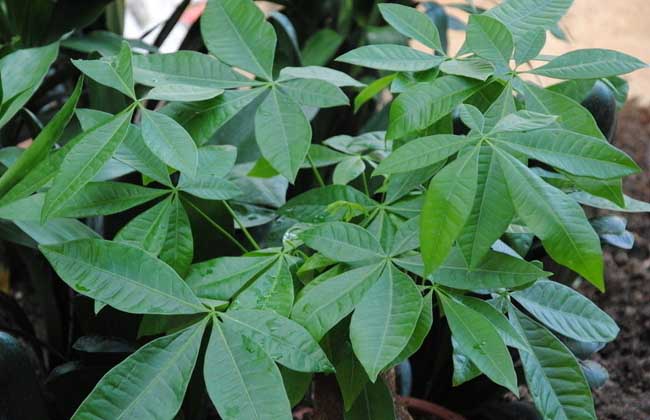
The money tree has always been a popular potted plant among gardening enthusiasts; whether at the office or at home, people are happy to grow one, some in small pots and some in large pots. But since the cultivation methods for the money tree are hard to get right, after growing one for a while they find it is not doing well. Below is a discussion of how the money tree should really be grown.
The growing environment for the money tree
The money tree is highly adaptable, liking light yet tolerating shade, and it grows well in full sun, partial sun or shaded spots. However, if grown in a dark place for a long time, its vigor will decline. When summer arrives, 50% shading is best, so that intense sun does not scorch the leaf tips and leaf margins.
For indoor ornamental growing, place it where there is some scattered light, and do not keep it there for more than 30 consecutive days. If leggy growth and declining vigor appear, let it gradually receive sunlight; never expose it abruptly to strong light, lest it fail to adapt and die.
Choosing potting soil for the money tree
Most money trees bought today come in soil provided by the seller, so gardeners need not repot immediately after purchase; grow it as is for now and consider repotting later. If repotting, the money tree in a pot generally uses loose garden soil or peat soil, leaf mold and coarse sand, with a small amount of compound fertilizer or chicken manure as a base fertilizer and growing medium.
How to water the money tree
The money tree has a very poorly developed root system, and many gardening enthusiasts find their money tree dies mostly from root rot. Some will ask how often the money tree should be watered and how much to give at one time. It must be stated clearly here that conditions vary from place to place, and the pot and soil used also differ, so there is no fixed watering standard. So how should gardeners water? Generally speaking, watering the money tree once a month is not too little. Here is a little tip: a plant short of water will not die quickly and will recover soon after watering, but if it is waterlogged it is basically beyond saving. The money tree can be misted often and watered sparingly.
How to fertilize the money tree
Normally, if the soil is fertile enough, no fertilizer is needed. If it has been grown for a long time, consider giving a light fertilizer; never use a strong fertilizer. Common foliage fertilizers can be used, but remember to apply them lightly.
Generally speaking, money trees have been beheaded, so every spring gardeners can also prune them appropriately, which both improves their appearance and encourages new branches to grow.
Pest and disease control for the money tree
If the stem's surface turns black or black thread-like fibers are exposed, it is stem rot causing the money tree's stem to rot. In the early stage of the disease, spray a 1000-fold solution of 50% Fungicide Wang water-soluble powder, once every 10 days, for 2—3 consecutive treatments. For anthracnose, spray 50% chlorothalonil wettable powder at 800-fold or 50% carbendazim at 600-fold, once every 7—10 days. For cabbage caterpillars, inchworms and red spider mites, regularly spray 40% omethoate at 800-fold or 50% dichlorvos at 1000-fold, once every 7 days for 2—3 consecutive sprays.
Precautions for growing the money tree
1. Sunlight should be appropriate: when growing the money tree, place it in a spot indoors with ample sunlight, and when positioning it make sure the leaf surfaces face the sun. Do not leave it shaded for long periods, otherwise the branches and leaves will twist and deform. It is best to mist the money tree's leaves once every 3 to 5 days, which both helps photosynthesis and makes the branches and leaves more attractive.
2. Water moderately: the money tree adapts well to moisture; generally, heavy outdoor watering, or not watering it indoors for more than ten days, will not cause waterlogging or drought. Still, watering remains an important part of growing the money tree. Too little water easily stalls the development of branches and leaves. Too much water may cause root rot and death. With a moderate amount of water, the branches and leaves grow thick and large. The first principle of watering the money tree is to prefer moist over dry; water more in the hot summer season and less in winter. Water more during the vigorous growth period, and less for small or newly planted specimens. Under normal conditions, watering once every 15 to 20 days is enough.
3. How to fertilize: the money tree's demand for fertilizer is greater than that of other flowers and trees. When repotting, the proportion of fertilizer soil can be one third. Fertilizer soil includes a mix of decomposed leaf litter, ground miscellaneous bone, soybean cake residue and so on; these fertilizer soils are highly effective and easy to obtain. But note that they must be fully decomposed, so as not to "burn" the leaves yellow. It is worth noting that during the money tree's growth period (that is, from May to September), a decomposed liquid fertilizer or flower fertilizer should be applied once every 15 days, so that it develops deep roots and lush leaves.
4. Temperature and humidity: growing the money tree has relatively high requirements for temperature and humidity. If the temperature is too low or the humidity insufficient, leaf drop may occur; in severe cases the branches become bare, which is bad for ornamentation and may even kill the plant. When growing the money tree, keep the temperature above 15°C and mist the branches and leaves often to increase humidity, while in late autumn and winter take care to protect it from cold and freezing. For indoor growing in summer, water once every 3-5 days; in spring and autumn, once every 5-10 days. In winter it depends on the room temperature; if the room temperature is around 12°C, watering once a month is enough. Its most suitable growing temperature is 18-30°C.
5. How to repot: newly acquired money tree plants do not need repotting that year, to prevent the tree's shape from being spoiled. The suitable season for repotting is spring, or it can be done in July or August, taking advantage of the plant's semi-dormant state during the high-temperature period. The money tree is fairly strict about its potting soil; the soil should be slightly moist and well drained, and an acidic sandy loam containing humus can be used.