How to Propagate a Money Tree? A Detailed Guide to Common Propagation Methods
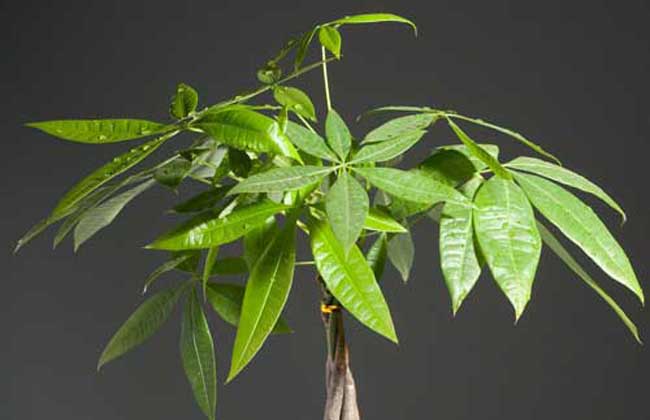
The money tree (Pachira aquatica) is a popular potted plant. In recent years, through cultivation and selective breeding, it has widely entered households in both urban and rural China. Its propagation methods are generally divided into three types: seed propagation, cutting propagation, and grafting propagation. Let's take a look at the propagation methods for the money tree below!
Seed Propagation of the Money Tree
The money tree is mostly propagated by seed. For sowing, fresh seeds should be used; collect them after they mature in autumn, remove the seed shells, and sow immediately. After sowing, cover with fine soil about 2 cm thick, then place in a semi-shaded spot and keep moist. Sprouting occurs about 7 days after sowing. The germination temperature is 22—26°C. When the seedlings grow to about 25 cm, thin out the dense ones and keep the sparse ones so the seedlings grow evenly. Seedling-grown plants grow rapidly; during the seedling stage, apply light nitrogen fertilizer and increase phosphorus and potassium fertilizer 2—3 times to encourage the base of the stem to swell.
Money tree seeds can be sown as long as the temperature is above 20°C, and the germination rate is quite high. Compared with purchased potted cuttings, a money tree grown from seed by yourself is easier to care for.
Grafting Propagation of the Money Tree
The money tree generally blooms and sets seed 8 years after sowing. To make it bloom and fruit earlier, you can choose a two-year-old braided seedling as the rootstock, and select one-year-old vigorous branches from a tree that has already bloomed and set seed as the scion. In mid-to-late February, using the cleft grafting method, the survival rate reaches 80%. After grafting, the money tree blooms the following year, which can advance blooming and fruiting by 5 years.
Cutting Propagation of the Money Tree
1. Collecting cuttings: Choose current-year semi-lignified branches that are vigorous, free of pests and diseases, and of good characteristics. Cut them on a cloudy day or a windless morning, with a cut length of 6 to 7 cm. The lower cut should be horseshoe-shaped and located below a leaf or axillary bud; the cut should be smooth to promote callus formation. Generally each cutting carries 2 palmate leaves. Be careful not to damage the leaves, so as to facilitate photosynthesis.
2. Timely cutting: Carry out cuttings from late June to early August, and they should be cut and inserted in the morning or evening. Before cutting, soak half of the cutting in 25PPM No. (1) ABT rooting solution for 20 to 24 hours, then take it out and rinse clean with water. Use a small wooden stick to make holes in the seedbed surface, then insert along the holes, and then seal and firm the holes. When the cutting is shorter, it can be inserted straight; when the cutting is longer, it can be inserted at an angle. The cutting depth should be such that it does not tip over, generally 3 to 5 cm. After cutting, water thoroughly in time, straighten any crooked cuttings, cover with plastic film, and firm the edges with soil.
3. Seedling stage management: After cutting, ensure environmental conditions suitable for rooting. Generally the soil temperature is 3°C to 5°C higher than the air temperature, the relative air humidity of the cutting bed is kept at 80% to 90%, and the light requirement is 30%. Ventilate 1 to 2 times a day. From June to August, when temperatures are high and water evaporates quickly, spray water once in the morning and once in the evening with a fine spray bottle, keeping the temperature between 23°C and 25°C. After the seedlings survive, apply fertilizer in time, mainly quick-acting fertilizers: nitrogen and phosphorus fertilizers in the early stage, an appropriate combination of nitrogen, phosphorus, and potassium in the middle stage, and in the late stage, to promote lignification of the seedlings, spray 0.2% monopotassium phosphate before the end of August and stop using nitrogen fertilizer. Generally, callus tissue forms in about 15 days, and rooting begins in about 30 days.