A Detailed Guide to Clivia Care Methods and Precautions
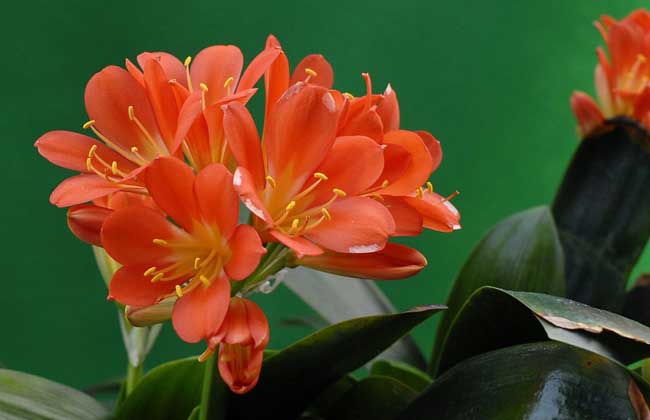
Clivia is native to southern South Africa and is a perennial herbaceous plant. Its flowering period lasts as long as 30-50 days, mainly in winter and spring, and it also blooms around the period from New Year's Day to the Spring Festival. It dislikes strong light and is a semi-shade plant. It likes cool conditions and dislikes high temperatures. The optimum growth temperature is 15-25°C, and growth stops below 5°C. It likes soil rich in humus with good drainage and moist soil, and dislikes dry environments. It has high ornamental value and is often grown in pots in greenhouses in China for viewing. Let's take a look below at what the care methods and precautions for Clivia are!
Clivia Care Methods
1. Soil: Clivia is suitable for soil rich in humus. This kind of soil has good aeration and good water permeability, and the soil is fertile and slightly acidic (pH6.5). The general soil mix for Clivia is 6 parts leaf mold, 2 parts pine needles, 1 part river sand or furnace ash residue, and 1 part base fertilizer (hemp seed, etc.). Leaf mold mainly refers to oak leaves, also called oak tree leaves. This kind of leaf is thick in texture and is very good humus. It is nutritious and has good water permeability. Other leaves are too thin and disappear after rotting, so they cannot be mixed with other media to make soil. When cultivating, use pots that gradually increase in size as the plant grows. When cultivating one-year-old seedlings, a 3-inch pot is suitable. In the second year, change to a 5-inch pot, and afterward repot into a pot one size larger every 1-2 years. Repotting can be done in spring and autumn.
2. Light: Clivia is a plant that likes moisture and is suitable for growing in high-humidity environments, but it does not have high light requirements. As long as the temperature is suitable, it does not matter whether the light duration is a little longer or shorter. Although good light can ensure that Clivia flowers are brightly colored, it still prefers slightly weaker light, so strong light must be avoided.
3. Repotting: When Clivia grows larger, it needs a bigger pot, which is what is called "repotting and changing soil." The best time to change the soil is in spring and autumn, because Clivia grows vigorously at this time and will not have its growth affected by changing the soil. The most critical point when changing the soil is to fill the soil firmly around the roots. Otherwise, if there is no soil around the roots, then water and nutrients cannot reach the roots, and root rot is likely to occur.
4. Watering: Clivia has relatively well-developed fleshy roots, and the roots store a certain amount of water, so this flower is relatively drought-tolerant. However, even drought-tolerant flowers cannot be severely short of water. Especially in summer, when high temperatures are combined with dry air, do not forget to water in time. Otherwise, the roots and leaves of the flower will be damaged, causing new leaves to fail to sprout, and the original leaves to become scorched. This not only affects flowering, but may even cause the plant to die. However, too much watering will also cause root rot. So you must master it well and often pay attention to whether the pot soil is dry or wet. When it becomes semi-dry, water once, but the amount should not be too much. Keeping the pot soil moist but not soggy is just right.
5. Fertilizing: Many flowers like fertilizer, but fertilizing flowers that like fertilizer also has a limit. Too much fertilizer is not good for growth and may even cause root rot or scorching of the plant. Clivia also belongs to this category of plants, and fertilizing must be done in the right amount. Flowers have different nutrient requirements at different growth and development stages. Therefore, different fertilizing methods suitable for the plant's needs should be adopted at each period, such as applying base fertilizer, topdressing, and foliar fertilizing.
① Applying base fertilizer (also called basal fertilizer): The purpose is to create conditions for plant growth and development and meet its nutrient needs. The base fertilizer for Clivia should be applied when repotting every 2 years. Apply commonly used manure (that is, poultry and livestock manure), compost, green manure, soybean cake fertilizer, etc. into the soil.
② Topdressing: This mainly promotes plant growth. Clivia can be given fertilizers such as cake fertilizer, fish meal, and bone meal. Apply less at the initial planting stage, and then as the plant grows larger and the leaves increase, the amount of fertilizer should gradually increase. When fertilizing, scrape aside the pot soil and apply it into the soil at a depth of 2-3 cm, but note that the fertilizer applied should not be too close to the root system to avoid burning the roots. Applying this kind of solid fertilizer once a month is generally enough, and it should not be more frequent.
③ Applying liquid fertilizer as topdressing: Liquid topdressing is made by diluting the soaked and fermented clear supernatant liquid of decomposed animal and plant materials with 30-40 parts clear water, then pouring it onto the pot soil. For small seedlings, dilute with 40 times water; for medium seedlings, dilute with 30 times water; for large seedlings, dilute with only 20 times water. After applying the fertilizer solution, water once with clear water 1-2 days later (the amount of water should not be too much), so that the fertilizer seeps into the root system in the pot soil and gives full play to its fertilizing effect. Do not water 1-2 days before applying liquid fertilizer; let the pot soil become somewhat dry before applying the fertilizer solution, which is more effective. The best time to fertilize is in the early morning; when pouring, the fertilizer solution should be poured along the edge of the pot, and care should be taken to avoid applying it on the plant and leaves. In addition, the type of fertilizer applied should also vary according to the season. For example, in spring and winter, it is suitable to apply some phosphorus and potassium fertilizers, such as fish meal, bone meal, and hemp cake, which help the formation of leaf veins and improve the glossiness of the leaves; while in autumn, it is suitable to apply some diluted infusion of decomposed animal hair, horns, hooves, or soybean cake, diluted with 30-40 times clear water before pouring, to help leaf growth.
④ Foliar topdressing: Fertilizing by this method mainly makes up for the deficiency of nutrients in the soil, solves the problem of nutrient deficiency in the plant, and makes seedlings grow faster and flowers and fruits grow larger. Foliar fertilizing means spraying the diluted fertilizer solution directly onto the leaf surface of the plant with a sprayer, so that nutrient elements enter the leaf tissue through the epidermal cells and stomata and are then transported throughout the plant. Commonly used fertilizers include urea, monopotassium phosphate, and superphosphate. When spraying, spray evenly on both the front and back sides of the leaves. During the growing season, spray once every 4-6 days; during semi-dormancy, spray once every 2 weeks. Generally, spray after sunrise, and stop spraying after the plant blooms. It must be noted that this method can only be used when the plant is found to be lacking fertilizer. If the plant has sufficient nutrients and is growing vigorously, it should not be used.
Later-Stage Management of Clivia Cultivation
The flowering period of Clivia is generally from February to April. After flowering, the flowering period can be extended by appropriately lowering the temperature, increasing ventilation, and reducing light. The length of the Clivia flowering period can be controlled through cultivation techniques.
1. Fertilizing: Apply an additional round of bone meal, well-fermented fish innards, and soybean cake water, which can make the flower colors brighter, the flowers larger, and the leaves thicker. Otherwise, it is easy to get small flowers, few in number, and pale in color. At the same time, care should be taken to avoid applying too much nitrogen fertilizer and insufficient phosphorus and potassium fertilizer, which can lead to weak growth or leggy leaves and affect bud formation and flowering.
2. Light: A certain amount of light should be provided to meet the light requirements for photosynthesis and flowering. Under strong light, the flowering period is short and the flower color is vivid; under weak light, the flower color is pale. Too long or too strong light, or long-term shading with insufficient light, will affect the production and accumulation of nutrients, making it impossible for buds to form and flowers to bloom.
3. Temperature: Suitable temperature has a clear effect on the quality of flowering. If the temperature is too high, root hairs exist for an extremely short time, and the function of absorbing water and fertilizer is greatly reduced, causing Clivia to enter a semi-dormant state; if the temperature is below 10°C, growth will also be inhibited; during the growing period it should be controlled at 15-25°C, and during the flowering period it should be 15-20°C. When root hairs exist for a long time and the function of absorbing water and fertilizer is good, the leaves grow short and wide, and the flowering is luxuriant. Attention should also be paid to maintaining a temperature difference of about 8°C between day and night for Clivia, because the organic matter it produces under higher daytime temperatures needs to be stored and digested under lower nighttime temperatures.
4. Moisture: Clivia cannot lack water throughout the plant's growth period. When it enters the flowering period, the water requirement is even greater, and the growing humidity should not be lower than 60%.
Causes of Flower Stalk Entrapment in Clivia and Treatment Methods
1. Causes of flower stalk entrapment
① Temperature too low: The temperature for Clivia to send up its flower stalk is about 20°C. If the temperature remains below 15°C for a long time, its flower stalk will be very difficult to grow out.
② Insufficient nutrition: Clivia has a relatively large demand for phosphorus and potassium fertilizer during bud formation and flowering. If lacking, the strength for Clivia to send up the flower stalk will be insufficient, resulting in flower stalk entrapment.
③ Lack of oxygen in the pot soil: During the bud formation period, the Clivia root system has a large oxygen demand. If the pot soil is too fine or remains in a state of high humidity for a long time, the permeability of the pot soil will be reduced, resulting in a lack of oxygen and causing flower stalk entrapment.
④ Constant-temperature cultivation: Clivia flowering requires a day-night temperature difference of 5°C to 8°C. If the plant is kept at basically the same temperature during both day and night, it will affect nutrient accumulation in Clivia, and flower stalk entrapment is very likely to occur during the flowering period.
⑤ Root damage or root rot: If the Clivia root system is damaged or rots, the channels for nutrient absorption will be blocked, affecting the plant's ability to send up the flower stalk and bloom.
⑥ Poor variety: Some varieties of Clivia are naturally prone to flower stalk entrapment.
2. Prevention and control measures
① Adjust the temperature and increase the temperature difference: When winter begins, after Clivia has undergone low-temperature treatment for about 20 days, place the plant under normal cultivation temperature at the appropriate time, and try to keep the day-night temperature difference at 5°C to 8°C.
② Apply more phosphorus and potassium fertilizer to ensure nutrition: In autumn and winter, appropriately increase the application of phosphorus and potassium fertilizer to promote flower formation and flower stalk emergence.
③ Ensure an appropriate water supply: During the period when Clivia is sending up its flower stalk, ensure that the water content of the pot soil is between 30% and 50%.
④ Use both medication and manual assistance to promote stalk emergence and flowering: You can apply a commercially purchased Clivia stalk-promoting agent according to the instructions onto the flower stalk or drip it into the pot soil; you can also manually prop open the leaves on both sides of the trapped area, but without damaging the leaves, to reduce the clamping force of the leaves on the flower stalk and encourage the flower stalk to extend out and grow taller as soon as possible.
⑤ Replace the soil again, first dry then wet: When replacing the soil, note that you should not water within 5 days after changing the soil, and the replacement soil cannot be dry soil; it should maintain about 30% moisture. After 5 days, water heavily once. In this way, it can generally send up the flower stalk and bloom.
Precautions for Clivia Cultivation
1. Clivia likes a semi-shady, cool environment, and must avoid high temperatures, strong light, and dryness. 15-25°C is the most suitable temperature. Below 5°C it begins to go dormant and stop growing, and high temperatures are also unsuitable. In summer, attention should be paid to avoiding heat. Otherwise, the leaves will become long and narrow and affect the ornamental value, so it should be cooled in time.
2. During the growth period of Clivia, keep the pot soil moist. During the high-temperature semi-dormant period, the pot soil should preferably be on the dry side, and water should often be sprayed on the leaf surface to achieve the purpose of cooling. Clivia likes fertilizer. Repot once every 2 to 3 years in spring and autumn, and add leaf mold to the pot soil. Rotate the pot frequently to prevent the leaves from leaning to one side.