What varieties of toxic succulents are there?
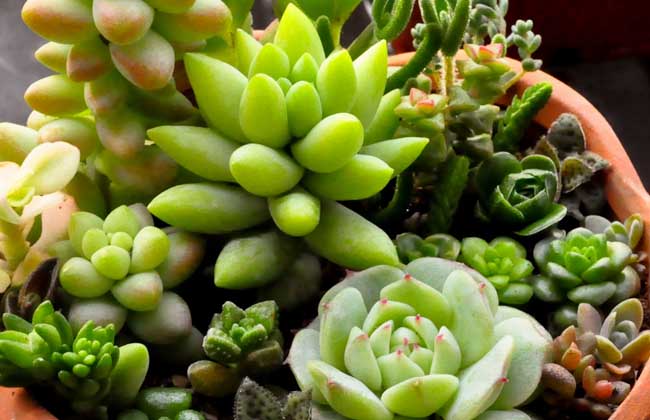
Now, with the popularity of succulents, more and more flower-growing enthusiasts are starting to grow succulents, but when growing succulents, one thing must be pointed out: some succulents are toxic, so extra care should be taken during cultivation. Below, the editor will introduce these toxic succulents to everyone!
Crown of Thorns
Crown of Thorns generally refers to Euphorbia milii, native to Africa, widely cultivated in the tropics and temperate zones of the Old World, and cultivated in both northern and southern China. It is commonly seen in parks, botanical gardens, and courtyards. The whole plant is used as medicine; external application can treat blood stasis pain, fractures, and malignant sores, etc. This species has many horticultural cultivation types, among which the yellow-white bracts are cultivated in very few places in China.
Euphorbia neriifolia cristata
Euphorbia neriifolia cristata is native to the arid, hot, and sunny regions of eastern India. It is a cristate variety of Euphorbia neriifolia, with ribbed succulent stems transformed into a cockscomb shape or flat fan shape; otherwise it is the same as Euphorbia neriifolia. The whole plant contains highly toxic white milky sap; accidental ingestion can cause severe poisoning; splashing into the eyes can cause blindness.
Night-blooming Cereus
Night-blooming Cereus is a plant in the genus Hylocereus of the cactus family, native to Mexico and the tropical rainforests of South America, and is now cultivated in tropical and subtropical regions worldwide. In China, it is mainly distributed in Guangdong and Guangxi, with Guangzhou, Zhaoqing, Foshan, and Lingnan as the main production areas. Its flower products are very popular in domestic and international markets and are mainly used to make flower dishes and soups, achieving the purpose of strengthening the body and nourishing health.
Euphorbia tirucalli
Euphorbia tirucalli is a plant in the genus Euphorbia of the Euphorbiaceae family. It prefers warm, dry, and sunny environments, is drought-tolerant and semi-shade-tolerant, not cold-tolerant, and avoids damp shade. It has no obvious dormant period.
Euphorbia spiralis
A plant in the genus Euphorbia of the Euphorbiaceae family. Native to Transvaal Province, South Africa. The plant is low-growing but has thick succulent roots. It is a small rare species in the genus Euphorbia. Its spiral ribs are very rare among Euphorbia species. It can be displayed as a specimen in botanical gardens and can also be cultivated by some enthusiasts.
Euphorbia obesa
Euphorbia obesa is a plant in the genus Euphorbia of the Euphorbiaceae family, also known as Huanngyu and Obesa. Native to Cape Province, South Africa. The plant is small and spherical, 8—12 cm in diameter. It has 8 neat ribs; the epidermis is gray-green with crisscrossing red-brown stripes, denser at the top; there are small brown blunt teeth on the rib edges.
Euphorbia polygona
Euphorbia polygona is native to South Africa and is a perennial succulent plant in the Euphorbiaceae family. The plant has a thick cylindrical succulent stem with more than 10 prominent ribs. The epidermis is green to gray-green, covered with white powder, and has relatively obvious, parallel dark horizontal ridges. Thorns grow on the rib edges, red-brown to dark brown, and fall off easily. The small leaves fall off early, so it gives the impression that the plant is always leafless. It has cyathia inflorescences with small purplish-red flowers, but under potted conditions it is not easy to bloom. Euphorbia polygona has a peculiar shape, resembling certain varieties of cactus plants. Planted in decorative pots to adorn desks, bookshelves, and windowsills, it is simple and natural, like a living handicraft.
Euphorbia decaryi
Euphorbia decaryi, also known as Decary's Euphorbia, is a perennial succulent plant in the genus Euphorbia of the Euphorbiaceae family. The plant is low and creeping, 5-10 cm tall, native to Madagascar off the east coast of Africa.
Euphorbia trigona 'Red'
Euphorbia trigona 'Red' is a cultivated variety of Euphorbia trigona. The original species Euphorbia trigona is produced in Namibia. Its form is a multi-branched shrub, with all branches growing upward. 3—4 ribs, usually 3 ribs, 4—6 cm thick and 15—25 cm long, but under cultivation the branches are thinner and longer. The rib edges have hard short teeth. The epidermis is dark green with white marbling. Opposite thorns are red-brown, 0.3—0.4 cm long. On the upper part of the branches, each rib has oval green leaves with short tips, leaf length 3—5 cm, and the leaf texture is very thin. In cold winters it sheds its leaves, and new leaves sprout in May of the following year.
Euphorbia neriifolia variegata
Euphorbia neriifolia variegata is a perennial succulent plant. The plant is tree-like, with a short, thick main trunk and numerous branches. The succulent stem is about 15 cm thick, with 4 to 5 ribs, prominent rib crests, and wavy rib edges. The epidermis is flower-white or yellow-white, and the thorns are gray-brown or purplish-brown, growing in pairs on the rib edges. During vigorous growth, lanceolate, flower-white or yellow-white leaves grow from the stem tips, but they fall off very early, giving the impression that the plant is leafless.
It is worth noting that toxic succulents means the plant's sap is toxic. As long as you do not accidentally ingest it, there will be no problem. Normal display is certainly beneficial and harmless.