Detailed Hydrangea Cutting Methods: Beginners Can Easily Learn to Propagate
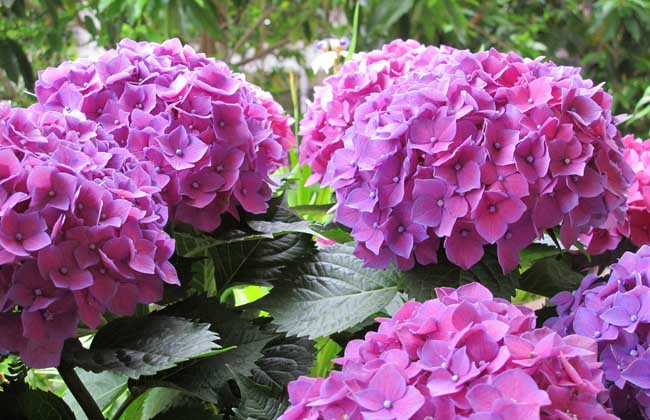
Hydrangea is a common potted ornamental flowering plant. Its propagation methods include division, layering, and cuttings, among other common methods. Among these, cuttings are what gardeners most want to use, as the operation is simple and the survival rate is relatively high. Below, the editor will introduce the cutting methods for hydrangea!
Hydrangea Cutting Time
The most suitable time for hydrangea cuttings is the plum rain season.
Hydrangea Cutting Methods
1. Choosing the cutting medium: This refers to the nutrient soil, river sand, peat soil, or other materials used for cuttings. For home hydrangea cuttings, it is difficult to obtain an ideal cutting medium due to limited conditions. It is recommended to use a pre-mixed and sterilized cutting medium. Medium-coarse river sand can also be used, but it should be rinsed several times with clean water before use. Do not use sea sand or river sand from saline-alkali areas, as they are not suitable for the growth of flowering plants.
2. Choosing cutting branches: When performing softwood cuttings of hydrangea, select robust current-year branches as cuttings during the period of vigorous growth from late spring to early autumn. After cutting the branches off, select the sturdy parts and cut them into sections 5-15 cm long, with each section carrying more than 3 leaf nodes. When cutting the cuttings, note that the upper cut should be made flat about 1 cm above the topmost leaf node, and the lower cut should be made at an angle about 0.5 cm below the bottommost leaf node. Both the upper and lower cuts should be smooth (the knife must be sharp). When performing hardwood cuttings, after temperatures rise in early spring, select robust branches from the previous year as cuttings. Each cutting usually retains 3-4 nodes, and the cutting method is the same as for softwood cuttings.
Post-Cutting Management Methods for Hydrangea
1. Temperature: The optimal temperature for cutting rooting is 20°C-30°C. Below 20°C, rooting of the cuttings is difficult and slow. Above 30°C, the upper and lower cuts of the cuttings are prone to infection by pathogens and rot, and the higher the temperature, the greater the proportion of rot. When low temperatures are encountered after cutting, the main measure for keeping warm is to wrap the flower pot or container used for cuttings with plastic film. When the temperature after hydrangea cutting is too high, the main cooling measure is to shade the cuttings, blocking 50-80% of sunlight. At the same time, mist the cuttings 3-5 times a day. On sunny days with higher temperatures, mist more frequently; on cloudy and rainy days with lower temperatures and higher humidity, mist less frequently or not at all.
2. Humidity: After hydrangea cutting, the relative humidity of the air must be maintained at 75-85%. The basic requirement for cutting rooting is that before the cuttings root, they must remain fresh and tender enough to carry out photosynthesis to produce rooting substances. However, cuttings that have not rooted cannot absorb enough water to maintain their internal water balance. Therefore, misting must be used to reduce water evaporation from the cuttings: under shaded conditions, mist the cuttings 3-5 times a day. On sunny days with higher temperatures, mist more frequently; on cloudy and rainy days with lower temperatures, mist less frequently or not at all. However, excessive misting makes the cuttings prone to infection by pathogens and rot, because many types of pathogens exist in water.
3. Light: Hydrangea cutting propagation cannot do without sunlight, because the cuttings still need to continue photosynthesis to produce nutrients and rooting substances to supply their rooting needs. However, the stronger the light, the higher the temperature inside the cuttings, the more vigorous the transpiration of the cuttings, and the more water they consume, which is not conducive to cutting. Therefore, after hydrangea cutting, 50-80% of sunlight must be blocked. After the root system grows out, gradually remove the shade net: on sunny days, remove the shade net at 4:00 p.m. each day, and cover it again before 9:00 a.m. the next day.