What are the control methods for powdery mildew on bitter melon?
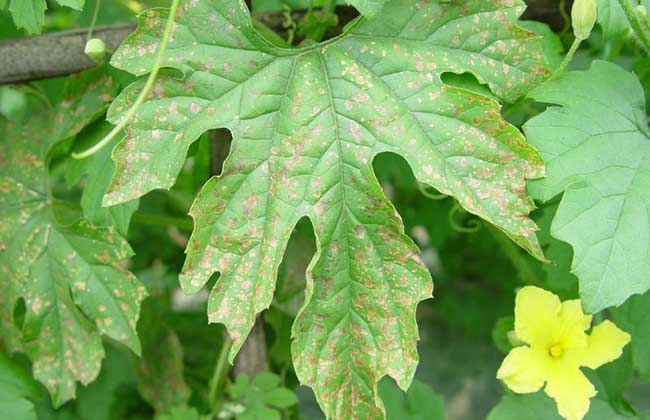
Powdery mildew on bitter melon occurs commonly on bitter melon plants, and different varieties differ in their resistance to powdery mildew. It mainly occurs on the leaves, followed by the leaf stalks and vines. The disease is caused by infection by fungi of the genus Erysiphe, which are obligate parasites that can only live parasitically on living tissue. The symptoms mainly damage the leaves. Let us take a look below at the control methods for powdery mildew on bitter melon!
Damage symptoms
Small round powdery mildew spots first appear on the front or back of the lower leaves of the plant, gradually expanding and becoming thick and dense, soon joining together into one patch. In the later stage of the disease, the entire leaf is covered with white powder, which then turns grayish-white, and finally the whole leaf becomes yellow-brown and withered. The disease mostly begins on the middle and lower leaves, and then gradually spreads to the upper leaves.
Conditions for disease onset
The pathogen can survive and overwinter on cucurbit vegetables and flowers such as Chinese rose in greenhouses, and after overwintering produces conidia, which spread by airflow. It takes about more than 20 hours from spore germination to infection, so the disease develops very quickly and often becomes epidemic in a short period. The pathogen can be active at 10-30°C, with the optimum temperature being 20-25°C. The disease develops quickly at a relative humidity of 45-75%; conidia can also germinate and cause disease when it is below 25%, while the disease is significantly suppressed when it exceeds 95%.
Control methods
1. For the control of powdery mildew on bitter melon, first implement crop rotation; do not plant continuously with cucurbit vegetables. Before sowing, apply new high-fat film to the ground to prevent soil compaction, isolate sources of diseases and pests, and increase the seedling emergence rate.
2. Before sowing bitter melon, soak the seeds in warm water at about 55°C, let them cool naturally, and continue soaking for 12 hours. Before sowing, mix the seeds with new high-fat film to repel underground diseases and pests, strengthen respiration intensity, and increase the seed germination rate.
3. Different varieties of bitter melon differ in their resistance to powdery mildew. Generally, early-maturing varieties have weak resistance, while mid- and late-maturing varieties have stronger resistance. Attention should be paid to cultivating strong seedlings, rational close planting, timely pruning of branches and leaves, improving ventilation and light conditions, so that the plants grow robustly and their disease resistance is improved.
4. Commonly used pesticides for powdery mildew on bitter melon include 15% triadimefon wettable powder, or 20% triadimefon emulsifiable concentrate at 2000-3000 times dilution, or 50% carbendazim wettable powder at 500 times dilution, or wettable sulfur powder at 300 times dilution, or 75% chlorothalonil wettable powder at 600-800 times dilution.
5. In greenhouses, use chlorothalonil smoke agent for fumigation to also control downy mildew and powdery mildew. When spraying, be careful to spray evenly on the middle and lower old leaves and the backs of the leaves. In the early stage of the disease, spray once every 7-10 days for 2-3 consecutive times, which can achieve a relatively good control effect.