What are the control methods for white rust in water spinach?
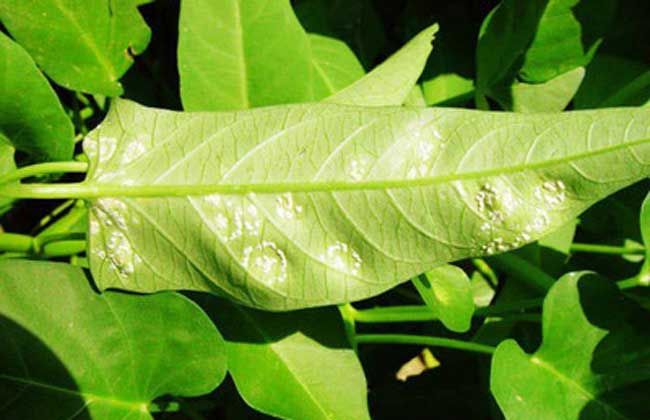
Water spinach (Ipomoea aquatica) originated in the tropical regions of China and is widely distributed across Southeast Asia. It is now commonly cultivated throughout southern, central, eastern and southwestern China. White rust is a common disease of water spinach, widely distributed and relatively serious in its damage. It affects leaves, petioles and tender stems. When it occurs severely, it significantly reduces yield and quality, and can even cause total crop loss. Let's take a look below at the control methods for white rust in water spinach.
Symptom expression
The lesions appear on the underside of the leaves. On the upper surface of the leaf, pale yellow to yellow spots first appear, later gradually turning brown. The lesions are relatively large. On the underside of the leaf, white raised blister-like spots form, nearly round or oval to irregular in shape, sometimes coalescing into larger blisters. In the later stage, the blisters rupture and release white sporangia. When the leaves are severely affected, the lesions are dense, the diseased leaves become deformed, and the leaves drop off.
Conditions for disease development
1. Continuous cropping land, land where the previous crop was severely diseased and much fungus remains in the soil, or low-lying waterlogged land with poor drainage and ventilation, or heavy clay soil that tends to be acidic.
2. Excessive application of nitrogen fertilizer, over-dense planting, crowded plants and rows, and poor ventilation and light penetration.
3. Seed-borne fungus, fungus carried in the nutrient soil used for raising seedlings, or organic fertilizer that is not fully decomposed or carries the fungus.
4. The disease is prone to occur in early spring with frequent rain or an early plum rain season, warm climate and high air humidity, or in autumn with frequent rain, heavy fog, heavy dew, or an early cold snap.
5. In greenhouse cultivation, ventilation is often withheld to preserve warmth and expel moisture, causing excessive humidity, which makes the disease prone to occur.
Control methods
1. Choose fields on high, dry terrain and cultivate with deep furrows and high beds so that water does not accumulate after rain stops.
2. After sowing, use medicated soil as a covering soil, and spray an insecticidal and sterilizing agent once before transplanting. This is an important measure for controlling diseases and pests.
3. The organic fertilizer used must be fully decomposed and must not be mixed with residues of this crop from the previous season.
4. Use paddy-upland rotation, and choose sterile soil for the nutrient soil used in raising seedlings, sunning it for more than three weeks before use.
5. For greenhouse cultivation, during the summer fallow period, irrigate inside the greenhouse, cover the ground with plastic film, close the greenhouse for a few days, and use high temperature to sterilize.
6. Choose disease-resistant, coated seeds. If not coated, use a seed dressing agent or seed soaking agent to sterilize.
7. Plant at a reasonable density, promptly remove diseased branches, leaves and plants, and carry them out of the field to burn. Apply medication or quicklime to the diseased planting holes.
8. Plastic film mulching cultivation can prevent soil-borne pathogens from harming the above-ground parts of the plants.