How to plant cut melon seeds? Detailed sowing method explained
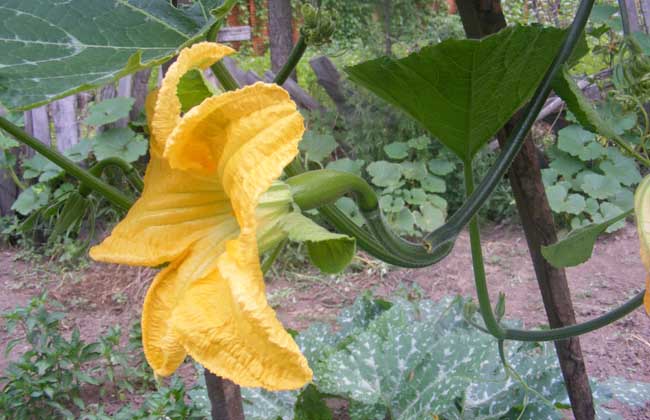
Cut melon (kan gua) is a variety of Chinese pumpkin (Cucurbita moschata), a new type of melon that can be cut and eaten piece by piece and regenerates quickly. Its growth characteristics and cultivation techniques are basically the same as those of ordinary pumpkin. Unlike pumpkin, cut melon needs a trellis after the vines begin to trail. It has low requirements for the natural environment and soil, and can be planted in both spring and summer. In production and cultivation it is mainly propagated by seed. Let's take a look below at how to plant cut melon seeds!
Seed soaking and sprouting
Cut melon generally uses the direct seeding method, sown in the open field, but to bring it to market earlier, seedling raising and transplanting can also be used. Before soaking, sun the seeds for 2-3 hours, then scald them in 55°C hot water for 2 minutes, stirring constantly while scalding. After the water temperature drops, change to clean water and soak the seeds for 8-10 hours, during which they should be taken out and rinsed once, then soaked again in fresh clean water, and then placed in a 28°C constant-temperature chamber to sprout before sowing.
Preparation of growing soil
The nutrient soil for raising cut melon seedlings is mixed in a ratio of 5 parts fertile, pest- and disease-free garden soil, 3 parts fully decomposed compost, and 2 parts fine sand or peat, mixed thoroughly and evenly. To each 1 cubic meter add 100 g of Lüheng No. 3 and 100 g of trichlorfon, cover with plastic film and pile to ferment for 2 days. After filling the pots, arrange them neatly and water thoroughly. Place 1 sprouted seed flat in each pot and cover with 0.8 cm of fine soil.
Seedling stage management
Cover the cut melon seedbed with plastic film to keep warm and retain moisture. Before emergence, the temperature should preferably be kept at 25-30°C. After emergence, remove the film according to the temperature conditions, with the temperature at 25-30°C during the day and 16-18°C at night. If the temperature is still low after emergence, replace it with new film that has good light transmission. When the daytime temperature meets the requirement, remove the film to let in light, or open both ends for ventilation, and cover it again when the night temperature is low.
Disease prevention at the seedling stage
When the cut melon seedlings grow true leaves, spray with 0.1% potassium dihydrogen phosphate plus 0.05% dichlorvos, once every five days. When the seedlings grow three true leaves, the spray concentration can be appropriately increased, and 75% chlorothalonil wettable powder at 1000 times dilution should be added to prevent and control anthracnose and root rot. After 2 true leaves, the covering can be removed. When the seedlings have 3 leaves and 1 heart, they can be transplanted.
Land preparation and transplanting
Before transplanting cut melon, prepare the land well and apply sufficient base fertilizer. Apply the base fertilizer in furrows; per mu, 4000 kg of decomposed organic fertilizer can be used, plus 50 kg of NPK compound fertilizer and 30 kg of potassium sulfate. For scattered planting, it is best to dig large holes for transplanting, applying base fertilizer before transplanting. For field planting, the density is 100-120 cm between rows and 60-80 cm between plants in the shed, with 600-1000 plants per mu, depending on soil fertility: plant more on poor soil and fewer on fertile soil. Water after transplanting.