How to prevent and control cucumber gray mold? Practical methods explained in one go
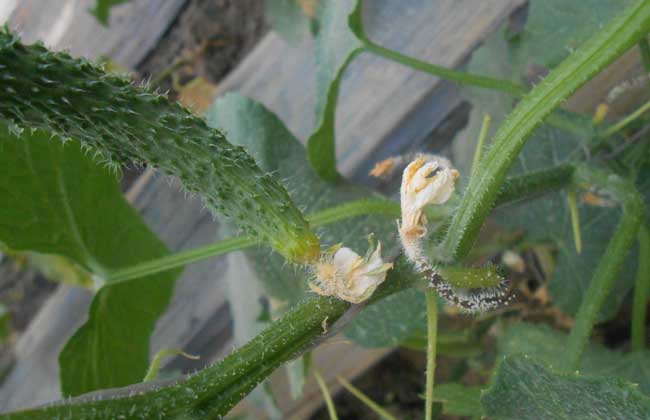
Cucumber gray mold is a disease that occurs year after year in protected cucumber cultivation. It is caused by infection with the fungus Botrytis cinerea of the class Deuteromycetes, and vegetable growers often call it fruit rot disease, mold rot disease, and so on. In recent years its occurrence has been increasing year by year. Because the fruit is often affected and caused to rot, let's take a look together at the prevention and control methods for cucumber gray mold!
Symptoms of cucumber gray mold
Cucumber gray mold mostly invades starting from spent female flowers. Initially, water-soaked lesions form at the flower base, and a grayish-brown mold layer gradually grows, causing the floral organs to soften, shrivel and rot, and gradually spreading to the young cucumber. The diseased part of the fruit first turns yellow, and later produces white mold that gradually turns pale gray, causing the diseased cucumber to stop growing, soften, rot and shrivel, and finally rot and drop off. When leaves are infected, the lesions are initially water-soaked, then become irregular light brown lesions with distinct edges, and sometimes a small amount of grayish-brown mold layer grows on the lesions. Under high humidity conditions, the lesions expand rapidly, forming large lesions 15-20 mm in diameter. When stems and vines are infected, the stems rot and the vines break, causing the plants to rot.
Occurrence pattern of cucumber gray mold
The pathogen overwinters as mycelium, conidia and sclerotia attached to diseased plant residues or left in the soil, and spreads through wind, rain and farming operations. The fruiting period of cucumber is the peak period for pathogen infection and disease development. It is prone to occur under high humidity (relative humidity above 94%), relatively low temperature (18-23°C), insufficient light, and weak plant growth. When the temperature exceeds 30°C and the relative humidity is below 90%, its spread stops. Therefore, this disease mostly occurs in greenhouses with low temperature and scant light in winter.
Prevention and control methods for cucumber gray mold
1. Remove diseased plant residues: In the late harvest period, thoroughly remove diseased plant residues, deep-plow the soil more than 20 cm, turn the diseased residues left on the soil surface into the lower layers, and spray a soil disinfectant plus New High Lipid Film to disinfect the soil, reducing the initial infection sources in the greenhouse. During the seedling stage and before the cucumbers swell, promptly remove diseased flowers, diseased cucumbers and diseased leaves, take them out of the greenhouse and deep-bury them to reduce sources of re-infection.
2. Strengthen cultivation management: Strengthen ventilation and air exchange, water appropriately, avoid watering on cloudy days, prevent excessively high temperatures, pay attention to heat preservation, and prevent cold waves from striking. In high-temperature seasons, deep-plow and irrigate in greenhouses, remove floating matter from the water surface, and deep-bury or burn it in a centralized way to keep the greenhouse clean.
3. Regulate temperature and humidity: In planting greenhouses, pathogen infection can be controlled by regulating temperature and humidity. Raise the indoor temperature to 31-33°C, start ventilation when it exceeds 33°C, maintain the temperature at 20-25°C in the afternoon, close the vents when it drops to 20°C, and keep the nighttime temperature at 15-17°C.
4. Disinfect and sterilize the greenhouse. Before planting, in seedling greenhouses or production greenhouses, use 5% Procymidone smoke agent at 1 kg per mu and keep the greenhouse closed for fumigation for 24 hours, and spray all around with Shijiale 40% suspension concentrate at 1000-1500 times dilution, or 50% Iprodione suspension concentrate or wettable powder at 800 times dilution, or 70% Thiram at 300 times dilution.