How to prevent and control white blight in Welsh onions? A detailed guide to practical methods
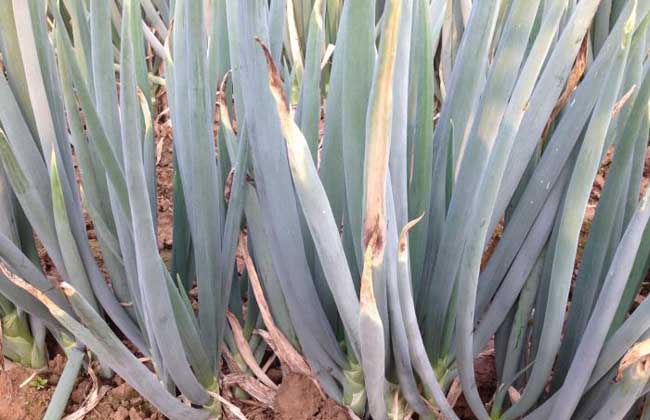
White blight in Welsh onions is a fungal disease. The pathogen mainly overwinters in the soil as chlamydospores, and when conditions are suitable the following spring it produces sporangia, which spread via irrigation water or wind and rain. Newly produced zoospores on the lesions and those on the soil surface spread by raindrop splash. The disease can occur during both the seedling stage and the adult plant stage, and the affected part is the Welsh onion leaves. Let's take a look below at how to prevent and control white blight in Welsh onions!
Symptoms of damage caused by white blight in Welsh onions
White blight in Welsh onions can occur during both the seedling stage and the adult plant stage. When seedlings and adult plants are infected, the leaf sheaths and leaf blades show oil-soaked dark green lesions with indistinct edges, which then gradually expand into large oil-soaked greenish-white lesions 5-10 cm in size. The center of the lesion is white to grayish-white, and as the lesion extends to the leaf tip the leaf gradually dries up and droops. On a single plant, in the early stage of the disease the lesions are mostly at the same height, which distinguishes it from phytophthora blight and gray mold.
Conditions for the occurrence of white blight in Welsh onions
The pathogen mainly overwinters in the soil as chlamydospores, and when conditions are suitable the following spring it produces sporangia, which spread via irrigation water or wind and rain. Newly produced zoospores on the lesions and those on the soil surface spread by raindrop splash. It generally begins in May-June, and as the rainy season arrives the disease worsens. In summer, continuous overcast and rainy weather makes the disease more likely to occur. After heavy rain, if drainage is not timely, water accumulates at the field edges, or there is excessive nitrogen fertilizer or leggy plant growth, the disease is severe.
How to prevent and control white blight in Welsh onions?
1. Choose disease-resistant and disease-tolerant varieties such as Gaojiao Bai, Jitui Cong, Wuye Qi, Bikeqi Welsh onion, and Zhangqiu Wutong.
2. Land where the disease has occurred should not be planted with onion and garlic vegetables for 2-3 years. After harvest, take care to remove diseased plant residues and bury them deeply in a centralized pit or burn them.
3. Use high beds or ridged cultivation, cultivate and earth up in time, and avoid the Welsh onion seedlings coming into contact with water as much as possible.
4. Apply compost fermented with effective microorganisms, and apply less quick-acting nitrogen to enhance the disease resistance of the plants.
5. In the early stage of the disease, spray 30% Ludebao suspension concentrate at 400-500 times dilution, or 77% Keshade wettable micro-particle powder at 500 times dilution, 60% phosethyl-Al · wettable powder at 500 times dilution, 72% Kelu wettable powder or 72% cymoxanil mancozeb wettable powder, 72% Keshuangqing wettable powder at 800 times dilution, once every 10 days or so, for 1 or 2 applications. When resistance to the above fungicides develops, switch to 69% Anke mancozeb wettable powder or water-dispersible granules at 1000 times dilution.