Can't tell Chinese rose and Rosa multiflora apart? Let me teach you how to distinguish them by their leaves
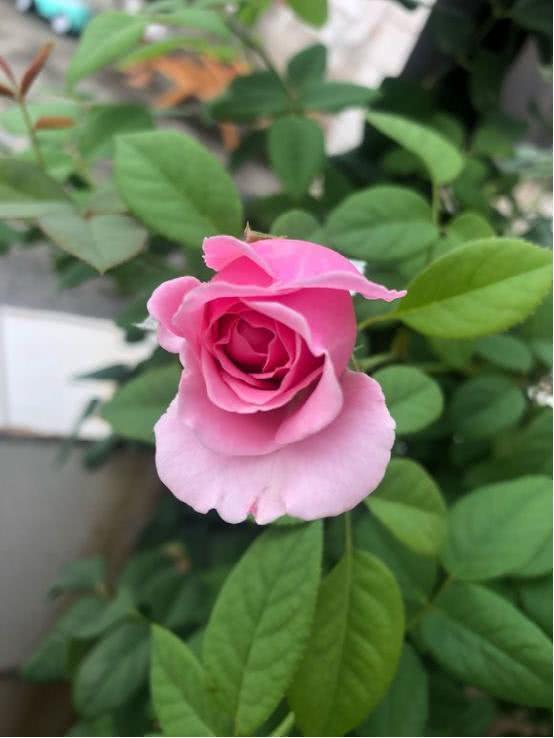
Many people are hopelessly confused about Chinese roses and Rosa multiflora. The two are practically relatives, and they really are quite similar - both the plants and the flowers share certain similarities. So for those friends who want to buy Chinese roses, how can they know whether what they bought is actually a Chinese rose or a Rosa multiflora?
Image: Chinese rose
Many flower enthusiasts suggest judging whether it is a Chinese rose or a Rosa multiflora by counting the leaves. Generally speaking, for most Chinese rose varieties, the number of leaves on a single small branch is five or seven, while for most Rosa multiflora varieties, the number of leaves on a single small branch is seven or nine. But this is only the general case.
Chinese roses can have three leaves, five leaves, or seven leaves, and in modern Chinese roses, the same branch may grow a side shoot with three leaves, a side shoot with five leaves, and also a side shoot with seven leaves. So in fact, leaf count can only serve as an auxiliary reference value, not an absolute one.
Image: Chinese rose
Some observant flower enthusiasts also notice: why do Chinese roses sometimes have an even number of leaves, like eight or six? Actually, under normal growth conditions for Chinese roses, the leaves on a single small branch are all odd-numbered - leaves in symmetric pairs, plus one leaf at the very tip, adding up to an odd number.
Image: Chinese rose
The appearance of an even number of leaves actually just indicates that the Chinese rose's growing conditions are somewhat unhealthy. Insufficient nutrients, imbalanced nutrients, inadequate water, insufficient sunlight, and so on can all lead to this abnormal growth condition, but it is nothing serious - generally only a few individual small branches will show even-numbered leaves.
Image: Rosa multiflora
Chinese rose leaves are relatively flat, without wrinkles, and the leaves are larger. Without artificial branch bending, the naturally growing branches are mainly upright, and the thorns are relatively few. What about Rosa multiflora then? Its more notable features are that both sides of the leaves are covered in fine hairs, the leaves are smaller, and the leaf edges have a ring of dark red tooth marks. The branches grow in a trailing manner (that is, they do not grow upright), and the thorns are relatively numerous.