How to grow Aralia elata shoots? Detailed explanation of planting techniques
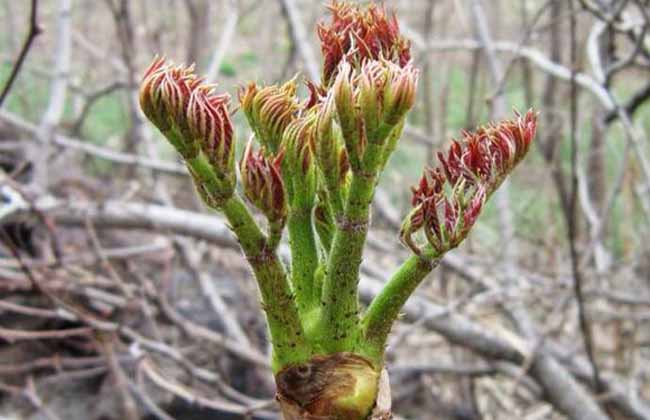
Aralia elata is also known as Aralia chinensis, cilaoya, Longya Aralia, Huyangci, etc. It grows at forest edges, in thickets and forest clearings. The young shoots are the edible part, and there are many ways to eat them: raw, stir-fried, pickled in sauce, made into soup, used as filling, or processed into small pickles with different flavors. It is a famous premium wild mountain vegetable, known as the “king of wild mountain vegetables.” Now let us take a look at Aralia elata planting techniques!
Aralia elata planting prospects
Aralia elata grows freely in the natural environment and does not have high requirements for environmental conditions. It has a high propagation rate from seed, grows fast, and requires little cost input, with no risk at all, and the operation process is easy to master. Artificial cultivation is still in its infancy, resources are decreasing, and social demand is increasing, so there is a huge domestic and international market. A plate of Aralia elata in a high-end restaurant is worth hundreds of yuan. However, due to years of harvesting, the plants die off, wild resources are destroyed year by year, and output declines year by year. Production can no longer meet market demand, so developing artificial production of Aralia elata is urgent. Therefore, artificial cultivation of Aralia elata has very broad development prospects.
Aralia elata planting benefits
1. Yield: When planting Aralia elata artificially, two plants are set per sq m. Through artificial domestication, the yield per plant can reach 0.5-1.5 kg. Calculated by large mu, 2000 plants are set per mu, and the yield can reach about 1.5 tons.
2. Benefits: Aralia elata is extremely rich in nutrients, and moreover the amount of natural wild plants is very small. The international market price is about 5000-10000 yuan per ton, and the economic income per mu can reach about 75000-15000 yuan.
Aralia elata seed seedling raising
1. Open-field seedling raising: Beds can be made in autumn or spring. Choose a flat plot, loosen and refine the soil, apply 300 kg of decomposed farmyard manure per mu, and 50 kg of nitrogen, phosphorus, and potassium compound fertilizer, applied all at once together with land preparation. Then make beds 1.2 m wide and 10 cm high. After the beds are made, sowing can begin. The sowing time is set from late March to Qingming Festival. Aralia elata seeds are very small. In order to improve sowing quality and make it uniform, fine sand should be mixed in when sowing, at 10-15 kg per mu.
2. Pot tray seedling raising: Use plastic pot trays to raise seedlings in advance in a greenhouse. The time can be set about 2 months before transplanting. The substrate can use crushed peat with a small amount of decomposed high-quality farmyard manure and compound fertilizer. In order to increase viscosity, a small amount of yellow mud also needs to be added to the substrate. When sowing, first fill the pot trays with substrate to 3/4 of their depth. After watering, sow the treated seeds. To be safe, it is best to sow 15-20 seeds per hole on average. After sowing, cover thinly with a layer of substrate or mountain topsoil, and then spread a thin layer of vermiculite powder on top.
Aralia elata planting techniques
1. Planting time: When Aralia elata seedlings grow to more than 10 cm and many prickles grow out on the stems, they can be planted. The seedlings to be planted must be planted after ventilation, water control, and hardening off. Generally, this is done in early spring when the 10 cm soil temperature reaches above 12°C. The method is the same as planting trees.
2. Planting density: Aralia elata has developed roots and luxuriant branches and leaves. If the row spacing is too narrow, it will inevitably affect ventilation and light penetration, causing the stems to grow excessively. Planting one plant per sq m is more reasonable. The row spacing can be appropriately wider. The best design method is 1.8 m row spacing and 0.6 m plant spacing, so that 700 holes can be planted per mu.
Aralia elata planting management
1. Weed control: In the first year, it is very easily harmed by weeds. Generally, the herbicides used for legume crops have a good effect, but which pesticide is most effective for weed control in Aralia elata still needs further testing. If manual weeding is adopted, then care must be taken not to damage the root system during hoeing. After summer, Aralia elata has grown to a certain height and its branches and leaves have also become luxuriant. At this time, the threat of weeds can be left to uncontrolled management.
2. Water management: Water management is mainly to prevent spring drought. Plots for propagating stems also need to be close to a water source. Once drought occurs, water immediately to ensure uniform and strong seedlings. In addition, although Aralia elata likes water, it is not tolerant of waterlogging. Therefore, once floods or waterlogging disasters occur, ditches should immediately be dug around the plot to drain waterlogging and alleviate the disaster.
3. Pruning and branch training: The pruning principle for Aralia elata is to make plant height suitable for harvesting, promote the development of more branches and roots, and increase yield. When pruning, cut close to the base of the branch, keep 4-6 lateral buds, and cut off the upper part. Pruning should be completed in early spring before sap flow, and during the growing season it can be done after harvest.
4. Reasonable topdressing: When planting Aralia elata, topdressing should be carried out appropriately according to soil fertility and growth vigor. Both farmyard manure and chemical fertilizer can be used. Farmyard manure can be spread directly on the beds, ridges, or holes, while chemical fertilizer should be applied in dug holes and covered with soil.
5. Timely harvesting: After the terminal bud of Aralia elata is broken off, 1-5 lateral buds below the terminal bud or secondary buds of the terminal bud sprout, so it can be harvested multiple times. It is best to harvest 2-3 times; do not harvest many times, so as not to exhaust the tree. Young shoots are suitable when 10-15 cm and the leaves have not yet unfolded. Lateral bud leaves unfold early, so they can be harvested at 5-10 cm.