Is wild celery the same vegetable as celery?
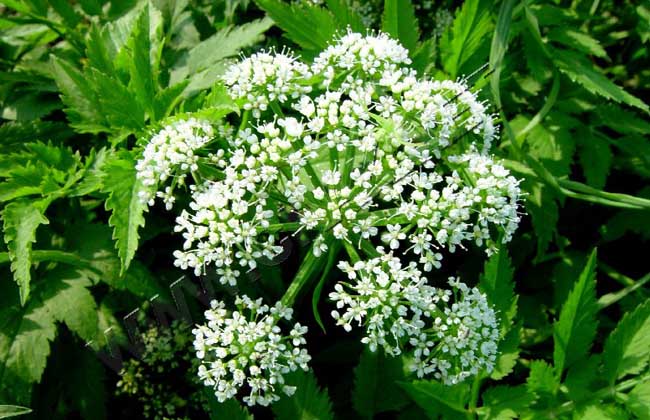
Wild celery is not celery. The Chinese scientific name of wild celery is poison hemlock, also known as baitouweng, poison ginseng, celery-leaf hook, spotted poison hemlock, zhoumaqin, etc. It is a perennial herbaceous plant of the genus Cicuta in the Apiaceae family, distributed in the North Temperate Zone. In China it is distributed in swampy watersides or ditch edges in the Northeast, Northwest, and North China regions. Its leaves resemble celery leaves, it blooms in summer, and the whole plant has a foul odor.
Wild celery grows 70-100 cm tall. The main root is shortened, with branch roots that are fleshy or fibrous. The rhizome is jointed, with transverse diaphragms inside, and brown. The stem is erect and solitary, cylindrical, hollow and striped, sometimes slightly purplish at the base, branched above, with the branches ascending and spreading. The leaf sheaths are membranous. The leaf blade outline is triangular or triangular-lanceolate, with segments linear-lanceolate or narrowly lanceolate. The upper stem leaves have short petioles, and the leaf blade division shape is like that of the basal leaves. The ultimate segments are narrowly lanceolate, with sparsely serrate margins.
The compound umbels of wild celery are terminal or axillary. The involucre usually absent or with 1 linear bract. The involucel bracts are numerous, linear-lanceolate. The umbellules have 15-35 flowers, and the pedicels are 4-7 mm long. The calyx teeth are obvious, ovate-triangular. The petals are white, obovate or nearly round, with an inflexed small tongue at the apex. The filaments are about 2.5 mm long, the anthers are nearly ovate, the stylopodium is flattened when young, and the styles are short and reflexed outward. The schizocarp is nearly ovate, constricted at the commissure, with broad ribs, corky, and the endosperm is slightly concave on the ventral side. The flowering and fruiting period is July-August.
Wild celery grows under mixed forests, in wetlands, or by ditches at altitudes of 400-2900 m. In the world it is distributed in the Far East region of the Soviet Union, Mongolia, Korea, and Japan. In China it is produced in Heilongjiang, Jilin, Liaoning, Inner Mongolia, Hebei, Shaanxi, Gansu, Sichuan, ** and other provinces and regions. It was historically cultivated in Xinghua, Jiangsu.
Wild celery is one of the highly toxic plants. Its toxic component, cicutoxin, is a neutral resin-like substance with picrotoxin-like action. It is easily soluble in alcohol and alkaline solutions, and is mainly contained in the root, but also present in other parts. Cicutoxin is very easily absorbed. If a person eats it, poisoning occurs within minutes, and the lips often blister (even blood blisters). The main toxicity is in the central nervous system, with a very significant convulsant effect. After poisoning there are dizziness, vomiting, spasms, skin redness, and a blue complexion, and finally paralysis appears, with death from respiratory failure. The toxic dose for humans is 30-60 mg, and the lethal dose is 120-150 mg.