What plant is the wild Sichuan pepper? An article to help you get to know it
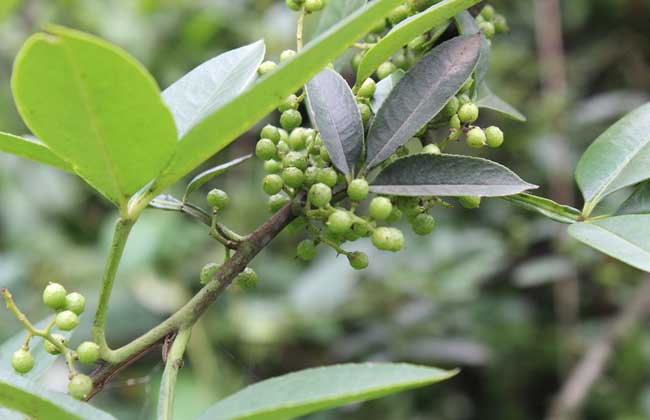
The wild Sichuan pepper, also known as green Sichuan pepper, local Sichuan pepper, and other names, is a deciduous shrub or small tree of the genus Zanthoxylum in the family Rutaceae. It can be planted as a specimen plant or used as a protective thorn hedge. It grows mostly in the wild, but can also be cultivated artificially. Its form is similar to that of Sichuan pepper, and the most important difference is that the leaves of the wild Sichuan pepper are thick and papery, with transparent glandular dots on both sides. The fruit is nearly spherical and ranges in color from yellow-brown to purplish-red. Used as medicine, it warms the middle and removes dampness, dispels wind and expels cold, and has the effects of relieving pain, strengthening the stomach, resisting bacteria, and expelling roundworms.
The leaves of the wild Sichuan pepper have 5 to 15 leaflets. The leaf rachis has a narrow leafy margin, and its upper side is grooved and sunken. The leaflets are opposite, sessile, or with very short petiolules when located at the base of the rachis. They are ovate, ovate-elliptic, or lanceolate, 2.5 to 7 cm long and 1.5 to 4 cm wide, slightly asymmetrical on both sides, with an acute or shortly pointed apex that often has a notch. There are many oil dots, which are semi-transparent after drying and often slightly raised, sometimes with pit-like depressions. The leaf surface often has bristle-like fine prickles, the midvein is sunken, and the leaf margin has sparse, shallow, blunt teeth.
The cymose inflorescence of the wild Sichuan pepper is terminal, 1 to 5 cm long. The tepals are 5 to 8, narrowly lanceolate, broadly ovate, or nearly triangular, sometimes differing in size and shape, about 2 mm long, and pale yellow-green. The male flowers have 5 to 8 stamens, and both the filaments and the semicircular raised rudimentary pistil are pale green, with 1 oil dot at the tip of the connective that turns dark brown-black after drying. The tepals of the female flowers are narrowly long lanceolate, with 2 to 3 carpels, and the style bends obliquely backward. The flowering period is from March to May, and the fruiting period is from July to September.
The wild Sichuan pepper is suitable for warm and humid conditions and deep, fertile loam or sandy loam soil. It has strong sprouting ability, is cold-resistant, drought-resistant, likes sunlight, has strong disease resistance, and its dormant buds have a long life, so it tolerates heavy pruning. It is not tolerant of waterlogging, and short-term water accumulation can cause death. It is produced in Qinghai, Gansu, Shandong, Henan, Anhui, Jiangsu, Zhejiang, Hubei, Jiangxi, Taiwan, China, Fujian, Hunan, and northeastern Guizhou. It is found on flat ground, low hills, or in sparse or dense forests on slightly higher mountain areas.
The fruit of the wild Sichuan pepper is used as an herbal medicine. It is warm in nature, pungent in taste, and numbs the tongue. It has the effects of warming the middle and dispersing cold, strengthening the stomach and removing dampness, relieving pain and killing parasites, detoxifying and regulating qi, and relieving itching and removing fishy odors. It can be used to treat conditions such as food stagnation, retained fluids, hiccups, vomiting, joint and muscle pain caused by wind-cold-damp pathogens, cold pain in the epigastrium and abdomen, diarrhea, dysentery, roundworms, and genital itching.