Detailed Explanation of Key Techniques and Management Methods for Cherry Tomato Cultivation
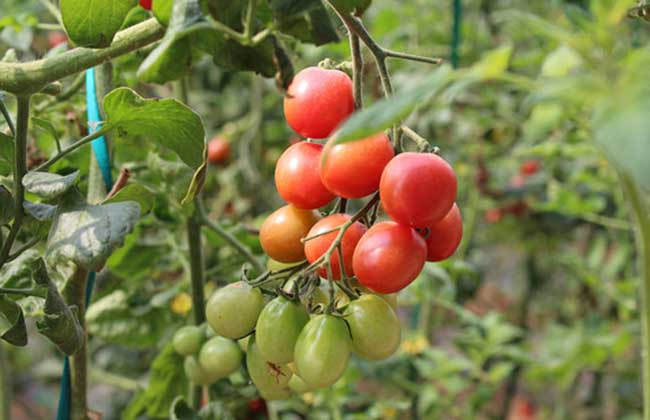
Cherry tomato, also known as small tomato, is an annual herbaceous plant of the genus Solanum in the nightshade family. The plant can grow up to 2 m at its tallest. It can be cultivated year-round in China. In the north, it grows only one season per year. In South China, the climate is suitable for growth, and from July and August each year until February of the following year, open-field cultivated cherry tomatoes with pure flavor can be eaten. Now let us take a look at cherry tomato cultivation techniques!
Cherry Tomato Growth Habits
The suitable temperature for cherry tomato growth and development is 23-28°C, with a night temperature of 15-18°C, an average temperature between 18-21°C, a daily maximum temperature between 20-24°C, and an average of 5 hours of sunlight per day. The soil moisture requirement is 60-80%, and slightly acidic soil with deep, loose, fertile layers and a pH of 6-6.5 is suitable. The fertilizer requirement is relatively high, and sufficient nutrients should be ensured at all stages, but the fertilizer demand differs somewhat among growth stages. In the early stage, nitrogen fertilizer is emphasized; in the later stage, potassium fertilizer is emphasized; phosphorus fertilizer is needed throughout the growth period, but potassium fertilizer demand must be ensured during the entire growth period.
Cherry Tomato Sowing and Seedling Raising
1. Seedbed preparation: The cherry tomato seedbed should be sheltered from wind, facing the sun, and well-drained. Each mu of field requires 6-7 sq m of seedling bed and 35-40 sq m of transplanting bed. For the subsoil of the seedbed soil, apply 1500 kg of decomposed human manure per mu, and spread 8 cm of nutrient soil on top. The nutrient soil is made of half fully decomposed organic fertilizer and half fertile soil that has not previously grown nightshade crops. Mix and sieve 7-10 days before sowing, mix in 5 kg of superphosphate, spray carbendazim for soil disinfection, and pile it for later use.
2. Sowing time: Cherry tomato has strong adaptability. Through different sowing periods and different facility cultivation, four-season production and year-round supply can be achieved. Usually, in the north, spring sowing is from April to June or autumn sowing is from August to September; in the south, spring sowing is from February to June or autumn sowing is from August to October; field planting can be done from August to February of the following year.
3. Germination promotion and sowing: Use 20 grams of seed per mu for cherry tomato. Soak in 1000-fold potassium permanganate solution for 10 minutes, then rinse with clean water and soak in warm water for 6 hours. Wash the seeds, shake off the water, keep them moist with wet gauze, and germinate at about 25°C. Sow after the seeds show white. Because the seeds are expensive, in order to ensure a high plant survival rate, the seeds are required to be sown individually by seed, and covered with 0.5 cm of nutrient soil. Maintain a relatively high temperature before emergence. After emergence, to prevent excessive growth, attention should be paid to ventilation.
4. Post-sowing management: At the two-true-leaf-one-heart stage of cherry tomato seedlings, select healthy disease-free seedlings and perform false planting on a sunny evening with fertilizer, medicine, and soil. The false planting bed is the same as the seedling bed. After false planting, water to settle the roots. At the same time, copper ammonium complex or Lüheng No. 2 can be used to control damping-off and early blight, spraying once every 7-10 days for 2-3 consecutive times.
Cherry Tomato Cultivation Management
1. Reasonable fertilization: Cherry tomato has a developed root system and vigorous growth. Fertilizer should be mainly organic fertilizer, combined with compound fertilizer. Apply 2500 kg of decomposed compost or barnyard manure per mu, or 2000 kg of human and livestock manure, or 100 kg of rapeseed cake, 30 kg of compound fertilizer, and 50 kg of superphosphate as base fertilizer. Regulate growth through water management. Before harvesting the fruit, for every 2-3 clusters of fruit harvested, apply liquid fertilizer 2-3 times according to the strength of growth, but appropriately increase potassium fertilizer.
2. Reasonable irrigation: Cherry tomato is a vegetable crop that flowers and fruits continuously. After entering the flowering period, watering should follow the principle of seeing moisture and seeing dryness (meaning water thoroughly at one time, then wait until the soil is almost dry before watering the second time; the purpose is to prevent root rot caused by overwatering and diseases and pests caused by moisture). Do not water too much, and do not let it dry out, otherwise it will cause flower and fruit drop and physiological fruit cracking.
3. Pruning and trimming: For determinate varieties of cherry tomato, try to promote their growth, always leaving 2 strong side branches on the upper part to grow upward, and pay attention to the balance between leaf number and fruit number. If growth is too weak, some flower buds can be removed. For indeterminate types, if early maturity is not the goal, double-stem pruning can be used. Because seeds are relatively expensive, production mostly uses single-stem pruning. To achieve the goals of improving quality, enhancing light, promoting ventilation, and preventing disease, old leaves below the fruit clusters that have been harvested can be removed.
4. Pest and disease control: For cotton leafworm and cotton bollworm on cherry tomato, 600-800-fold trichlorfon or dichlorvos solution can be sprayed. For aphids, 1000-fold 10% imidacloprid solution can be sprayed. Common diseases include damping-off, early blight, bacterial wilt, and viral disease. In the early stage of disease onset, 500-fold 64% oxadixyl wettable powder, or 400-500-fold 70% zineb wettable powder, or 500-600-fold 50% thiophanate-methyl can be sprayed for control.
5. Harvesting and packaging: Because cherry tomato has high sugar content, harvesting only when fully mature can truly reflect its inherent flavor and quality. When harvesting, be careful to keep the calyx and pick by hand from the abscission layer of the fruit stalk. However, yellow fruit can be harvested at 80% maturity, and the flavor is instead good, because the flesh is prone to deterioration after full maturity. Hard paper boxes are suitable for packaging to avoid crushing. Usually 500 grams is a small package, and 5000 grams is a large hard paper box or hard plastic box. The box has ventilation holes to prevent water droplets, so as not to affect transport and storage time.
Key Points for Cherry Tomato Cultivation
1. Variety: Choose mid-to-late maturing varieties among indeterminate growth types, and plant Taiwan Ruby (namely Xinshengnü), which has a long production period, high yield, and strong heat and moisture tolerance.
2. Seedling raising: Because cherry tomato seeds are relatively small, more attention should be paid to sowing quantity and temperature and humidity management. Germination occurs at about 27°C soil temperature. After germination, it is appropriate to lower the soil temperature to 20°C. Pay attention to ventilation. When the first true leaf grows but has not yet grown as large as the cotyledons, it should be moved to a seedling pot to promote flower bud differentiation.
3. Field planting: Choose soil with deep layers, convenient drainage, and fertile soil, and preferably a plot that has not previously grown nightshade crops. After land preparation and fertilization, make 30 cm high beds, with two rows per bed, and plant spacing of 30-45 cm, which is good for pruning. To reduce pests and diseases, control weed growth, prevent fruit rot, keep fruit clean, and improve commodity value, when planting, it is generally standard to plant seedlings with buds on the first inflorescence.
4. Tying vines: After cherry tomato field planting and recovery, trellises should be inserted and vines tied in time. Early-maturing self-topping varieties should have low trellises, with a trellis height below 1 m. For tall-trellis varieties, the trellis height should be above 1.5 m. Generally, A-shaped trellises and vertical trellises are inserted, and the trellis poles should be sturdy and firm to prevent lodging. Tie the vine from above the first cluster of fruit, tying the stem to the trellis, and thereafter tie once every 2-3 leaves. Pay attention to tightness when tying vines: tie tighter when the plant is growing vigorously, and tie looser when growth is weak.
5. Leaf removal: During cherry tomato cultivation, to achieve the goals of improving quality, enhancing light, promoting ventilation, and preventing disease, old leaves below the fruit clusters that have been harvested can be removed.
6. Fruit setting: Cherry tomato cultivation usually uses an electric vibrator for pollination. For some varieties cultivated in seasons with poor pollination, the vibrator effect is poor, so spraying 4-CPA is used to prevent flower and fruit drop.
7. Shoot thinning: According to the growth condition of cherry tomato, it can be divided into two methods: single-stem pruning and double-stem pruning. Single-stem pruning keeps only the main stem and removes all side buds. Double-stem pruning, in addition to the main stem, keeps only one side branch growing from the leaf axil below the first inflorescence, and removes all other side buds. When removing buds, attention should be paid to doing it early, preferably on a sunny day. Keep the wound dry to avoid infection by pathogens. If done on a rainy day, spray medicine immediately after the operation to prevent disease.