How to prevent and control pests and diseases in garland chrysanthemum? A detailed explanation of key practical techniques
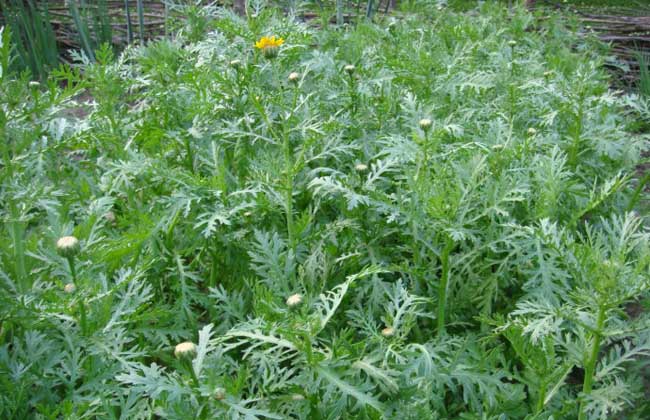
Garland chrysanthemum is a semi-cold-tolerant vegetable with low light requirements; generally, weaker light is preferable. It originated in the Mediterranean and has a cultivation history of more than 900 years in China, and it is widely distributed, but the cultivation area across both the north and south is very small. During cultivation, attention must be paid to pest and disease control. Let us take a look at the pest and disease control techniques for garland chrysanthemum below!
Damping-off
[Symptoms] It mostly occurs in the middle and late stages of seedling raising. It mainly harms the base of the seedling stem or the underground root system. At first, oval or irregular dark brown lesions appear. In the early stage, diseased seedlings wilt during the day and recover at night. The diseased part gradually becomes sunken and constricted, and some gradually turn dark brown. When the lesion expands and encircles the stem once, the plant finally dries up and dies, but it does not lodge. Mildly diseased plants only show brown sunken lesions and do not die. When the seedbed humidity is high, a not very obvious light brown spiderweb-like mold can be seen on the diseased part.
[Control] In the early stage of disease onset, spray 38% oxadixyl, pyrimethanil and copper fungicide 800-fold solution, or 41% polyoxin · pyrimethanil 600-fold solution, or 20% tolclofos-methyl EC 1200-fold solution, or 72.2% Previcur AS 800-fold solution, once every 7-10 days. Alternatively, dilute Dajiangjun + MenShen at 600-fold and irrigate the seedbed at 3 liters per sq m before sowing, after sowing, and before transplanting. At transplanting, after transplanting, and before the expected period when disease commonly occurs, dilute this product at 600-fold for root irrigation, applying once every 7 days, with the number of applications depending on the condition of the disease.
Leaf spot
[Symptoms] Cockscomb leaf spot infects leaves, petioles and stems. Leaf lesions are round, then expand into irregular large lesions and develop concentric rings. The lesions change from reddish brown to dark brown, with a grayish brown center. Lesions on stems and petioles are brown and elongated. Fishtail palm leaf spot produces small dark brown round spots on leaves, which later expand or merge into irregular large patches, with slightly raised edges and small black dots scattered on both sides of the leaf. Clivia leaf spot (leaves have oval, elongated light reddish brown lesions surrounded by chlorotic halos, which later expand into irregular large patches, and black dots are produced on the lesions).
[Control] In the early stage of disease onset, spray 20 ml of 4% pyrimidine nucleoside antibiotic + 20 ml of 41% polyoxin pyrimethanil, diluted in 15 kg of water, once every 5-7 days, for 2-3 consecutive applications.
Sclerotinia rot
[Symptoms] It mainly harms stems and vines, leaves and fruits. When the stem base is infected, water-soaked spots first appear, then expand and become light brown, causing soft rot or longitudinal splitting of the stem base, and white cotton-like mycelium grows on the surface of the diseased part. When leaves are infected, gray to grayish brown wet-rot large spots appear on the leaf surface. The boundary between the lesion edge and healthy tissue is not obvious. When humidity is high, flocculent white mold appears on the spot surface, eventually causing the leaves to rot. When fruits are infected, water-soaked spots first appear and after expansion become wet rot, densely covered with white cotton-like mycelium. In the later stage of disease, varying numbers of black mouse-dropping-like sclerotia appear on the surface of the diseased part.
[Control] In the early and middle stages of disease onset, use 30 ml of 20% simeconazole and prochloraz + 25 ml of oxadixyl and kresoxim-methyl, diluted in 15 kg of water, once every 5-7 days, for 2-3 consecutive applications.
Cabbage webworm
[Symptoms] Early-instar larvae bore into and feed on the heart leaves of young seedlings, spin silk and form webs. In mild cases, they affect the growth of the seedlings; in severe cases, they can cause the seedlings to dry up and die, resulting in missing plants and broken rows. Older larvae, in addition to chewing the heart leaves, can also bore into the stem pith and roots, and can transmit bacterial soft rot, causing the plants to rot and die.
[Control] At the peak of larval hatching, or when heart leaf damage and silk webs are first seen, apply 5% chlorfluazuron EC 4000-fold solution by spraying 2-3 times, and be sure to spray the pesticide onto the heart leaves.
Aphids
[Symptoms] Aphids are pests with piercing-sucking mouthparts. They often gather on leaves, tender stems, flower buds, terminal buds and other parts, sucking sap, causing leaves to shrivel, curl and become deformed. In severe cases, they cause branches and leaves to wither and even the whole plant to die.
[Control] When the aphid count reaches 500 per 100 plants in the field and the ratio of beneficial insects to pests is greater than 1:500, use 50 ml of 25% yamanqing EC per mu, or spray a series of imidacloprid products at 1500-2000-fold solution, 60-70 g of 10% yashijing, 20% imidacloprid 2500-fold solution, or 25% pirimicarb 3000-fold solution for control. In wheat regions where wheat aphids have developed resistance to imidacloprid and acetamiprid, the agent should not be used alone and can be reasonably mixed with low-toxicity organophosphorus pesticides for spraying.