Detailed Explanation of Key Technical Points for Garlic Pest and Disease Control
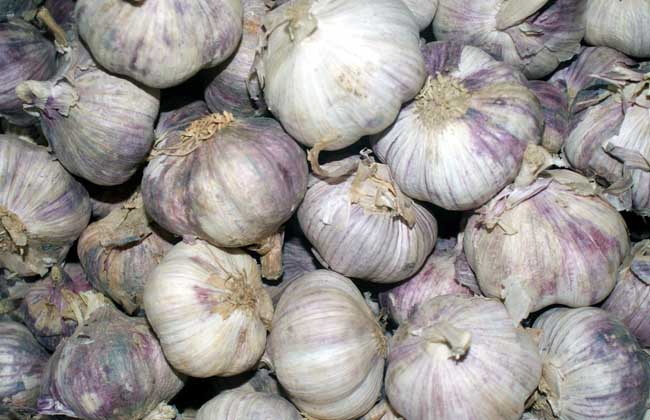
Garlic is a half-year herbaceous plant of the genus Allium in the Liliaceae family, and is the collective name for garlic-type plants. It is widely cultivated across the country. Because garlic often shows different disease symptom manifestations and cannot be controlled promptly and correctly, this leads to severe disease outbreaks and relatively large losses. Below, let us take a look at the common pest and disease control techniques for garlic.
Garlic Purple Blotch
[Disease characteristics] In the field, the disease mostly begins at the leaf tip or the middle of the flower stalk, and after a few days spreads to the lower part. At first, slightly sunken small white spots appear, with a slightly purple center. After enlargement, they become yellow-brown spindle-shaped or oval lesions. When humidity is high, black mold-like material is produced on the diseased area, namely the pathogen's conidiophores and conidia. The lesions mostly have concentric rings and tend to break off easily from the diseased area. During storage, the neck of infected bulbs becomes dark yellow or reddish-brown and soft-rotted.
[Control method] At the early stage of disease, spray 75% chlorothalonil wettable powder at 500-600 times dilution, or 64% oxadixyl wettable powder at 500 times dilution, 40% dabufan wettable powder at 500 times dilution, 58% metalaxyl · mancozeb wettable powder at 500 times dilution, or 50% iprodione wettable powder at 1500 times dilution, once every 7-10 days, for 3-4 consecutive applications, all with relatively good results.
Garlic Soft Rot
[Disease characteristics] Garlic soft rot is a bacterial disease, and low temperature and high humidity favor its occurrence. After garlic is infected, the disease first appears at the leaf margin or midvein, forming yellow-white streaks along the leaf margin or midvein that can run through the entire leaf. When humidity is high, the diseased area becomes yellow-brown and soft-rotted. Generally, the lower leaves are affected first, then it gradually spreads to the upper leaves, causing the whole plant to turn yellow and wither or die.
[Pest control to prevent disease] Because pests create wounds on garlic, this favors invasion by soft rot bacteria, and some pests carry the bacteria internally or externally and directly spread the disease. Therefore, pest control is very important for the control of soft rot. Early on, attention should be paid to controlling underground pests such as wireworms and mole crickets, and from the seedling stage onward, pests such as striped flea beetles and root maggots should be controlled.
[Chemical control] Before disease onset or at the early stage, use 72% agricultural streptomycin at 3000-4000 times dilution, or 47% kasugamycin-copper WP at 750 times dilution, 50% amobam at 1000 times dilution, or new phytomycin at 3000-4000 times dilution, spraying once every 5-7 d, with 2-3 consecutive applications depending on the disease condition. Focus should be placed on lightly diseased plants and the plants around them, and care should be taken to spray the stem base of plants near the soil surface.
Garlic Leaf Blight
[Disease characteristics] Leaf blight mainly occurs on leaves and flower stalks, and mostly spreads starting from the leaf tip. In the early stage, the lesions are small round flower-white dots, and after enlargement they become irregular or oval in shape, appearing gray-white or gray-brown, with black mold-like material produced. In severe cases, the diseased leaves wither and die. If the flower stalk is affected, it tends to break at the diseased area, and many small black dots are produced there, making it difficult for garlic to bolt.
[Control method] Strengthen field management, maintain reasonable planting density, increase the application of comprehensive nitrogen, phosphorus, and potassium fertilizers, add biological multi-antibacterial fertilizer, cultivate strong seedlings, drain promptly after rain, and prevent waterlogging in the field. You may spray 75% chlorothalonil or 65% zineb at 500 times dilution, 50% leaf blight powder at 1000 times dilution, or 10% sakulijing powder at 400-500 times dilution.
Garlic Gray Mold
[Disease characteristics] Gray mold mostly occurs in the late growth stage of the plant, starting first from the tips of the lower old leaves. The lesions are initially water-soaked, then turn white or light gray-brown, developing inward from the tip. After the lesions expand, they become spindle-shaped or oval, and gray-brown mold-like material is produced on both sides of the lesions. In severe cases, it can spread from old leaves to all leaves of the whole plant, causing the leaf sheaths and even underground bulbs to rot, with tissue collapse, and later drying to gray-white. Gray mold and sclerotia can be seen on the diseased area.
[Control method] The control method is basically the same as for leaf blight.
Garlic Viral Disease
[Disease characteristics] Garlic viral disease is also called mosaic disease. Affected plants show irregular stripes or spots of dark green and light yellow on the leaves. In severe cases, it causes plant stunting or distortion.
[Control method] Select virus-free garlic seed, strengthen field management, remove diseased plants, control aphids promptly, fertilize comprehensively, apply biological multi-antibacterial fertilizer, and enhance the disease resistance of the plants.
Garlic Mosaic Disease
[Disease characteristics] Garlic mosaic disease is one of the common diseases on garlic. It occurs commonly in all vegetable-growing areas and mainly harms open-field cultivated garlic. In hot and dry years, the disease is severe. In severe cases, it often causes leaf distortion and deformity, plant stunting, and fewer and hardened cloves, directly affecting yield. In the early stage, intermittent yellow streaks appear along the leaf veins, later connecting into long stripes alternating yellow and green. The plant becomes stunted, and in some plants the central leaf is wrapped by adjacent leaves, showing curled deformity and remaining unable to fully extend for a long time, causing leaf distortion and deformity. After infection, the bulbs become smaller, and the number of cloves and fibrous roots decreases. In severe cases, the cloves become hard, especially during storage. The yield and quality of affected garlic decline significantly, causing seed degeneration.
[Control measures] 1) Strict seed selection: establish a foundation seed base as much as possible, use bulbs (cloves) from lightly diseased areas as seed to reduce the virus-carrying rate of bulbs, and where conditions permit, it is best to use tissue-culture virus-free seedlings. 2) Practice crop rotation: avoid continuous cropping or intercropping/rotation with crops such as Welsh onion and Chinese chives. 3) Control aphids to prevent disease: spray insecticides in garlic fields and surrounding crops to control aphids, so as to prevent repeated virus infection. For chemicals, 10% imidacloprid wettable powder at 2000-2500 times dilution may be used. In addition, silver-gray plastic film strips may be hung to repel aphids or insect-proof nets may be used for covering cultivation. 4) Strengthen management: strengthen water and fertilizer management for garlic, avoid premature aging, and improve plant disease resistance.
[Chemical control] Begin spraying for protection at the early stage of disease. Chemicals may include 2% junceduke aqueous solution at 200 times dilution, or 5% jun du qing aqueous solution at 200-300 times dilution, or 1.5% zhibingling emulsion at 1000 times dilution, or 20% virus A wettable powder at 500 times dilution, or 20% kangrun No. 1 wettable powder at 500 times dilution, etc., for spray control. Apply once every 7-10 days, for 2-3 consecutive applications, depending on disease development.
Garlic Rust
[Disease characteristics] Garlic rust is one of the common diseases of garlic and occurs commonly in all vegetable-growing areas. It mainly harms open-field cultivated garlic, Welsh onion, scallion, onion, and others. In years with low temperature and much rain in early spring, much rain during the plum rain period, or much fog and rain in autumn, the disease is severe. In severe cases, it often causes leaf blades to be densely covered with blister-like spots, directly affecting garlic leaf yield and quality, and indirectly affecting garlic bulb yield. It mainly harms leaves and false stems. In the early stage, spindle-shaped chlorotic spots appear, and later slightly raised round or oval uredinia form under the epidermis. After the epidermis ruptures, orange-yellow powder is released (the pathogen's uredinia and urediniospores). The lesions are surrounded by pale yellow halos, and later the lesions join together, causing the entire leaf to turn yellow and wither, and the plant dies prematurely. In the late growth stage, black telia that do not rupture the epidermis are produced on unruptured uredinia.
[Control measures] 1) Scientific fertilization: apply sufficient organic fertilizer, increase phosphorus and potassium fertilizer to improve disease resistance, and avoid over-application of nitrogen fertilizer. 2) Crop rotation: carry out crop rotation with non-Allium crops for more than 2 years. 3) Clean the field: remove diseased residues promptly and take them out of the field for centralized destruction.
[Chemical control] Begin spraying for protection at the early stage of disease. Chemicals may include 40% flusilazole emulsifiable concentrate at 5000-6000 times dilution, or 10% difenoconazole water-dispersible granules at 1500 times dilution, or 15% triadimefon wettable powder at 1500 times dilution, or 70% pinrun dry suspension at 600-800 times dilution, or 25% propiconazole emulsifiable concentrate at 3000 times dilution, or 75% mebenil wettable powder at 1000 times dilution, etc., for spray control. Apply once every 7-10 days, for 2-3 consecutive applications, depending on disease development.
Onion Fly
[Damage characteristics] The adult is a small gray fly with transparent wings, and the larva resembles a dung maggot. In the central-south region, generally 4-6 generations occur per year. Late March to early May and September to early October are the peak periods of larval damage. The larvae generally bore into the bulbs of sown garlic and onion to feed. Dozens of larvae are often found in one bulb. The affected bulbs are hollowed into holes, causing rot, yellowing of leaves, and wilting leading to death.
[Control method] Apply fully decomposed organic fertilizer, apply it evenly and deeply to prevent adults from laying eggs and reproducing, strictly select seed, remove rotten and damaged garlic cloves, and isolate seed from fertilizer when sowing. Where seed flies are numerous, sugar-vinegar liquid may be used to trap and kill adults, with the ratio sugar:vinegar:water = 1:1:2.5, adding a small amount of trichlorfon and mixing well, pouring it into a container with sawdust and covering it. Open the cover during the day on sunny days to trap and kill. Use biological multi-antibacterial fertilizer added to the base fertilizer, and additionally spray liquid biological multi-antibacterial fertilizer at 200 times dilution during the seedling stage. When adults are laying eggs, use mieshabi at 6000 times dilution or 2.5% deltamethrin at 3000 times dilution, spraying once every 5-7 days, for 2-3 consecutive applications.