What regions are the main production areas of peas distributed in?
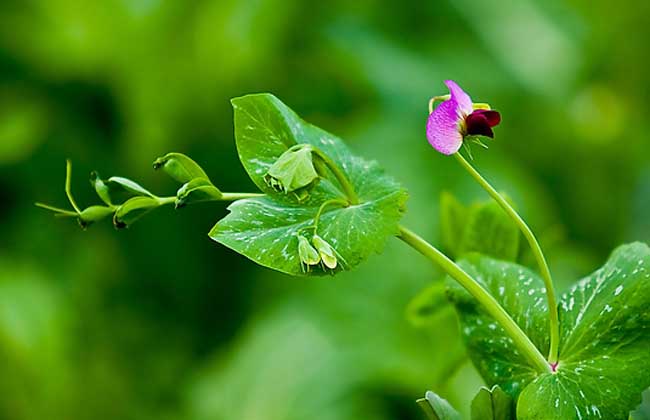
Peas are also known as green peas, snow peas, small cold peas, Huai beans, hemp beans, green small beans, liu beans, etc. They belong to long-day cold-season legumes and originated thousands of years ago in western Asia, the Mediterranean region, Ethiopia, and western Asia Minor, and all of the South Caucasus. Iran and Turkmenistan are secondary centers of origin. China is the world's second-largest pea producer after Canada. Let's take a look at the production area distribution of peas below!
The place of origin of peas
Soviet botanist Vavilov believed that the centers of origin of peas were Ethiopia, the Mediterranean, and Central Asia, with the Near East as a secondary center of evolution. Some also believe it originated from southern Caucasus to Iran. Peas were first introduced eastward from their place of origin to northern India, then through Central Asia to China, introduced to Japan in the 16th century, and introduced to the United States after the discovery of the New World.
In Central Asia, the Near East, and northern Africa, there is also a wild species of the genus Pisum, the Mediterranean pea, distributed there. This species can be crossed with currently cultivated peas and produce fertile offspring, and may be the primitive type of modern peas. Peas are now the world's fourth-largest legume crop.
Pea production area distribution
1. Domestic production areas: In China, peas are mainly distributed in central, northeastern, and other regions. The main production areas include Sichuan, Henan, Hubei, Jiangsu, Qinghai, Jiangxi, and several other provinces and regions.
2. Foreign production areas: The main foreign production areas of peas include western Asia, the Mediterranean region, Ethiopia, and western Asia Minor.
The production environment of peas
1. Peas are long-day plants that prefer cool and moist climates. They are cold-tolerant but not heat-tolerant. Seedlings can withstand low temperatures of 5°C. The suitable temperature during the growing period is 12-16°C, and the suitable temperature during the pod-setting period is 15-20°C. Above 25°C, the fertilization rate is low, fewer pods are set, and yield is low. The growth period of most varieties is shorter in the north than in the south. Southern varieties moved northward flower and set pods earlier. This is because spring sowing in the north shortens the seedling period that would otherwise overwinter in the south. Therefore, in the north, the growth period of peas is 65-75 days for early-maturing varieties, 75-100 days for mid-maturing varieties, and 100-185 days for late-maturing varieties.
2. Peas have low soil requirements and can be planted in well-drained sandy loam or newly reclaimed land. Neutral soil (pH 6.0-7.0) that is loose and contains relatively high organic matter is suitable, as it is favorable for emergence and the development of rhizobia. When soil acidity is below pH 5.5, diseases are more likely to occur and the pod-setting rate decreases, so lime should be added to improve the soil.
3. Peas have deep root systems and are slightly drought-tolerant but not moisture-tolerant. Poor drainage at sowing or during the seedling stage can easily cause root rot. Drought during the flowering period leads to poor fertilization and can easily form empty pods or shriveled pods.