When is the best time to plant cabbage?
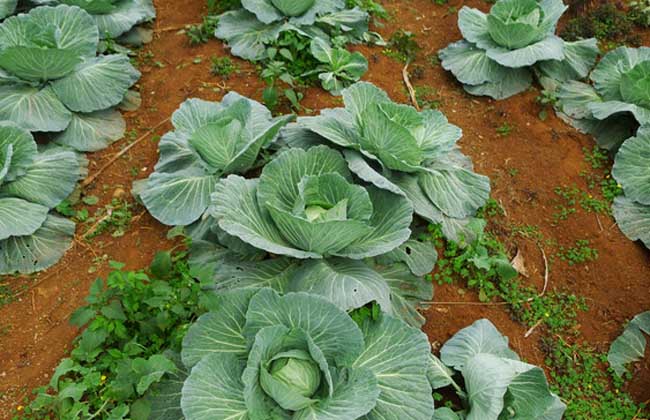
Cabbage, botanically known as head cabbage, originated in the Mediterranean region of Europe and is now widely cultivated throughout China. It is one of the common vegetables and is not strict about planting time and environmental conditions. Let's take a look at the planting time for cabbage!
Cabbage planting time
Cabbage is highly adaptable, tolerating both cold and heat, and in northern China it can be grown in the open field in spring, summer and autumn. In the high-cold regions of Northeast China, Northwest China and North China, it is mostly seeded in spring and summer, transplanted in summer and harvested in autumn, with a long growing period and large heads. In North China and some cities in Northeast and Northwest China, spring and autumn cropping is dominant, and multiple cropping is also possible.
Cabbage planting density
1. Early-maturing varieties: plant spacing of 33-40 cm, 4000-6000 plants per mu.
2. Mid-maturing varieties: plant spacing of 45-50 cm, 2500-3000 plants per mu.
3. Late-maturing varieties: plant spacing of 60-65 cm, 1500-1800 plants per mu.
Cabbage planting conditions
Cabbage has basically the same environmental requirements as Chinese cabbage, but it is more widely adaptable and somewhat more resistant than Chinese cabbage.
1. Temperature: Cabbage likes a mild climate and can withstand severe frost and relatively high temperatures. The suitable temperature during the head-forming stage is 15-20°C, but the adaptable temperature range is 7-25°C; seedlings can endure low temperatures of -15°C and high temperatures of 35°C.
2. Soil: Cabbage requires sufficient soil moisture and humid air; if the soil is dry, head formation will be affected and yield will be reduced.
3. Light: Cabbage is a long-day crop and has a wide adaptability to light intensity, with a light saturation point of 30000-50000 lx.
4. Fertilizer: Cabbage is a fertilizer-loving and fertilizer-tolerant crop with a relatively high nutrient uptake. It needs more nitrogen fertilizer during the seedling stage and rosette stage, and more phosphorus and potassium fertilizer during the head-forming stage. The ratio of nitrogen, phosphorus and potassium absorbed over the whole growing period is about 3:1:4. For every 1000 kg of heads produced, it absorbs 4.1-4.8 kg of nitrogen, 0.12-0.13 kg of phosphorus and 4.9-5.4 kg of potassium. On the basis of sufficient nitrogen fertilizer, combined application of phosphorus and potassium fertilizers has an obvious yield-increasing effect.