What Are the Varieties of Enoki Mushroom? An Introduction to Common Varieties
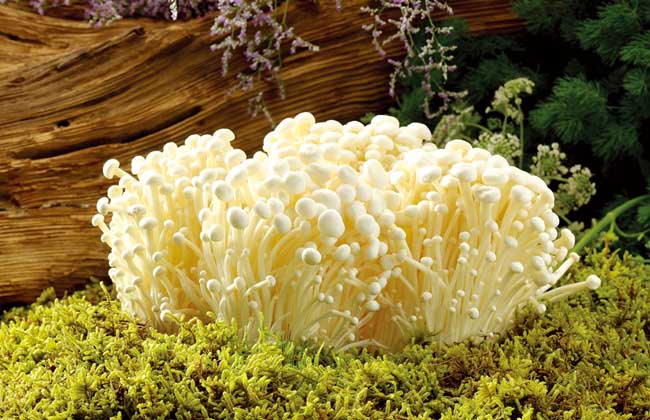
Cultivated enoki mushroom types are classified by the speed and earliness of fruiting into early-fruiting and late-fruiting types; by the temperature at which fruiting occurs into low-temperature and moderately high-temperature types; and by the number of fruiting bodies produced into the fine-dense type (many stalks) and the coarse-sparse type (few stalks). Let us take a look below at what varieties of enoki mushroom there are!
Sanming No. 1 strain
The Sanming No. 1 strain is widely cultivated. Its mycelium grows quickly, filling a test tube in 7 days, and can fill a bottle or bag in 25 to 30 days. It fruits quickly, producing mushrooms in just over 30 days, and has a short cultivation cycle, completing the entire cultivation cycle in 70 to 80 days. It has high yield, with biological efficiency reaching 70% to 100%, and good quality, with uniform stalk thickness and light color. Its content of the 8 amino acids needed by the human body accounts for 44.5% of total amino acids, higher than that of ordinary mushrooms. It has a wide suitable temperature range and can fruit at 3 to 21°C. It has strong stress resistance, with few diseased or deformed mushrooms.
007 and 008 young-fruiting mushroom
The cap is light yellow to yellowish brown. The upper part of the stalk is light in color, white to pale yellow, while the lower part is darker, golden yellow to dark brown, densely covered with short brown fuzz. It has strong stress resistance, and after inoculation the mycelium colonizes the substrate quickly, fruits early, and has relatively high yield. During the growth of the mushroom buds, only weak scattered light (5 to 10 lux) is needed, and the color of the fruiting body deepens as light intensity increases. The dark-colored strain of enoki mushroom has a soft, smooth cap, a crisp, tender stalk, and a rich fragrance, making it suitable for producing fresh mushrooms for the domestic market.
White strain F21
A strain from the Microbiology Research Institute of Jiangshan City, Zhejiang Province. It fruits neatly, with about 200 mushrooms per cluster, a stalk length of 15 to 23 cm, and an inward-curling cap that does not easily open. The white strain is insensitive to light; even if the cultivation environment has strong scattered light, the fruiting bodies remain pure white throughout with a glossy sheen, making them suitable for canning or salt-processing for export.
The white strain of enoki mushroom grows more slowly, has poor stress resistance, and weak resistance to contamination. When cultivated in bottles or bags, the mycelium does not easily colonize the substrate thoroughly. During fruiting, it has weak tolerance to carbon dioxide. In a poorly ventilated environment, although many mushroom buds form, few develop into mature mushrooms, and the stalks tend to twist, become deformed, or rot at the core. This phenomenon is especially severe in the later stages, so in production usually only the first two flushes are harvested, resulting in lower yield. The white strain of enoki mushroom has pure white fruiting bodies and is suitable for processing into export goods. Because of its mild flavor, it is sometimes less popular than the dark-colored strain of enoki mushroom for the domestic market.
Hybrid 19
Bred by the Sanming Fungus Research Institute in Fujian. The fruiting body is white to pale yellow, with the lower part yellow to light brown. The mycelium growth temperature is 3 to 30°C, with an optimum temperature of 22 to 24°C. The fruiting body formation temperature is 3 to 18°C, with an optimum temperature of 13 to 15°C. The biological efficiency is 80% to 120%.
Sujin No. 6
Bred by the Microbiology Research Institute of Jiangsu Province. The fruiting body is white to pale yellow to yellow. The optimum mycelium growth temperature is 22 to 24°C. The fruiting body formation temperature is 3 to 20°C, with an optimum temperature of 13 to 15°C. The biological efficiency is 80% to 120%.
FU088
Introduced and bred by the Microbiology Research Institute of Hebei Province. The fruiting body is pure white and the cap does not easily open. The mycelium growth temperature is 3 to 30°C, with an optimum temperature of 22 to 24°C. The fruiting body formation temperature is 3 to 18°C, with an optimum temperature of about 12°C. The biological efficiency is 60% to 80%.
FV57
“FV57” enoki mushroom is a high-quality, high-yield variety bred by the Vegetable Research Institute of the Gansu Academy of Agricultural Sciences, featuring high yield, high quality, and high biological efficiency. According to measurements, its biological efficiency reaches as high as 83%, 16.6% higher than the control "Hybrid 19" and 12% higher than Jinkou. Its maximum suitable fruiting temperature is 2°C higher than that of "Hybrid 19", and it does not turn brown at 16°C, giving the product high value; its crude protein and soluble sugar are 18.4% and 78.6% higher than those of "Hybrid 19" respectively, while cellulose is reduced by 40%, significantly improving quality.