The mouse melon has a delicious fruity flavor with a hint of banana and lime, and can be eaten directly.
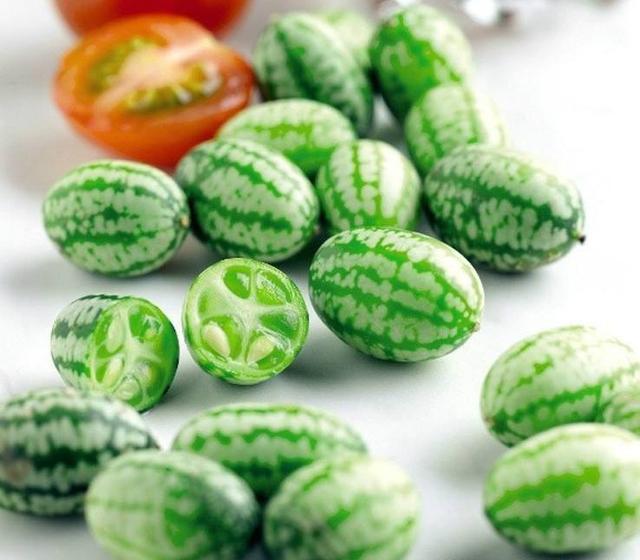
Mouse melon
Pepquino generally refers to the mouse melon
Mouse melon (scientific name: Melothria scabra Naudin): plant height 1.2-1.8 m, fruit spacing 22-30 cm. It is a wild plant from Central America.
Annual or perennial climbing vine, with slender vines climbing along a trellis net.
Leaves palmate, shallowly lobed, growing along the climbing vine, with smaller leaves at the tip. It has curling tendrils.
The vine can reach several feet in length, forming a pergola-like or spiderweb-like hanging curtain.
The fruit is oval, fleshy, just like a miniature version of a small watermelon.
Its appearance is no different from an ordinary watermelon, the flesh inside is blue-green, the texture is crisp and refreshing like a cucumber, and its nutritional value is higher than that of an ordinary watermelon. It can be eaten directly.
Native to Central America. Its habitat is mostly along swamps, beside sandy roads, and in low woods.
It has been successfully cultivated in many places; the growing method is no different from growing cucumbers and is relatively simple. Its main economic value is as food.
Morphological characteristics
The "mouse melon" has a plant height of 1.2-1.8 m and fruit spacing of 22-30 cm. It is a wild plant from South America. Annual or perennial climbing vine, with slender vines climbing along a climbing net. Stems and branches have angular grooves, densely covered with white or slightly yellow stiff hairs. Tendrils slender, undivided. Leaves palmate, 3-7 shallowly lobed, serrate, rough on both sides, covered with short bristles. The largest leaves grow near the base of the plant, about 2 inches long; the leaves grow along the climbing vine, with smaller leaves at the tip. It has curling tendrils. The vine can reach several feet in length, forming a pergola-like or spiderweb-like hanging curtain.
Monoecious, flowers yellow, with very small 5 petals. Fruit oval, fleshy, usually indehiscent, smooth or with tuberculate protrusions.
Seeds numerous, flattened, smooth, hairless, seed margins not arched.
It has exactly the same shape and rind pattern as an ordinary watermelon, only concentrated in size.
The inner flesh is blue-green, the outer skin is smooth and tender, only 3 cm long and 2 cm in diameter, each weighing 6 grams.
Its shape is similar to a sweet potato, its appearance is no different from an ordinary watermelon, the skin is white, the texture is crisp similar to crosne, and the root is stem-like.
The "mouse melon" comes in two colors and shapes: one is pale green with patterns, and the fruit is usually oval; the other is dark green alternating with yellow, and the fruit is generally round.
The "mouse melon" is only 1/20 the size of a large watermelon, with green skin, red flesh, and black seeds; some, when cut open, look like a combination of watermelon and cucumber, with a blue-green interior, and taste like a cucumber with especially high water content. When the "mouse melon" is planted in a flowerpot, the fruit it produces is only 2 cm in diameter, covered all over with spines, looking like a small cactus ball.
Origin and habitat
The "mouse melon", this wild fruit, originates from Central America. Its preferred habitat is along swamps, beside sandy roads, in low woods, on parking lot shrubs, and along the edges of almost any fence.
After a Dutch food producer discovered it, the seeds were brought back to the Netherlands for greenhouse cultivation. In 1987 a Dutch company began planting it in the United States and Asia. The growth cycle is 60 to 85 days, and a single plant's yield can reach 60 to 100 fruits.
Cultivation methods
The "mouse melon" can be cultivated in spring and summer, and should be planted in a place with ample sunlight or in a plastic greenhouse. It is suitable for planting in loose, fertile fields with convenient irrigation and drainage; during the growing period, pay attention to fertilizer and water supply to increase yield. Soil pH that is neutral or slightly acidic helps improve quality. If indoor seedling raising is used, transplanting outdoors after leaves have grown gives better results. It can be grown creeping on the ground or on a trellis; trellising gives a larger yield. The general growth cycle is 60-85 days; after trellising, a single plant is 1.2-1.8 m tall, and each plant yields 60-90 fruits.
Sow from late February to April: germinate at a temperature of about 24°C; when two or three leaves have grown, the temperature can be lowered to about 18-21°C. During the first four weeks of growth, give them enough warmth. Potted plants are usually best placed on a sunny windowsill. The harvest season is from July to September.
Disease control
The mouse melon has very few diseases; in autumn there is sporadic powdery mildew, spray with 25% ethirimol 800-1,000 times dilution, spraying 3-4 times continuously. The main pests are aphids and melon fruit borers. For aphids, spray with 36% acetamiprid granule dispersible agent 3,000-6,000 times dilution; for melon fruit borers, spray with 5% Prevathon (chlorantraniliprole) 1,000 times dilution.
Culinary uses
The fruit of the mouse melon is edible and can be eaten directly; the watermelon seeds are also edible. This watermelon fruit has a delicious flavor, with an aroma similar to banana and lime. The "mouse melon" is generally seen only in high-end restaurants, mainly in salads. This mini watermelon can be eaten in many ways, from salads to desserts: it can be eaten directly as a snack or appetizer, or paired with a simple summer salad as a home-style dish, and can also be made into a stir-fried mouse melon, or its juice made into sorbet to relieve the summer heat; if paired with dark chocolate, the flavor is even better.
Introduction status
United Kingdom
Mini watermelons are now sold on the UK market. After the mini watermelon landed in the UK, it immediately caused a sensation, and major restaurants rushed to order them for people to "try something new."
Chengdu
Liujiang, Xinjin County, Chengdu carried out seedling raising in March 2011, and transplanted them into greenhouses for field planting in early April. Due to abnormal climate in 2011 and lack of experience in the first attempt, in the end only 28 of 100 seedlings survived. Fertilizer and management are no different from ordinary watermelon; it also likes high temperatures, and during the period since June when temperatures reached above 30°C, it grew especially fast. The trial planting was mainly to accumulate experience and explore the market. Once expanded planting is carried out and both the survival rate and fruiting rate have improved, pricing will then be set reasonably according to market conditions.
Hangzhou
In 2011, the Vegetable Research Institute of the Hangzhou Academy of Agricultural Sciences introduced this mini watermelon into Hangzhou. Mini watermelons have a low sugar content and are suitable for some special groups of people to eat. The introduction of mini watermelons, while meeting market demand, has increased the diversity of vegetable and fruit varieties in Hangzhou and provided consumers with more choices.
Huizhou
Luofu Mountain in Huizhou City first introduced mini watermelons to Guangdong. In January 2011, 50 seeds were trial-planted, and by June 2011, 3,000 fruits were successfully produced. They look like watermelons on the outside and like cucumbers on the inside, extremely refreshing, with a slight sweetness. In Guangdong Province, because the climate is relatively suitable, they can be planted year-round; the growing method is no different from growing cucumbers and is relatively simple.
Shanghai
On June 27, 2013, the Gaolao Zhuang Fruit and Vegetable Professional Cooperative in Shanyang Town, Jinshan District successfully grew the "mouse melon." This melon is the size of a cherry tomato, with blue-green flesh and a slightly sweet taste, mini and cute. According to the person in charge of the cooperative, the "mouse melon" was planted in Shanghai for the first time, but it is actually not a watermelon; rather, it is a fruit from South America, the "mouse melon." After 3 years of cultivation, it was finally successfully grown in Shanghai. The market price is about 160 yuan/kg.
Main value
The biggest characteristic of the "mouse melon" is its extremely high vitamin C content. It is rich in potassium and magnesium, and when fully ripe it becomes sweet with a hint of sourness.
This small watermelon fruit has a delicious flavor, with an aroma similar to banana and lime. It contains 12.6% protein, 16.30% fiber and 56.8% carbohydrates.